Cryptography / Decision Guide
Symmetric vs Asymmetric Cryptography
Symmetric and asymmetric cryptography are complementary mechanisms serving distinct architectural roles. Symmetric ciphers provide high-throughput bulk encryption using a shared secret key, whereas asymmetric cryptography uses public/private key pairs for public-key distribution and digital signatures. A signature validates for data under a public key; signer attribution and evidence of key control additionally require an authenticated identity binding and trustworthy key custody.
Direct Comparison Matrix
| Dimension | Symmetric Cryptography | Asymmetric Cryptography | Primary Operational Trade-off |
|---|---|---|---|
| Attribution Capability | Shows that a valid tag came from some holder of the shared key; it cannot distinguish which holder created it | Verifies that a signature validates for specific data under a public key. Attribution to a person depends on an authenticated key-to-identity binding and evidence that the private key remained under that person’s control; a copied, shared, delegated, or compromised key breaks that chain. Legal non-repudiation further depends on jurisdiction and evidentiary standards | Symmetric MACs cannot distinguish among key-sharing parties; signatures can support attribution only with separate identity and custody evidence. |
| Computational Throughput | Extremely fast (Gigabytes/sec via hardware AES-NI) | Computationally far more expensive per byte — commonly cited as roughly two to three orders of magnitude slower, though the actual ratio varies widely by algorithm, key size, and hardware acceleration; consult a current benchmark (e.g., openssl speed) for figures on your target platform rather than treating any single number as universal |
Use asymmetric crypto to exchange keys, then symmetric ciphers for bulk data. |
| Data Size Limits | Arbitrary message length | Applies to public-key encryption specifically (e.g., RSA-OAEP), not to signatures or key agreement: RSA-2048 with OAEP-SHA256 encrypts ≤ 190 bytes (modulus_bytes − 2×hashLen − 2). ECDSA/EdDSA sign a fixed-size digest regardless of message length, and ECDH/X25519 key agreement has no payload to size-limit at all. | Asymmetric encryption wraps symmetric keys rather than encrypting bulk files; signatures and key agreement aren’t subject to this limit in the first place. |
| Key Architecture | Single shared secret key (K) | Linked Key Pair: Public Key (Kpub) + Private Key (Kpriv) | Symmetric keys require secure out-of-band distribution or key agreement. |
| Key Distribution Requirement | Requires pre-shared secret key over secure channel | Public key can be distributed freely; binding requires authentication (PKI) | Public keys eliminate shared secret transport but require an authenticated binding — X.509 certificates are the common mechanism, but out-of-band fingerprint verification and pinned keys are also used. |
| Post-Quantum Resilience | Grover’s algorithm gives an ideal sequential key-search query bound of roughly 2^(n/2), but concrete attack cost also depends on circuit depth, error correction, oracle cost, and available hardware. AES-128 remains NIST’s Category 1 comparison baseline; AES-256 provides additional margin. | RSA and ECC would be rendered tractable to break by Shor’s Algorithm once a sufficiently capable, fault-tolerant quantum computer exists (none does today). | A future CRQC would require migration away from classical asymmetric primitives. Symmetric key size remains a profile- and threat-model decision rather than a universal doubling rule. |
| Primary Architectural Role | Bulk payload encryption at rest and in transit | Key exchange, digital signatures, identity authentication | Complementary paradigms combined in hybrid encryption protocols. |
| Primary Primitives | AES-256-GCM, ChaCha20-Poly1305, HMAC-SHA256 | RSA-OAEP / PSS, ECDSA, Ed25519, X25519 | Modern protocols prefer AEAD (AES-GCM) and ECC (Ed25519 / X25519). |
Hybrid Encryption Architecture: Combining Both Primitives
Production systems rarely use asymmetric cryptography to encrypt large files or database fields directly. Instead, protocols combine asymmetric key exchange with symmetric bulk encryption in a Hybrid Encryption pattern:
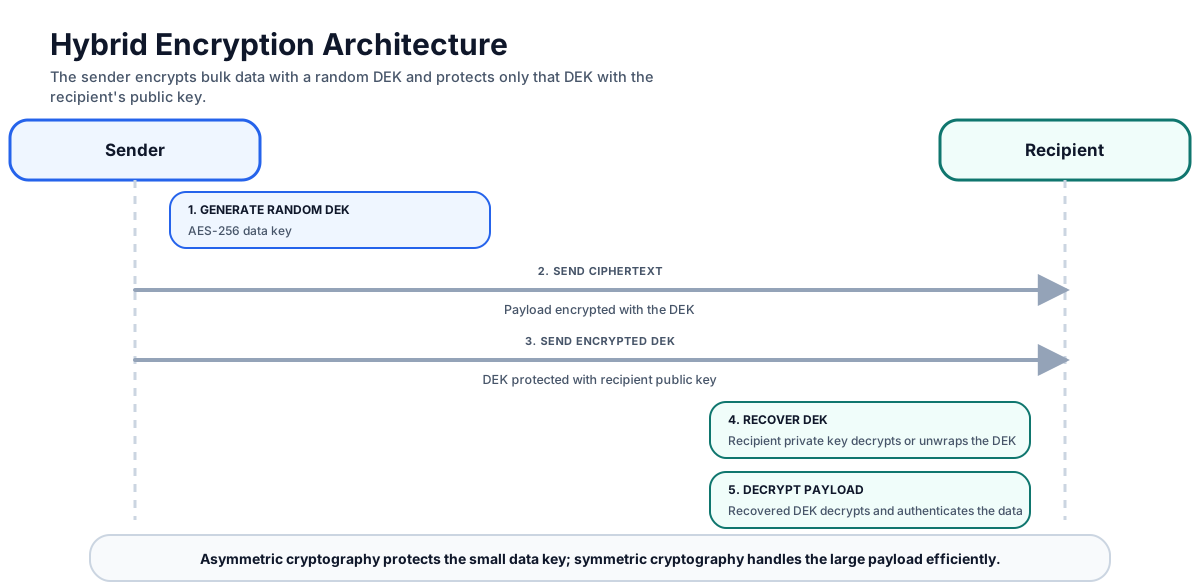
Asymmetric cryptography protects the DEK; symmetric cryptography protects the bulk payload
Standardized Hybrid Protocols
- HPKE (Hybrid Public Key Encryption, RFC 9180): Modern standard combining KEM key encapsulation, KDF key derivation, and AEAD symmetric encryption.
- TLS 1.3 (RFC 9846, which obsoletes the original RFC 8446): Certificate-authenticated full handshakes use ephemeral key establishment, commonly X25519 or the hybrid X25519MLKEM768 group defined by RFC 10024, followed by HKDF and a negotiated AEAD such as AES-GCM or ChaCha20-Poly1305. TLS 1.3 also permits PSK-only operation, which does not provide forward secrecy for that connection.
- OpenPGP (RFC 9580): Encrypts files/messages using a symmetric session key wrapped under the recipient’s RSA or ECC public key.
Cryptographic Objective Selection Matrix
| System Engineering Objective | Selected Cryptographic Paradigm | Recommended Standard | Operational Mechanics |
|---|---|---|---|
| Bulk Data Confidentiality at Rest | Symmetric Encryption | AES-256-GCM for records, objects, and files; AES-XTS (not GCM) for block-device/disk-volume encryption | Encrypt database fields, files, and objects using AES-GCM within a DEK/KEK hierarchy; full-disk/block-device encryption conventionally uses AES-XTS instead (see Full-Disk & File Encryption) since fixed-size disk sectors don’t have room for an AEAD tag. |
| Key Encapsulation to Single Receiver | Asymmetric HPKE | HPKE (RFC 9180) | Sender’s KEM operation against the receiver’s public key yields a shared secret, which HKDF expands into an AEAD context (key + nonce schedule) used to encrypt the payload directly; using that context to wrap a separate DEK is one common application pattern, not HPKE’s only mode of operation (RFC 9180 also defines PSK and auth modes). |
| Network Transit Confidentiality | Hybrid Encryption | TLS 1.3 (ephemeral key establishment + HKDF + negotiated AEAD) | A certificate-authenticated full handshake uses an ephemeral group such as X25519 or X25519MLKEM768 to establish shared keying material; HKDF derives the traffic secrets and keys used by the negotiated AEAD. |
| Payload Integrity & Authentication | Symmetric MAC | HMAC-SHA256 | Both endpoints share secret key; verifier checks HMAC tag over message. |
| Unforgeable Signature Evidence | Asymmetric Digital Signature | Ed25519 (RFC 8032) / RSA-PSS | Signer uses a private key; verifier checks that the signature validates for the payload under the public key. Identity and custody remain separate checks. |
Critical Cryptographic Boundary Rules
- Do Not Encrypt Large Payloads with RSA: RSA modular exponentiation is slow and constrained by modulus size. Use HPKE or a hybrid construction.
- Symmetric MACs Do Not Provide Non-Repudiation: A shared-key HMAC tag proves the message was created by a holder of the key, which includes both sender and receiver. A private-key digital signature is necessary evidence toward non-repudiation, not a guarantee by itself — the complete outcome also depends on the key-to-identity binding, key custody, and evidence handling (see the attribution row above and the signature-verification checklist on the Digital Signatures page).
- Validate Public Key Identity Bindings: Exchanging public keys over an unauthenticated channel leaves endpoints vulnerable to Man-in-the-Middle (MitM) key substitution. Bind public keys using PKI X.509 certificates or out-of-band fingerprint verification.
Symmetric encryption is far faster per byte but requires shared keying material; asymmetric cryptography can establish or protect that material, but only once the public key itself is authenticated. Production systems combine them: authenticated key agreement or a KEM establishes session keying material, while public-key encryption can wrap a per-object DEK; the resulting symmetric keys protect bulk data within protocol-defined usage and lifetime limits.
Primary references
- NIST SP 800-57 Part 1 Rev. 5: Recommendation for Key Management: General — NIST CSRC SP 800-57
- RFC 9846: The Transport Layer Security (TLS) Protocol Version 1.3 — IETF RFC 9846