Security Foundations / Concepts
Monitoring, Incident Response & Operational Learning
Detective controls generate telemetry; incident response is the process that turns an actual detection into contained, recovered, and understood harm; and operational learning is what feeds the outcome back into risk and control decisions instead of letting the same failure recur silently. This closes the loop this journal has followed from objective → requirement → control → verification → residual risk, returning the outcome to where that chain started.
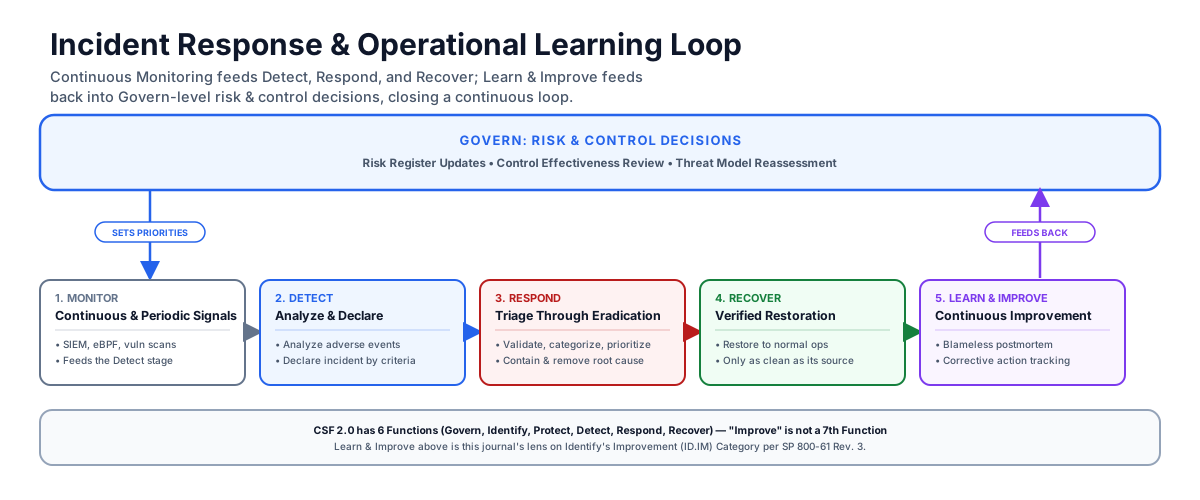
Incident Response & Operational Learning Loop (journal working model informed by NIST SP 800-61 Rev. 3): Continuous Monitoring → Detect (analyze adverse events; declare incidents against defined criteria) → Respond (triage, validate, categorize, prioritize, contain, eradicate) → Recover → Learn & Improve → Govern-level risk and control decisions.
Continuous Monitoring: Feeding the Response Pipeline
The response pipeline is fed by candidate signals surfaced through automated security telemetry, or via reports from users, cloud service providers, external security researchers, business partners, or law enforcement authorities. Under the CSF 2.0 mapping used by NIST SP 800-61 Rev. 3, Detect analyzes adverse events and declares an incident when defined criteria are met; after declaration, Respond triages and validates incident reports, then categorizes and prioritizes the incident before containment and eradication. This draws on the same Detective Control category introduced in Security Controls & Defense in Depth; the inputs below are commonly run continuously (SIEM correlation, eBPF tracing), but not all detective controls are—periodic or on-demand checks (a weekly vulnerability scan, an ad hoc log review) still feed the same pipeline:
| Monitoring Input | What It Surfaces | Where the Evidence Goes |
|---|---|---|
| SIEM log aggregation & correlation | Cross-system patterns a single log source would miss (e.g., one identity failing auth across several services in sequence). | Alert queue; ordinary SIEM logs are not automatically tamper-evident—see the same caveat in Identity & Access Fundamentals. |
| eBPF / runtime tracing | Anomalous process, network, or syscall behavior inside a running workload. | Detection engineering rules; feeds the Detect stage below. |
| Automated vulnerability & exposure scanning | New CVEs or misconfigurations in already-deployed assets. | Vulnerability management pipeline—see Threats, Vulnerabilities & Risk for prioritization signals. |
| User & entity behavior signals | Deviations from a subject’s established access pattern (geo-velocity, unusual data volume). | Risk-based authentication triggers and SOC alert triage. |
A high volume of monitoring signal is not the same as effective detection—alert fatigue and unparsed log formats are real failure modes for this stage, as already noted for Detective Controls generally.
From Event to Incident: Decision Boundaries
Not every monitoring signal enters the incident response process. Three terms define the decision boundary between normal operations and an active incident:
- Event: An observable occurrence in a system or network—a login, a configuration change, a DNS query. Most events are routine.
- Alert: A tool or analyst indication that an event may require investigation. An alert can be a true positive (an actual security concern) or a false positive (benign activity that matched a detection rule). Alert volume without triage quality produces alert fatigue, not security.
- Cybersecurity incident: An occurrence that actually or imminently jeopardizes, without lawful authority, the confidentiality, integrity, or availability of information or an information system; or constitutes a violation or imminent threat of violation of law, security policies, or acceptable use policies (NIST definition).
Detect-stage adverse-event analysis is where an alert crosses—or does not cross—the organization’s defined threshold for declaring an incident. Respond-stage triage then validates the incident report, assesses scope, categorizes and prioritizes the incident, and assigns the response posture. Legal and regulatory notification obligations run on their own triggers, not on the organization’s internal declaration: the SEC’s disclosure-timing trigger is the registrant’s own materiality determination, and GDPR’s 72-hour clock starts from the controller’s awareness of a qualifying personal-data breach (see the notification criteria below). This is why defining both the organization’s internal incident criteria and its distinct, regulator-defined notification triggers explicitly, before an event occurs, is part of preparation.
The Incident Response Lifecycle: Rev. 2’s Phases vs. Rev. 3’s Current Structure
NIST SP 800-61 Rev. 2 (2012) described a four-phase model: Preparation → Detection & Analysis → Containment, Eradication & Recovery → Post-Incident Activity. NIST withdrew Rev. 2 and published NIST SP 800-61 Rev. 3 in April 2025—Incident Response Recommendations and Considerations for Cybersecurity Risk Management: A CSF 2.0 Community Profile—which replaces those phases with incident response activities mapped onto all six of NIST CSF 2.0’s Functions: Govern, Identify, Protect, Detect, Respond, and Recover. In-incident activity concentrates in Detect, Respond, and Recover; continuous-improvement outcomes are captured specifically under Identify’s Improvement (ID.IM) Category—CSF 2.0 has exactly six Functions, and “Improve” is not a seventh one. ID.IM is new in CSF 2.0 and explicitly consolidates the prior version’s scattered improvement subcategories (PR.IP-7, DE.DP-5, RS.IM, RC.IM) into one place. The table below maps the historical phase names to the current structure—use the right-hand column as the current reference; the left-hand column is retained here because the phase vocabulary is still widely used in practice:
| Historical Rev. 2 Phase (2012, withdrawn) | Current Rev. 3 / CSF 2.0 Mapping | What Happens |
|---|---|---|
| Preparation | Govern / Identify / Protect | Incident response plans, playbooks, roles, and tooling are established as part of ongoing risk management—not a one-time setup before the “real” lifecycle starts. |
| Detection & Analysis | Detect | Monitoring surfaces candidate adverse events; analysis determines whether defined incident criteria are met and declares an incident when they are. |
| Containment, Eradication & Recovery | Respond and Recover | Respond triages and validates incident reports, categorizes and prioritizes confirmed incidents, contains the spread, and eradicates the cause; Recover restores affected systems to normal operation. |
| Post-Incident Activity | Identify — Improvement (ID.IM) Category | Rev. 3 frames this as continuous improvement woven through the incident lifecycle and across all Functions, rather than a single retrospective meeting held only after closure—but it is organized as a Category under Identify, not a separate Function. |
This journal uses the practical operational sequence detect and declare → triage → contain → eradicate → recover → learn below as a working narrative, because it remains widely used in practice—but treat it as this journal’s operational lens on top of Rev. 3’s structure, not a restatement of Rev. 3 itself:
- Detect & Declare: Monitoring or an external report surfaces a candidate adverse event; Detect-stage analysis compares it with defined criteria and declares an incident when those criteria are met.
- Respond — Triage: Validate the incident report, assess scope, categorize and prioritize the incident, and assign severity (see below).
- Respond — Contain: Limit the incident’s ability to spread further (isolate a workload, revoke a credential, block an IP) without necessarily removing the root cause yet.
- Respond — Eradicate: Remove the root cause—patch the vulnerability, delete the malicious artifact, close the misconfiguration.
- Recover: Restore affected systems to normal operation, validated against defined recovery criteria with residual uncertainty documented rather than declared “clean” outright—see the caveat on automated recovery controls in Security Controls & Defense in Depth: recovery is only as clean as what it restores from.
- Learn: Conduct a blameless postmortem and track corrective actions (below)—this journal stage maps to CSF 2.0’s Identify/Improvement (ID.IM) Category, not a distinct CSF Function, and its outcomes feed back across all six Functions.
Operational Incident Readiness & Evidence Integrity
Having an incident response plan on paper is distinct from being operationally prepared to execute it during an active crisis. High-assurance security programs validate four foundational readiness requirements prior to an incident:
- Tabletop Exercises & Playbook Validation: Regularly execute simulated threat scenarios (tabletop exercises and red/blue-team drills) to stress-test escalation paths, validate playbook accuracy, and identify operational friction under realistic time constraints.
- Forensic Evidence Preservation & Chain of Custody: Write-once-read-many (WORM) evidence vaults for raw disk images, memory dumps, and network PCAPs are a common, recommended practice for making tampering evident—not a universal legal requirement; other tamper-evident mechanisms (e.g., cryptographic hashing plus append-only, access-controlled logging) can substitute depending on jurisdiction and the proceeding involved. Document a verifiable chain of custody (timestamp, hash, collector identity) to support evidence admissibility for legal or regulatory proceedings—chain of custody is evidence that supports admissibility, not a guarantee of it; whether evidence is actually admitted depends on the jurisdiction, the applicable rules of evidence, and how the evidence is presented.
- Notification & Escalation Decision Records: Pre-define legal, regulatory, and customer notification criteria. Key examples: the SEC cybersecurity disclosure rule generally requires covered public-company registrants to disclose a material cybersecurity incident within four business days after determining the incident is material (not four days after discovery); GDPR Article 33 generally requires a controller to notify the supervisory authority within 72 hours after becoming aware of a personal-data breach, unless the breach is unlikely to result in a risk to individuals’ rights and freedoms. Maintain documented decision logs whenever notification thresholds are evaluated during an incident—whether the decision is to notify or not.
- Time Synchronization & Telemetry Integrity: Enforce Network Time Protocol (NTP / IEEE 1588 PTP) synchronization across all servers, microservices, and network devices. Consistent, synchronized timestamps are essential for accurate cross-system log correlation and timeline reconstruction during forensic investigation.
Containment, Evidence & Service-Continuity Trade-offs
Containment normally prioritizes stopping ongoing harm, but the fastest isolation action can also destroy volatile evidence, interrupt a safety- or mission-critical service, or remove the only management path available to responders. Evidence preservation is not a reason to let an attack continue unchecked, and service availability is not a reason to leave an adversary unconstrained. The incident plan should establish who can decide among those competing consequences before responders face them under pressure.
The decision should consider:
- Ongoing harm and attacker freedom: whether delay permits continued exfiltration, destructive action, lateral movement, or safety impact.
- Evidence uniqueness and volatility: whether memory, process, network-connection, or cloud-control-plane evidence will disappear when a host is powered off or a workload is rebuilt, and whether equivalent evidence already exists elsewhere.
- Service criticality and viable alternatives: whether immediate shutdown creates greater human, mission, legal, or systemic harm, and whether segmented isolation, credential revocation, traffic redirection, read-only operation, or a continuity workaround can constrain the threat without a complete stop.
- Authority and recordkeeping: who authorized the decision, what facts and uncertainty were known, which alternatives were considered, what interim monitoring or containment was added, and when the decision must be revisited.
For example, isolating a compromised workload at the network boundary while retaining power for a time-bounded memory capture can preserve evidence without allowing normal egress—but only if the isolation path is independently verified and the extra collection time does not permit continued harm. The response record should state the threat state and trade-off explicitly rather than presenting the selected action as universally correct.
Incident Severity Classification (Journal Working Example)
Severity classification determines escalation speed, staffing, and communication obligations. The scale below is an illustrative, locally defined example—not a scale NIST SP 800-61 or CSF 2.0 mandates—organizations commonly define their own tiers scoped to their own systems and obligations:
| Severity | Illustrative Criteria | Typical Response Posture |
|---|---|---|
| SEV-1 (Critical) | Active, confirmed compromise of production data or systems; safety, legal, or large-scale customer impact. | Full incident command activated immediately; executive and, where applicable, regulatory notification triggers evaluated. |
| SEV-2 (High) | Confirmed security failure with contained but significant impact (e.g., one tenant’s data exposed, not the full customer base). | Dedicated response team engaged; executive awareness, not necessarily activation. |
| SEV-3 (Moderate) | Confirmed incident or security-control failure with limited impact and no evidence yet of significant spread. | Standard incident workflow and on-call investigation; escalates to SEV-2 if scope or impact increases. |
| SEV-4 (Low) | Confirmed low-impact policy or acceptable-use violation that meets the organization’s incident criteria but presents negligible immediate harm. Benign anomalies that do not meet incident criteria remain alerts and do not enter this table. | Lightweight incident workflow with documented triage, ownership, remediation, and closure. |
Roles During an Incident (Common Practice, Not a NIST-Defined Structure)
Many organizations running structured incident response adapt role concepts from the Incident Command System (ICS)—a command structure originally developed for emergency services and formalized in the US under FEMA’s National Incident Management System—rather than a security-specific standard; this pattern is visible in widely cited incident-command write-ups from practitioners such as Google’s SRE book’s chapter on managing incidents and PagerDuty’s incident response documentation. The roles below are common industry practice, not a scheme NIST SP 800-61 itself defines:
| Role | Responsibility | Explicitly Not Responsible For |
|---|---|---|
| Incident Commander | Owns the overall response, makes final calls under uncertainty, and declares when the incident is contained/resolved. | Performing the hands-on technical remediation directly. |
| Technical Lead | Directs the hands-on investigation, containment, and eradication work. | External communications or business-impact decisions. |
| Communications Lead | Manages internal updates, customer/regulator notifications, and coordinates with legal on disclosure obligations. | Technical remediation decisions. |
| Scribe | Maintains a timestamped record of actions, decisions, and evidence for the postmortem and any legal/regulatory follow-up. | Making response decisions themselves. |
Small teams routinely collapse several of these roles into one person; the value of naming them separately is that the responsibilities stay in the plan even when there’s no headcount to give each one a dedicated owner.
Post-Incident: Closing the Loop Back to Risk and Control Decisions
An incident that ends at “resolved” without feeding its findings back into risk and control decisions increases the likelihood that the same failure recurs. The blameless postmortem’s output should route to the same mechanisms this journal already covers elsewhere, not exist as a standalone document:
- Risk register update: A materialized incident is direct evidence for updating likelihood and impact estimates—see Inherent, Current, Target & Residual Risk in Threats, Vulnerabilities & Risk.
- Control effectiveness reassessment: An incident that occurred despite a control being “in place” is a signal about that control’s operating effectiveness specifically—see Control Effectiveness Types & Lifecycle Governance in Security Controls & Defense in Depth.
- Threat model reassessment trigger: An incident is one of the explicit reassessment triggers named in Trust Boundaries & Threat Modeling—the scenario that occurred should be checked against whether it was modeled, and if not, why not.
- Corrective action tracking: Each postmortem action item needs an owner and a due date tracked to closure, not left as an aspirational list—an untracked corrective action is functionally the same as an unaddressed control exception (see Control Exceptions, Expiry & Reassessment in the same page above).
“Blameless” means the postmortem investigates the systemic and process conditions that allowed an error to cause harm, rather than singling out the individual who made it—the goal is a system that tolerates the mistake next time, not a search for who to hold responsible.
Essential Incident Response Diagnostic Checklist
When auditing an incident response program or reviewing a specific incident’s handling, evaluate these 7 diagnostic questions:
| Diagnostic Focus Area | Key Evaluation Question | Target Verification & Audit Evidence |
|---|---|---|
| Detection Coverage | Would this incident’s initial access vector have generated a monitored signal at all, or was detection incidental (e.g., a customer report)? | Detection engineering coverage maps against the incident’s actual event sequence. |
| Severity Accuracy | Was the incident’s severity assessed and escalated correctly given what was actually known at each point in time? | Timeline reconstruction comparing severity assigned vs. information available at that timestamp. |
| Containment Speed | How much time elapsed between confirmed detection and effective containment? | Incident timeline with timestamped containment actions. |
| Containment Trade-off | When containment could destroy volatile evidence or interrupt a critical service, did the designated authority document the known threat state, viable alternatives, time bound, and reason for the selected action without allowing evidence collection or availability concerns to prolong uncontrolled harm? | Timestamped decision record, isolation validation, evidence-acquisition log, continuity action record & scheduled reassessment. |
| Recovery Verification | Was the recovered state validated against defined recovery criteria (image/config/credential provenance checks), not just restored to “working,” with any residual uncertainty documented rather than assumed away? | Recovery validation records—see the recovery-control caveat in Security Controls & Defense in Depth. |
| Corrective Action Closure | Are postmortem action items tracked to a named owner and closed, not left open indefinitely? | Corrective action tracker with owner, due date, and closure status. |
| Feedback Loop Completion | Did this incident’s findings actually reach the risk register, control effectiveness review, and threat model—not just the postmortem document? | Cross-references from the postmortem to updated risk register entries, control reviews, and threat model revisions. |
Monitoring produces candidate signals; Detect declares incidents against defined criteria; Respond contains and eradicates them; and Recover restores verified service. When containment conflicts with evidence or continuity, record the threat state, authority, alternatives, and time bound, then feed the outcome back into risk, controls, and threat models.
Primary references
- NIST SP 800-61 Rev. 3: Incident Response Recommendations and Considerations for Cybersecurity Risk Management: A CSF 2.0 Community Profile — NIST CSRC SP 800-61 Rev. 3
- NIST Cybersecurity Framework 2.0 — NIST CSF 2.0
- SEC Cybersecurity Disclosure Rule (Form 8-K Item 1.05) — SEC Press Release 2023-139
- GDPR Article 33 — Notification of a personal data breach to the supervisory authority — EUR-Lex