Security Architecture & Design Principles / Distributed Systems
Cloud & Distributed Secure Architecture Patterns
Public cloud replaces a static network boundary with shared infrastructure and workloads whose addresses change every deploy. Three patterns carry most of the security weight: isolating tenants at compute, storage, cryptographic, and identity layers; constraining where traffic may originate and where it may go; and treating a running node as a disposable instance of a versioned artifact. Each pattern rests on an assumption that is easy to leave unstated, which is where the failures happen.
Everything below assumes the shared responsibility model: the provider secures the infrastructure, and the customer secures configuration, identity, and data on top of it. A control the provider makes available but does not enforce — an unencrypted bucket, a wildcard IAM policy — is the customer’s. Cloud Security Architecture & IAM Perimeters covers that split and the organizational guardrails referenced here.
Multi-tenant isolation, layer by layer
Preventing tenant A from reaching tenant B’s data is the defining requirement of multi-tenant SaaS. Four layers each bound a different failure, and each holds only while a specific condition holds.
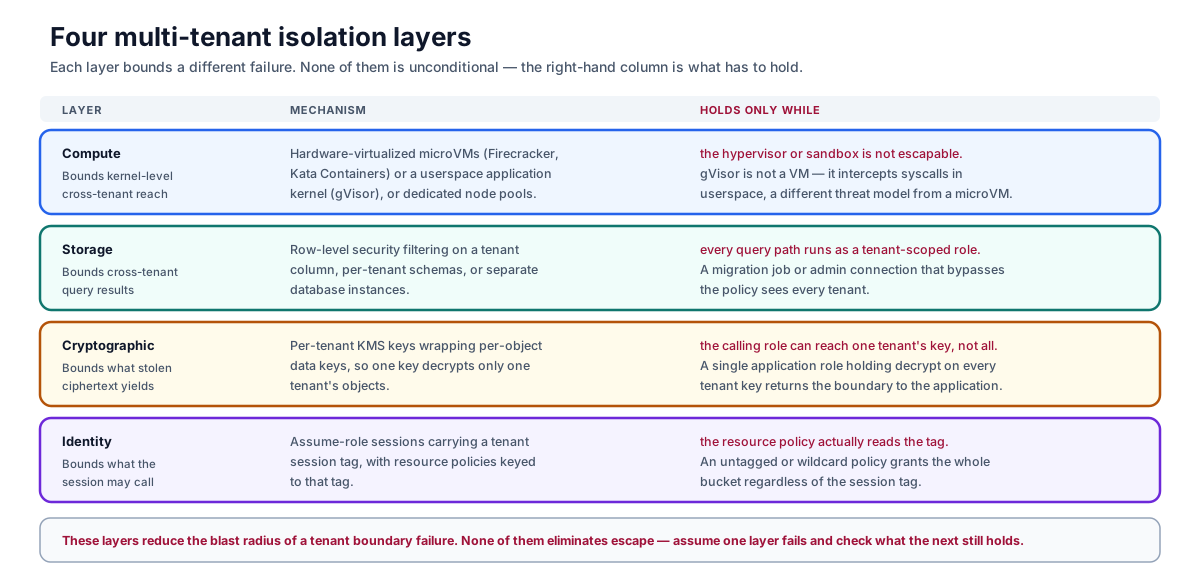
Four isolation layers, each paired with the assumption it silently depends on
| Isolation layer | Mechanism | What it bounds — and what has to hold |
|---|---|---|
| Compute | Hardware-virtualized microVMs (AWS Firecracker, Kata Containers) or a userspace application kernel (gVisor), or dedicated node pools per tenant. | Bounds how far a container escape reaches. It holds only while the hypervisor or sandbox itself is not escapable — these reduce the blast radius of a kernel bug, they do not eliminate escape. gVisor is not a microVM: it intercepts syscalls in userspace and acts as the guest kernel without hardware virtualization, which is a materially different threat model from Firecracker’s. |
| Storage & database | Row-level security keyed on a tenant column, per-tenant schemas, or separate database instances. | Bounds what a query returns. Row-level security holds only while every query path runs as a tenant-scoped role — a migration job, analytics connection, or admin session that bypasses the policy sees every tenant. Separate instances remove that risk and add operational cost. |
| Cryptographic | Per-tenant KMS keys wrapping per-object data keys. | Bounds what stolen ciphertext yields: tenant A’s objects cannot be decrypted with tenant B’s key. It holds only while the calling role can reach one tenant’s key rather than all of them — a single application role with decrypt on every tenant key moves the boundary back into the application. |
| Identity | Assume-role sessions carrying a tenant session tag, with resource policies keyed to that tag. | Bounds what the session may call. It holds only while the resource policy actually reads the tag; an untagged or wildcard policy grants the whole bucket regardless. |
The pattern across all four: state the condition, then verify it separately from the mechanism. Kernel-level isolation primitives — namespaces, cgroups, seccomp, and mandatory access control — are covered in Container & Kubernetes Security.
Network and service perimeters
Reaching a managed service over its public endpoint is the default and is rarely what you want. Three controls narrow it, and each has a documented limit.
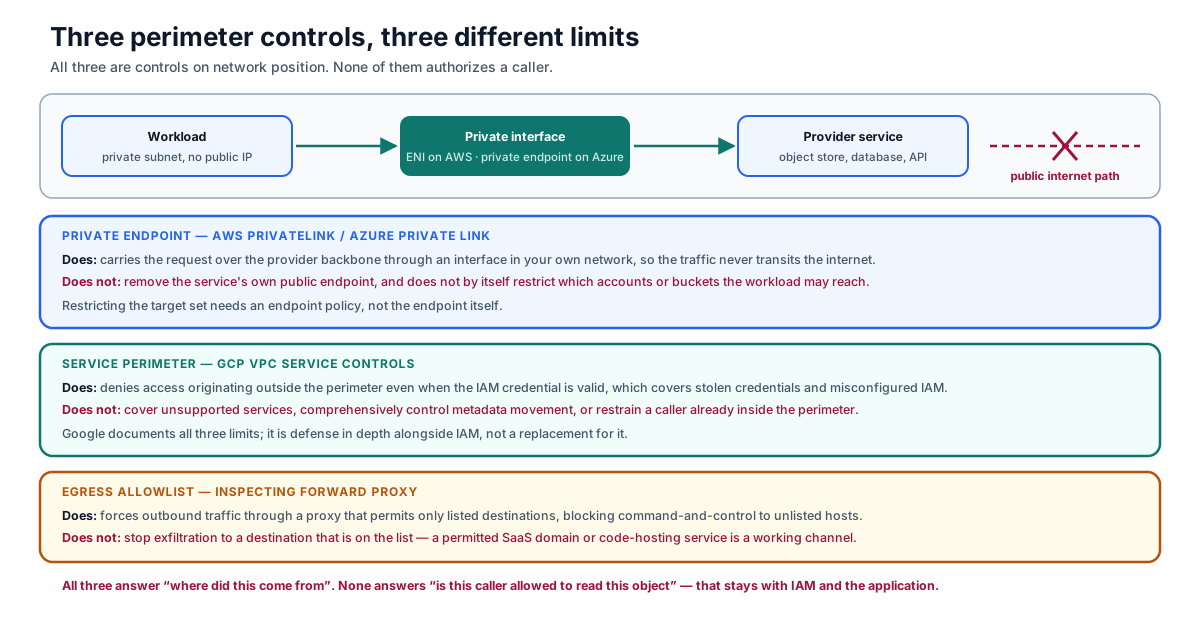
Private endpoints, service perimeters, and egress allowlists: what each stops, and what each does not
- AWS PrivateLink / Azure Private Link reach a service over the provider backbone through an interface in your own network — an elastic network interface (ENI) on AWS, a private endpoint on Azure — so the request never transits the internet. It does not remove the service’s own public endpoint, and it does not by itself restrict which accounts or buckets the workload may reach; that needs an endpoint policy.
- GCP VPC Service Controls define a perimeter around Google-managed API services and deny access originating outside it even when the IAM credential is valid, which mitigates stolen-credential and misconfigured-IAM exfiltration from outside. Google documents the limits: it covers supported services only, it “is not designed to enforce comprehensive controls on metadata movement,” and it does not restrain a caller already inside the perimeter. The AWS analogue is not a single feature but a combination — service control policies and resource control policies in AWS Organizations, plus VPC endpoint policies and organization-ID condition keys.
- Egress proxy allowlisting routes outbound traffic through an inspecting proxy (e.g. Envoy, Squid) permitting only listed destinations, blocking command-and-control to unlisted hosts. It does not stop exfiltration to a destination that is on the list — a permitted SaaS domain or code-hosting service is a working channel.
All three answer where did this request come from. None answers is this caller allowed to read this object, which stays with IAM and the application.
Immutable infrastructure and ephemeral workloads
Patching a running server over SSH produces configuration drift, un-audited change, and hosts whose software set matches no reviewed definition. Immutable infrastructure replaces live patching with atomic replacement.
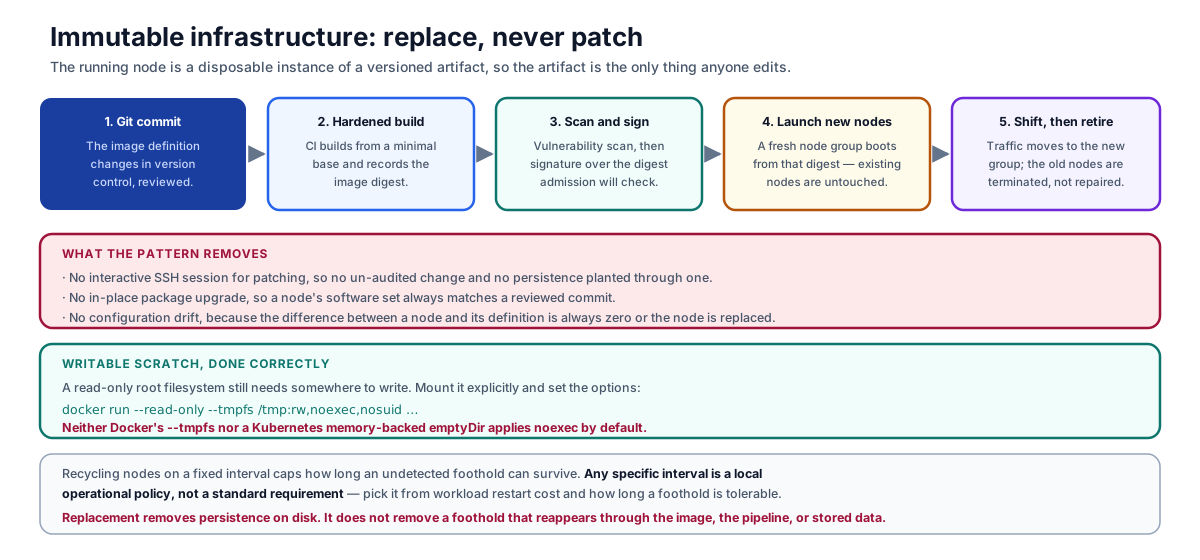
Git commit to node retirement: the artifact is the only thing anyone edits
- No live patching. Instances and container nodes are never modified in place; a change is a new commit, a new image digest, and a new node group.
- Bounded workload lifespan. Recycling nodes on a schedule caps how long an undetected foothold survives on disk. Any specific interval is a local operational policy, not a standard requirement — pick it from restart cost and how long a foothold is tolerable, not from a number copied out of a blog post.
- Read-only root filesystems. Mount the root read-only (
--read-only, orreadOnlyRootFilesystem: true) and grant scratch space explicitly with its options set —--tmpfs /tmp:rw,noexec,nosuid. Neither Docker’s--tmpfsnor a Kubernetes memory-backedemptyDirappliesnoexecby default, so a read-only root alone still leaves an executable writable path.
What replacement does not fix: a foothold that reappears through the image, the build pipeline, or stored data comes back with every new node. Pipeline integrity is a separate control — see CI/CD Pipeline Security & Workload Identity and Infrastructure as Code (IaC) & Immutable Security, which covers drift detection and policy-as-code enforcement on the definitions themselves.
Cloud architecture review checklist
The checklist below is a journal working model, not a published audit standard. When auditing a cloud application architecture, evaluate these six criteria:
| Diagnostic area | Evaluation question | Verification & audit evidence |
|---|---|---|
| Tenant key scoping | Are tenant objects encrypted under per-tenant keys, and is the application role scoped to one tenant’s key per request rather than to all of them? | KMS key policies, role session tagging, envelope encryption code path. |
| Query path coverage | Does every database connection — including migrations, analytics, and admin — run as a tenant-scoped role, or can one bypass row-level security? | Database role inventory, row-level security policy definitions, connection audit. |
| Private access plus endpoint policy | Are managed-service APIs reached through private endpoints, and is an endpoint policy restricting which accounts and resources are reachable? | VPC endpoint configuration and attached policies, route tables. |
| Perimeter coverage gaps | Which services in the protected projects are unsupported by the service perimeter, and what covers them instead? | Perimeter configuration, supported-service list, compensating IAM policy. |
| Writable scratch options | Are containers deployed read-only with tmpfs mounts that explicitly set noexec, rather than relying on defaults? |
Pod security admission policy, container run arguments, mount options. |
| No interactive production access | Is SSH to production instances closed in favor of session-manager style brokered access, with the session recorded? | Security group ingress rules, session manager logs, break-glass procedure. |
Each isolation layer bounds a different failure and holds only while a specific condition does — a single application role with decrypt on every tenant key removes cryptographic isolation entirely. Private endpoints, service perimeters, and egress allowlists all answer where a request came from, never whether the caller is authorized. Immutable replacement removes on-disk persistence, not a foothold that returns through the image or pipeline; and a read-only root still needs tmpfs mounted with noexec set explicitly.
Primary references
- AWS Well-Architected Framework: Security Pillar — verified the shared responsibility split, identity perimeter guidance, and private connectivity patterns used here.
- Google Cloud VPC Service Controls overview — verified what Google claims the perimeter mitigates, and its stated limits on supported services, metadata movement, and callers inside the perimeter.
- Azure Private Link overview — verified that Azure’s construct is a private endpoint in a virtual network and that instance-level mapping is what provides the leakage protection.
- gVisor: What is gVisor? — verified that gVisor is an application kernel intercepting syscalls in userspace and is explicitly not a virtual machine.
- Docker: tmpfs mounts — verified that
noexecis not a default tmpfs mount option and must be set explicitly.