Cryptography / Standards
Recommended Cryptographic Algorithms & Standards
Selecting cryptographic algorithms requires balancing mathematical security strength, computational overhead, and international regulatory compliance. Security architects must enforce standardized, peer-reviewed primitives that satisfy the applicable governing body's own criteria — NIST FIPS/SP validation, Germany's BSI TR-02102 recommendations, or NSA CNSA 2.0 requirements — since these bodies do not always converge on the same algorithm, key size, or curve choice, while deprecating legacy ciphers vulnerable to cryptanalytic or quantum attacks.
Quantum Impact on Cryptographic Strength
Quantum computing impacts symmetric and asymmetric primitives in fundamentally different ways:
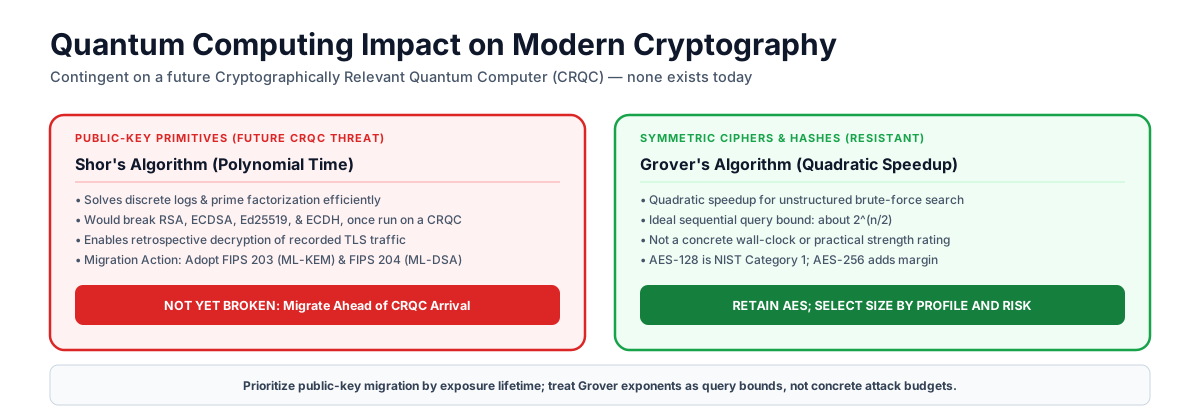
Shor's algorithm changes the asymptotic security of RSA and ECC; Grover's algorithm changes ideal query exponents, while concrete symmetric-attack cost still depends on the quantum implementation and resources
- Grover’s Algorithm & Quantum Collision Bounds: Grover provides an ideal sequential query bound of
O(2^(n/2))for unstructured key or preimage search, while generic quantum collision algorithms such as BHT (Brassard et al., 1997) have an idealO(2^(n/3))query bound under strong quantum-memory assumptions. These exponents are not concrete practical security-strength ratings: reversible-oracle cost, circuit depth, error correction, parallelization, and physical resources also matter. NIST therefore uses the work needed to attack AES-128 as its Category 1 PQC comparison baseline rather than classifying AES-128 as a practical 64-bit primitive. Larger keys and digests provide additional margin where the governing profile or protection lifetime calls for it. - Shor’s Algorithm (Asymmetric Public Key Cryptography): Solves prime factorization and discrete logarithms in polynomial time — a superpolynomial asymptotic improvement over the best-known classical attacks. Concrete resource costs depend on the quantum circuit and arithmetic model, so one fixed exponent would give false precision. A sufficiently capable, fault-tolerant quantum computer running it would render RSA, ECC, ECDSA, and Diffie-Hellman tractable to break, but no such computer exists today; NIST’s PQC evaluation criteria likewise caution that concrete quantum security estimates are more nuanced than headline asymptotic figures. Mitigate the future risk by transitioning to NIST Post-Quantum Cryptography (PQC) standards ahead of that threshold.
Cryptographic Standards Matrix: RFC / Industry Specifications vs. NIST/FIPS Compliance
A critical discipline in security architecture is distinguishing between RFC-Defined, Widely-Deployed Specifications (industry-wide web encryption — not all of which are IETF Standards Track; some, like X25519 and AES-GCM-SIV, are IRTF/CFRG Informational RFCs), FIPS/NIST Approved Primitives (U.S. Federal & FedRAMP compliance), and Post-Quantum Standards:
| Primitive / Algorithm | IETF / Industry Specification | NIST / FIPS Compliance Status | Target Engineering Guidance & Use Case |
|---|---|---|---|
| AES-GCM (128- or 256-bit key) | RFC 5288 (TLS 1.2 GCM cipher suites) / RFC 9846 (TLS 1.3 AEAD negotiation) | NIST APPROVED (NIST SP 800-38D defines the underlying GCM construction) | Widely deployed AEAD, but not a universal default across protocols or storage systems. TLS 1.3 requires implementations to support AES-128-GCM and also defines AES-256-GCM, ChaCha20-Poly1305, and AES-CCM suites; IPsec and data-at-rest choices must follow their own protocol, platform, and compliance profiles. |
| AES-GCM-SIV | RFC 8452 | NOT FIPS/NIST APPROVED (IRTF/CFRG Informational RFC, not IETF Standards Track) | Nonce-misuse-resistant AEAD mode: reusing a GCM nonce exposes the XOR of the two plaintexts and breaks GCM’s forgery/authentication guarantee outright, and can additionally yield full plaintext recovery when the attacker knows, guesses, or can exploit structure in one of the reused-nonce plaintexts — GCM-SIV is designed to avoid all of that under nonce reuse. Repeated encryption of the identical (key, plaintext, AAD) tuple under GCM-SIV still reveals ciphertext equality to an observer. |
| ECDHE-X25519 | RFC 7748 / RFC 9846 | NOT SP 800-56A APPROVED (RFC 7748 is IRTF/CFRG Informational; incorporated into IETF Standards-Track RFC 9846, which obsoletes the original RFC 8446) | Modern, high-speed Ephemeral ECDH key agreement used across TLS 1.3 and SSHv2. |
| ECDHE (NIST P-384 / P-256) | RFC 9846 | NIST APPROVED (NIST SP 800-56A R3) | NIST-approved options for FIPS 140-3 and FedRAMP boundaries, subject to the applicable profile. SP 800-52 Rev. 2 accepts either P-256 or P-384. P-384 is the classical CNSA 1.0 transition choice for NSS, not a CNSA 2.0 end-state algorithm. |
| Ed25519 / Ed448 | RFC 8032 | NIST APPROVED (FIPS 186-5) | Modern fast digital signature scheme for SSH, WebAuthn, and software signing. |
| RSA-PSS (3072-bit+) | RFC 8017 | NIST APPROVED (FIPS 186-5) | Preferred RSA signature padding for new designs; continued PKCS#1 v1.5 use is protocol- and profile-dependent rather than universally prohibited. |
| SHA-256 / SHA-512 / SHA3-256 | RFC 6234 (SHA-256/SHA-512 only — RFC 6234 predates SHA-3) / FIPS 202 (SHA3-256) | NIST APPROVED (FIPS 180-4 / FIPS 202) | Standard cryptographic hash digest algorithms for digital signatures and TLS. |
| HKDF-SHA256 | RFC 5869 | NIST APPROVED (NIST SP 800-56C R2) | Standard Extract-and-Expand key derivation function for key extraction and expansion. |
| KMAC256 / KMAC128 | SP 800-185 | NIST APPROVED (SP 800-185) | KMAC itself is a keyed hash function / MAC-and-PRF built on cSHAKE — use it directly for message authentication. SP 800-108 Rev. 1 separately defines KDF-in-Counter-Mode and similar constructions that can use KMAC as their underlying PRF; that KDF role is a distinct, composed use, not what KMAC does on its own. |
Disallowed & Legacy Cryptographic Algorithms
| Algorithm | Legacy Specification | Status & Vulnerability | Migration Action |
|---|---|---|---|
| 3DES / TDEA | 64-bit Block Cipher | DISALLOWED: Disallowed by NIST SP 800-131A Rev. 2 for encryption after Dec 31, 2023; vulnerable to Sweet32 birthday collisions after 2^32 blocks. | Migrate to an approved AEAD supported by the target protocol or storage profile, commonly AES-GCM. |
| MD5 | 128-bit Hash Function | DISALLOWED: Disallowed by NIST SP 800-131A Rev. 2 for digital signatures & certificates; practical chosen-prefix collisions have been demonstrated. | Replace with SHA-256 or SHA3-256. |
| RC4 | Stream Cipher | DISALLOWED: Prohibited by IETF RFC 7465 and NIST SP 800-52 Rev. 2 for TLS; biased keystream bytes allow plaintext recovery. | For TLS, use a TLS 1.3 AEAD suite supported by both peers, such as AES-GCM or ChaCha20-Poly1305. |
| RSA-1024 | Public Key Cipher | DISALLOWED FOR GENERATION: Disallowed by NIST SP 800-131A Rev. 2 for key transport and generating new digital signatures after Dec 31, 2013 (< 112 bits security strength). 1024–2047-bit RSA remains permitted for legacy signature verification — this is not a blanket ban on accepting existing RSA-1024 signatures. | Replace with Ed25519 or 3072-bit RSA-PSS for anything generating new keys or signatures. |
| SHA-1 | 160-bit Hash Function | DISALLOWED FOR NEW SIGNATURE GENERATION: Disallowed by NIST SP 800-131A Rev. 2 for generating new digital signatures & certificates after Dec 31, 2013, and for other collision-dependent uses; practical collision demonstrated (SHAttered, 2017). Limited legacy signature verification and non-collision-dependent uses (e.g., HMAC-SHA1) remain permitted — this is not a blanket ban on SHA-1 in every context. | Replace with SHA-256 for anything generating new signatures or requiring collision resistance. |
NIST Post-Quantum Cryptography Standards and FIPS 206 Under Development
NIST finalized three quantum-resistant FIPS standards in August 2024 — FIPS 203, FIPS 204, and FIPS 205. NIST is developing FIPS 206 for FN-DSA; it is not yet a finalized FIPS publication and should be tracked through the NIST PQC standardization page:
| Standard Number | Algorithm Name | Mathematical Paradigm | Target Cryptographic Function | NIST Status |
|---|---|---|---|---|
| FIPS 203 | ML-KEM (Kyber) | Module Lattice (ML-WE) | Key Encapsulation (KEM) | FINALIZED (Aug 2024) |
| FIPS 204 | ML-DSA (Dilithium) | Module Lattice (ML-SIS) | General Digital Signatures | FINALIZED (Aug 2024) |
| FIPS 205 | SLH-DSA (SPHINCS+) | Stateless Hash Trees | Backup Fallback Signatures | FINALIZED (Aug 2024) |
| FIPS 206 (in development) | FN-DSA (Falcon) | Fast-Fourier Lattice | Compact Digital Signatures | UNDER DEVELOPMENT; NOT FINALIZED |
NSA CNSA 2.0 Profile for National Security Systems
The NSA Commercial National Security Algorithm Suite 2.0 is transition guidance for U.S. National Security Systems (NSS). It is not a general U.S. federal, FedRAMP, or commercial-cloud algorithm mandate. Its 2022 advisory predates NIST’s final ML-KEM and ML-DSA names, so the crosswalk below distinguishes the advisory’s literal names from their standardized descendants rather than rewriting the older source as though it used the final terminology.
| Function | CNSA 2.0 Advisory Selection | Current NIST Crosswalk or Boundary |
|---|---|---|
| Symmetric encryption | AES-256 | The CNSA 2.0 end-state symmetric cipher. AES-128 remains approved in other NIST profiles; CNSA’s AES-256 rule is specific to NSS in scope. |
| Hashing | SHA-384 or SHA-512 | The CNSA 2.0 end-state hash choices. |
| Key establishment | CRYSTALS-Kyber Level V | Its standardized descendant is ML-KEM-1024 in FIPS 203. The advisory’s 2022 terminology should remain visible when attributing the original requirement. |
| General digital signatures | CRYSTALS-Dilithium Level V | Its standardized descendant is ML-DSA-87 in FIPS 204. |
| Firmware and software signing | LMS or XMSS | Stateful hash-based signatures require rigorous state management; reusing a one-time signing state can destroy security. |
| Classical transition algorithms | CNSA 1.0 includes P-384 and RSA-3072 | These support the transition but are not the CNSA 2.0 end state. Do not describe P-384 as a CNSA 2.0 curve requirement. |
The advisory targets exclusive CNSA 2.0 use by 2030 for software and firmware signing and traditional networking equipment, and by 2033 for web browsers, servers, cloud services, operating systems, niche equipment, large PKI, and custom or legacy equipment. Adoption planning must still follow the exact NSS category and implementation schedule in the current NSA guidance rather than treating 2030 as one universal deadline.
BSI TR-02102-1 Profile Snapshot (Version 2026-01)
BSI TR-02102-1 version 2026-01 is recommendatory guidance aimed primarily at new cryptographic systems planned from 2026. It is not a universal compliance approval, and its forecast horizon extends only through the end of 2032. The current edition provides these concrete selection boundaries:
| Area | Current BSI TR-02102-1 Recommendation | Scope / Transition Boundary |
|---|---|---|
| Symmetric encryption | AES-128, AES-192, and AES-256; at least a 128-bit key. AES-GCM, AES-GCM-SIV, and CCM are among the recommended authenticated modes. | For high or long-term protection requirements, BSI advises a 256-bit symmetric key. The mode and nonce rules still depend on the application. |
| Classical key establishment | At least 3,000 bits for RSA or finite-field DH and at least a 250-bit elliptic-curve subgroup order for ECDH. | Sole use of classical key-establishment mechanisms is recommended only through the end of 2031; later use should be combined with a recommended quantum-safe KEM and key derivation. |
| Digital signatures | At least 3,000-bit RSA or a 250-bit elliptic-curve subgroup order for the listed classical signature schemes. | BSI targets transition to quantum-safe signatures by 2035 and recommends an upgrade path for products expected to operate beyond 2030. |
| Hash functions | At least a 256-bit digest for general applications. | When collision resistance is required for high or long-term protection, BSI advises an output of at least 384 bits. |
Regional Standards: Chinese ShangMi (SM) Algorithm Suite
Under China’s Cryptography Law (2020) and technical standards such as GB/T 39786-2021 (Baseline for Cryptographic Application in Information Systems), commercial cryptography evaluation is overseen by the State Cryptography Administration (SCA) and sector regulators. Requirements to adopt the ShangMi algorithm suite depend on the specific system classification level, certification regime, and applicable sector rules (such as for Critical Information Infrastructure, government systems, or financial infrastructure). General commercial software operating outside designated regulatory scopes is not mandated to replace AES, RSA, or ECC.
| SM Algorithm | Cryptographic Primitive | Comparable Role (Western) | Regulatory Context & Scope |
|---|---|---|---|
| SM2 | Elliptic Curve Public Key | Fills the role ECDSA/ECDH/ECIES fill in Western stacks — an ECC-based signature and key-exchange scheme; it is a distinct algorithm design (not interchangeable at the wire-format or math level) and not simply equivalent to Ed25519. | Elliptic-curve public-key algorithm (GB/T 32918); adoption depends on system security classification, regulatory regime, and sector-specific commercial cryptography rules. |
| SM3 | Cryptographic Hash | Fills the role SHA-256 fills — comparable digest size and general-purpose use, distinct internal design. | 256-bit cryptographic hash function (GB/T 32905); used for integrity verification and digital signatures within applicable regulatory scopes. |
| SM4 | 128-bit Block Cipher | Fills the role the AES block cipher fills (128-bit block, 128-bit key) — SM4 is a block cipher, not itself an AEAD mode; it is commonly deployed with GCM (analogous to AES-128-GCM), but “SM4” and “AES-128-GCM” are not the same category of thing. | 128-bit block cipher (GB/T 32907); used for bulk payload and transmission encryption within applicable regulatory scopes. |
| SM9 | Identity-Based Encryption | IBE / Identity PKI | Identity-based public-key algorithm (GM/T 0044) using identifier strings as public keys in supported PKI architectures. |
Algorithm-Selection Workflow
The tables above are a reference, not a decision procedure — picking an algorithm for a specific system means working through several independent constraints, roughly in this order, since an earlier answer can eliminate options a later one would otherwise allow:
- Jurisdiction and regulatory regime: Which compliance framework actually governs this system? U.S. federal or FedRAMP work is bound by the applicable NIST FIPS/SP and validated-module requirements; National Security Systems additionally follow NSA CNSA 2.0’s post-quantum transition profile, with classical CNSA 1.0 algorithms such as P-384 serving only during the transition. Chinese Critical Information Infrastructure or government and financial systems may mandate the ShangMi suite depending on classification level; German or other European profiles may reference BSI TR-02102 or separate national or EU guidance. A system spanning jurisdictions may need to satisfy more than one regime simultaneously, which can rule out an otherwise-sound algorithm.
- Protocol and interoperability constraints: The algorithm has to be one the protocol actually negotiates — TLS 1.3’s cipher suite list, SSH’s
KexAlgorithms, or a target library’s supported set — not just one that’s individually secure. An excellent algorithm nobody on the other end of the connection implements is not a usable choice. - Required security strength: Match key/output size to the actual sensitivity and exposure window of what’s being protected (see NIST SP 800-57’s security-strength categories) — this is also where post-quantum posture enters: does this data need to resist harvest-now-decrypt-later, and if so, over what timeline (see the Post-Quantum Cryptography page)?
- FIPS-module (validation) requirements: A cryptographically sound, standards-track algorithm can still fail a compliance requirement if the specific software module implementing it hasn’t completed FIPS 140-3 validation — algorithm approval and module validation are tracked separately (see the FIPS 140-3 IG reference below), and a procurement or audit requirement often means the validated module, not just the algorithm choice.
- Data-protection lifetime: How long does this data need to stay confidential or tamper-evident after it’s created? A short-lived session key has different quantum-readiness and rotation requirements than an archival signature that must remain verifiable for decades — the longer the required protection window, the more conservative the margin (larger keys, PQC readiness, avoiding algorithms already showing cryptanalytic erosion) needs to be.
Treat this as a checklist to work through per system, not a one-time global choice — a payment-processing service, an internal build-signing pipeline, and a public website’s TLS termination can legitimately land on different answers even within the same organization.
Algorithm selection depends on jurisdiction and regulatory regime, not just cryptographic soundness: a widely deployed, RFC-defined algorithm (X25519, AES-GCM-SIV) can still fail a FIPS 140-3 validation requirement, and NIST approval doesn't imply BSI or other regional-body endorsement. Match key size and algorithm to the required security strength, protocol support, module validation status, and how long the data must stay protected.
Primary references
- NIST SP 800-57 Part 1 Rev. 5: Recommendation for Key Management: General — NIST CSRC SP 800-57
- NIST FIPS 140-3 IG: Implementation Guidance for FIPS 140-3 — NIST CMVP FIPS 140-3 IG Announcements
- NIST SP 800-56A Rev. 3: Recommendation for Pair-Wise Key-Establishment Schemes Using Discrete Logarithm Cryptography — NIST CSRC SP 800-56A R3
- NIST SP 800-108 Rev. 1: Recommendation for Key Derivation Using Pseudorandom Functions — NIST CSRC SP 800-108 R1
- NSA CNSA 2.0: Commercial National Security Algorithm Suite 2.0 — NSA Cybersecurity Advisory (PDF) — verified NSS scope, selected algorithms, and transition dates.
- BSI TR-02102-1 (Version 2026-01): Cryptographic Mechanisms: Recommendations and Key Lengths — BSI Technical Guideline TR-02102-1 (PDF)
- Chinese GB/T 39786-2021 Standard Record: Baseline for Cryptographic Application in Information Systems — SAMR GB/T 39786-2021 Record
- Quantum Collision Bounds (BHT Algorithm): Quantum Cryptanalysis of Hash Functions (Brassard, Høyer, Tapp) — arXiv:quant-ph/9705002
- RFC 8452: AES-GCM-SIV: Nonce-Misuse-Resistant Authenticated Encryption — RFC 8452 (IRTF/CFRG Informational)
- RFC 7748: Elliptic Curves for Security (Curve25519 / Curve448) — RFC 7748 (IRTF/CFRG Informational)