Security Foundations / Concepts
Security Objectives & Properties
A security objective defines a target property—such as confidentiality, integrity, or availability—that a system is engineered to preserve. Some objectives (confidentiality, integrity) are best understood as invariants a system tries to hold continuously; others (resilience, recovery) are explicitly about how the system behaves and recovers after that invariant is broken, whether the cause is a hostile attacker, an accident, a structural failure, or an environmental event. Technical controls and architectural safeguards are deployed specifically to enforce these objectives. Defining required security properties upfront prevents misapplying cryptographic algorithms, authentication schemes, or backups to solve the wrong failure mode.
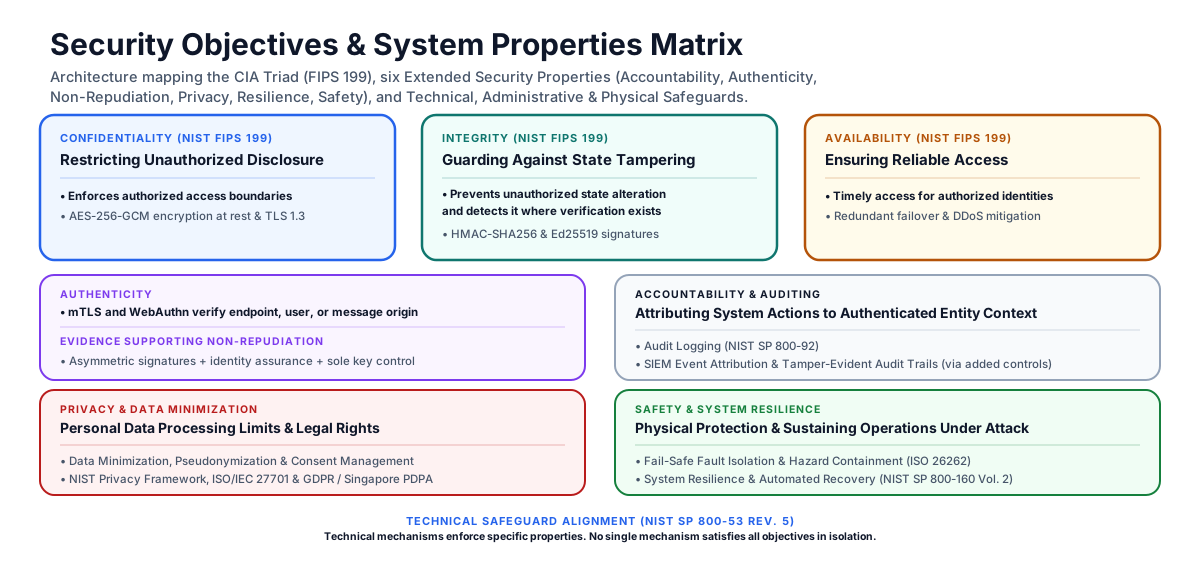
Security Objectives & System Properties Matrix: CIA Triad (FIPS 199) → six extended properties (Accountability, Authenticity, Non-Repudiation, Privacy, Resilience, Safety) → Technical, Administrative & Physical Safeguard Alignment (NIST SP 800-53 Rev. 5). Impact-severity categorization (Low/Moderate/High) is covered in the table below, not in this diagram.
System Criticality & FIPS 199 / FIPS 200 Impact Categorization
Rather than treating security objectives as arbitrary choices, system architectures evaluate system criticality based on potential magnitude of harm. NIST FIPS 199 is a U.S. federal standard—mandatory for federal information systems, but its applicability statement explicitly excludes national security systems (as defined in 44 U.S.C. § 3542(b)(2)) and classified information; those are categorized under a separate national-security-system process (e.g., CNSSI 1253), not FIPS 199. NIST SP 800-60 Vol. 1 Rev. 1 is supplemental NIST guidance that assists agencies in mapping information types to FIPS 199 categories; it is not itself a mandatory standard, but the Low/Moderate/High impact model they define is a useful, widely borrowed structure for reasoning about system criticality in any organization. Under that model, system categorization follows a 4-step progression:
- Inventory Information Types & System Functions: Identify all data types (e.g., PII, medical records, financial transactions, system credentials) processed or stored by the system.
- Assess Potential Impact Severity: Evaluate potential harm magnitude across Confidentiality (SC Confidentiality), Integrity (SC Integrity), and Availability (SC Availability) if compromised.
- Establish the FIPS 199 System Security Category: For each security objective, take the highest potential impact assigned to any information type or system function. Retain the result as a three-component security-category tuple:
- System Security Category = {(Confidentiality, impact), (Integrity, impact), (Availability, impact)}
- Determine the Overall Impact Level and Select Controls: NIST FIPS 200 applies the high-water-mark principle across the three FIPS 199 objective ratings to determine the system’s overall Low, Moderate, or High impact level. FIPS 200 then requires a corresponding minimum security control baseline; NIST SP 800-53B enumerates the Low, Moderate, and High baselines drawn from the SP 800-53 Rev. 5 catalog.
FIPS 199 Impact Severity & Magnitude Matrix
| FIPS 199 Impact Level | Harm Potential & Magnitude of Impact | Illustrative System Scenario (not automatic—depends on actual harms & context) | Mandatory Control Baseline (Federal Model) |
|---|---|---|---|
| Low Impact | Limited adverse effect: Minor degradation in operational capability, minor asset damage, or minor financial loss. | A public marketing website could land here, but only after evaluating what a compromise would actually harm—a defaced site tied to brand trust or containing hidden lead-gen forms may not be Low. | NIST SP 800-53B Low baseline (FIPS 200 selects the baseline; SP 800-53B enumerates its controls). CIS Controls IG1 is a separate, non-federal hygiene baseline that is loosely comparable in scope, not a FIPS Low equivalent. |
| Moderate Impact | Serious adverse effect: Significant degradation in operational capability, significant asset damage, or non-fatal injuries. | A B2B SaaS database workload is often rated here, but the actual category depends on what the data is and who is harmed if it’s breached—not the “B2B SaaS” label itself. | NIST SP 800-53B Moderate baseline. The current FedRAMP Rev. 5 path carries the former Moderate assessment baseline into Class C, with FedRAMP-defined parameters and requirements layered on top. The class describes assessment information and ongoing commitments, not the cloud service’s FIPS 199 category or an agency risk decision; see the FedRAMP Consolidated Rules for 2026. SOC 2 is an independent attestation framework with its own control criteria—not a NIST Moderate baseline. |
| High Impact | Severe or catastrophic adverse effect: Complete loss of critical operational capability, major financial destruction, severe injury, or loss of life. | Power grid SCADA control or autonomous vehicle control plausibly reach High on safety grounds; healthcare ePHI or a core banking ledger are not automatically High—the category still depends on the specific harm (e.g., scale, reversibility) the organization assesses. | NIST SP 800-53B High baseline. The current FedRAMP Rev. 5 path carries the former High assessment baseline into Class D, with additional FedRAMP parameters and requirements; the class itself is not a FIPS 199 category or an agency risk decision. See the FedRAMP Consolidated Rules for 2026. ISO 26262 is an unrelated automotive functional-safety standard, not a generic FIPS High equivalent—it is cited here only because autonomous vehicle control also falls in the High category by consequence, not because the standards align. |
The high-water-mark process operates at two related levels. FIPS 199 first takes the highest impact for each CIA objective across the information types and functions processed by the system, preserving the resulting three-component system security category. FIPS 200 then takes the highest of those three objective ratings to determine the system’s overall impact level for minimum-baseline selection. For example, a system categorized as Low for Confidentiality, High for Integrity, and Low for Availability retains that CIA tuple under FIPS 199, but FIPS 200 treats its overall impact level as High when selecting the minimum baseline—the corresponding SP 800-53B High baseline is a system-wide minimum control baseline, not a set of technical safeguards alone.
System impact categorization establishes the minimum security baseline required for organizational and system implementation, spanning management, operational, and technical controls—not technical safeguards alone. The architecture is designed to preserve these invariants under the assessed threat model—no control set eliminates residual risk entirely:
- Confidentiality Invariant: Restricts disclosure to authenticated, authorized identities across the evaluated impact baseline.
- Integrity Invariant: Detects and rejects impermissible modification, deletion, or corruption of the accepted state.
- Availability Invariant: Preserves reliable operational access for authorized callers under the adverse conditions the baseline was designed for.
Extended System Security Properties
Comprehensive security engineering across all systems—whether cloud-native microservices or legacy enterprise infrastructure—may require enforcing operational security properties beyond the core CIA invariants, depending on what the system actually does: a system with no personal data has no meaningful Privacy property to enforce, and one with no life-safety implications has no Safety property to enforce.
| Extended Property | Target System Invariant | Representative Specification / Mechanism | Primary Engineering Application |
|---|---|---|---|
| Accountability | Producing evidence that supports tracing system actions to an authenticated identity—strength of attribution depends on log integrity and identity binding, not the logging mechanism alone. | NIST SP 800-92 | SIEM audit trails, made tamper-evident via added cryptographic chaining or WORM storage, & attributable identity context. |
| Authenticity | Verifying identity, message, or payload origin is genuine. | NIST SP 800-63-4 / FIDO2 | Mutual TLS (mTLS) microservice identity & WebAuthn passkey authentication. |
| Non-Repudiation | Cryptographic evidence that supports attributing an action to an entity, making it harder for that entity to credibly deny it. | RFC 8032 (Ed25519) | Asymmetric digital signatures on transaction ledgers & code commits. |
| Privacy | Processing personal data in compliance with individual rights & limits. | NIST Privacy Framework / ISO/IEC 27701 | Data minimization, pseudonymization, consent management & GDPR/PDPA compliance. |
| Resilience | Withstanding active attack, adapting, and recovering core state. | NIST SP 800-160 Vol. 2 | Automated failover, graceful degradation, and chaos engineering drills. |
| Safety | Ensuring failure modes cannot cause physical harm or loss of life. | ISO 26262 / IEC 61508 | Fail-safe fault isolation, interlocks, and hazard containment circuits. |
Crucial Security Boundaries & Cryptographic Distinctions
Failing to distinguish between related security properties leads to fundamental architectural vulnerabilities. The matrix below contrasts key security boundary pairs, common misconceptions, and their correct engineering realizations:
| Security Boundary / Property Pair | Key Distinctions & Architectural Trade-Offs | Common Architectural Misconception | Correct Engineering Realization |
|---|---|---|---|
| Authentication vs Authorization | • Authentication: Verifying who an entity is. • Authorization: Deciding what actions an identity may execute. |
Treating identity proofing as permission grant. (Valid login ≠ access to admin routes). |
Authenticate via WebAuthn / OIDC; authorize per-request via Zero Trust Policy Enforcement (RBAC / ABAC). |
| Availability vs Reliability | • Reliability: The system operates without failure over a given period, under its stated design conditions—those stated conditions are a design/testing choice and do not inherently exclude hostile inputs, though they commonly assume normal operating load unless adversarial conditions were explicitly designed and tested for. • Availability: The system is accessible and usable by authorized users when needed—hostile activity (e.g., DDoS) is one cause of unavailability, not its defining characteristic; hardware failure or a bad deploy can equally cause an outage. |
Assuming 99.999% uptime under normal load guarantees resilience against attack traffic. (A highly reliable system can still be knocked offline by a DDoS it was never tested against). |
Build auto-scaling clusters and rigorous change management for Reliability; layer WAF rate limiting and BGP scrubbing specifically for Availability under hostile conditions. mTLS’s principal properties are endpoint authentication and confidentiality/integrity of the channel—it is not itself an availability control, and the extra handshake and certificate-validation work it adds is an availability dependency to account for, not a mitigation. |
| Confidentiality vs Privacy | • Confidentiality: Preventing unauthorized observation. • Privacy: Respecting individual rights, minimization, and legal consent. |
Assuming encrypting PII satisfies privacy laws. (Encrypting unauthorized PII still breaches GDPR/PDPA). |
Encrypt database columns for Confidentiality; enforce data minimization, retention caps, and consent management for Privacy. |
| Integrity vs Authenticity vs Non-Repudiation | • Integrity: Data unchanged in transit or storage. • Authenticity: Verified origin—achievable under a shared key (e.g., HMAC) or an asymmetric key pair (e.g., digital signature); not limited to shared-key schemes. • Non-Repudiation: Cryptographic evidence that constrains an entity’s ability to deny an action, strongest under an asymmetric private key an entity alone controls. |
Assuming HMAC-SHA256 provides Non-Repudiation. (Either party holding the shared key can forge a valid tag, so a third party cannot distinguish who produced it). |
Use HMAC-SHA256 for symmetric service-to-service authenticity where both parties are mutually trusted; use Ed25519 digital signatures where non-repudiation towards a third party is required, such as audit logs. |
| Unauthenticated vs Authenticated Encryption (AEAD) | • Unauthenticated (AES-CBC): Encrypts payload without integrity checks. • AEAD (AES-GCM): Encrypts and appends an authentication tag simultaneously. |
Assuming AES-CBC provides Integrity. (Attackers can flip bits; a padding-oracle attack additionally requires an implementation that leaks padding-validity information back to the attacker). |
For new application-level authenticated encryption, prefer an appropriately selected AEAD mode (AES-256-GCM / ChaCha20-Poly1305) to enforce Confidentiality, Integrity, and data-origin authentication under the shared key in one pass—recognizing that not every valid cryptographic use case (e.g., deterministic encryption for lookups, or protocols with their own framing/MAC layer) maps cleanly onto general-purpose AEAD. |
Security Mechanisms vs Supported Properties
Security mechanisms enforce specific properties. No single mechanism satisfies all objectives in isolation:
| Security Mechanism | Primary Enforced Properties | Secondary Supported Properties | Structural Limitations & Unsupported Objectives |
|---|---|---|---|
| Access Control Lists (RBAC / ABAC) | Authorization Enforcement | Resource Isolation | Assumes presented identity token was authentic and untampered. |
| Authenticated Encryption (AES-256-GCM) | Confidentiality, Integrity, Authenticity (under possession of the shared symmetric key) | Data Origin Verification among key holders | Does not enforce Authorization permissions or Service Availability; does not identify which symmetric-key holder produced the ciphertext, so it does not provide non-repudiation. |
| Digital Signatures (Ed25519 / ECDSA) | Integrity, Authenticity, evidence supporting Non-Repudiation | Payload Proof of Origin | Does not provide Confidentiality (plaintext visible) or legal intent proof; the signature is evidence toward non-repudiation, not a legal guarantee of it on its own. |
| Audit Logging (NIST SP 800-92) | Accountability | Forensic Attribution | Does not block initial exploit execution; provides post-incident attribution. SP 800-92 covers log management generally—tamper-evidence or immutability requires additional mechanisms (e.g., cryptographic hash chaining, WORM storage, restricted write access), not something the standard mandates by itself. |
| Authenticator / MFA (WebAuthn / FIDO2) | High-Assurance Authentication (when configured for multi-factor & phishing resistance) | Phishing Resistance (WebAuthn origin binding) | WebAuthn supports both single-factor passkeys and multi-factor authenticators; high assurance requires multi-factor verification. Does not grant Authorization privileges, perform Identity Proofing, or prevent post-login session hijacking. |
| Redundant Load Balancers & Auto-Scaling | Availability, System Resilience | Failover Recovery | Does not prevent data exfiltration, injection attacks, or unauthorized reads. |
From Objective to Verified Control: The Traceability Chain
A security objective by itself is not actionable—”Confidentiality” does not tell an engineer what to build or an auditor what to check. Closing that gap requires an explicit chain connecting the abstract objective to a verified engineering outcome. The five links below are a journal working model, not a named standard’s formal process, though each link maps to concepts covered elsewhere in this journal:
| Chain Link | What It Establishes | Concrete Example | Where It’s Covered |
|---|---|---|---|
| 1. Security Objective | The property being protected—CIA triad or an extended property from this page. | Confidentiality of customer payment data. | This page. |
| 2. Testable Security Requirement | A specific, falsifiable statement scoped to this system—not the objective restated in different words. | “PII fields in the customers table must be encrypted at rest with AES-256-GCM; plaintext must never appear in application logs.” |
Derived per-system; not a separate journal page. |
| 3. Selected Control | The concrete technical, administrative, or physical safeguard chosen to satisfy the requirement. | Column-level AES-256-GCM encryption with KMS-managed keys; log redaction middleware. | Security Controls & Defense in Depth. |
| 4. Verification Evidence | The artifact that demonstrates the control is actually implemented and operating, not merely designed. | Passing unit test asserting ciphertext-only storage; SAST rule flagging known plaintext-PII logging patterns in source code—a static check against known patterns, not proof that no PII reaches logs at runtime across dynamic values, dependencies, and configuration; that broader claim needs dynamic or integration testing. Periodic access-log review. | Control-specific test/audit tooling; see the validation pipeline in Security Controls & Defense in Depth. |
| 5. Residual-Risk Decision | What remains unaddressed after the verified control, and who is accountable for accepting, further mitigating, avoiding, sharing, or transferring it. | Key-management compromise is not addressed by column encryption alone; the risk owner accepts this residual risk, with KMS access auditing—a detective control, not a compensating one, since it evidences a compromise after the fact rather than providing equivalent protection against it—kept in place for visibility. | Threats, Vulnerabilities & Risk. |
Skipping link 4 is a common failure: a control that was designed and deployed but never verified provides insufficient assurance that it operates as intended—the control may well be working, but nothing confirms it behaves as intended under real conditions, so it cannot be relied on for a risk decision.
Essential Security Property Diagnostic Checklist
When auditing a system architecture or API endpoint, evaluate these 8 diagnostic questions against target verification evidence:
| Diagnostic Focus Area | Key Architectural Evaluation Question | Target Verification & Audit Evidence |
|---|---|---|
| Accountability | Are state-changing administrative actions logged with attributable identity context, and is that log made tamper-evident through added controls (cryptographic chaining, WORM storage)—not assumed from NIST SP 800-92 alone? | Tamper-evident SIEM audit trails & log hash chains. |
| Authenticity | How is the identity of calling microservices, clients, and API callers verified cryptographically? | mTLS certificate validation & FIDO2 WebAuthn logs. |
| Availability | What is the system’s Recovery Time Objective (RTO) for restoring service after a DDoS-driven outage, and separately, what data-loss tolerance (Recovery Point Objective, RPO) applies when an incident—DDoS or otherwise—forces a restore from backup? | Automated DDoS load testing & failover drill logs; backup/restore drill logs against the stated RPO. |
| Confidentiality | Which authenticated identities are explicitly authorized to observe this data field? | Column-level encryption audit & RBAC permission matrix. |
| Integrity | How is payload ciphertext tampering or database corruption cryptographically detected and rejected? | AEAD tag verification logs & SAST cipher suite audits. |
| Privacy | Is personal data processing minimized, pseudonymized, or restricted by explicit legal consent boundaries? | Data flow inventory, DPIA reports & GDPR/PDPA audits. |
| Resilience | How does the system degrade gracefully when downstream database or identity dependencies fail? | Chaos engineering test suite & circuit breaker metrics. |
| Safety | Could an unauthorized state change trigger physical, operational, or safety hazards (ISO 26262)? | ISO 26262 hazard analysis & fail-safe circuit checks. |
Security objectives define the properties a system must preserve and the evidence needed to verify them. FIPS 199 retains separate confidentiality, integrity, and availability ratings, while FIPS 200 uses their highest value to select the minimum federal baseline.
Primary references
- ISO/IEC 27000:2026: Information security management systems — Overview — ISO 27000
- NIST FIPS 199: Standards for Security Categorization — NIST CSRC FIPS 199
- NIST SP 800-53B: Control Baselines for Information Systems and Organizations — NIST CSRC SP 800-53B