Application Security / Client & Mobile
Client-Side & Mobile Security
The client runs on hardware the operator does not control. A determined user can read process memory, unpack a binary, patch it, and rewrite every request in transit — so no client-side check is a security boundary, and any secret shipped to a client is disclosed. What the client does provide is a set of browser- and OS-enforced boundaries that a server can configure but not replace: the origin model in the browser, and the app sandbox plus hardware-backed key storage on mobile. Client-side security engineering is mostly the work of configuring those boundaries correctly and knowing precisely what each one bounds.
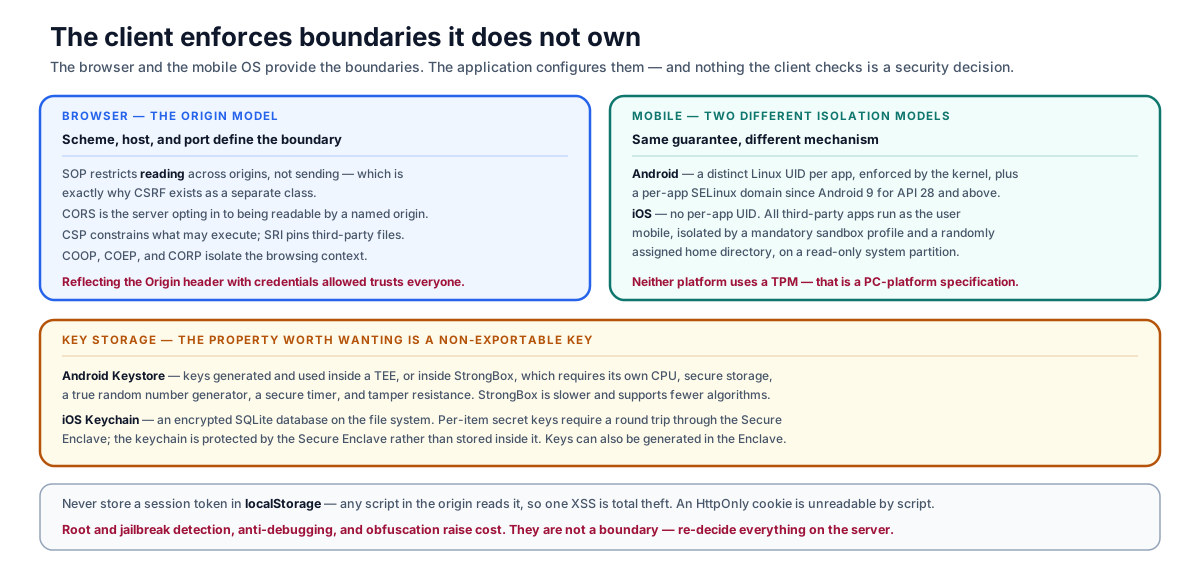
The three boundaries a client actually enforces, and where each one stops
The origin, and the controls that relax or constrain it
An origin is the triple of scheme, host, and port — https://app.example.com:443. The same-origin policy (SOP) is the browser’s default: script running in one origin may not read the DOM or the response body of another. It is a read restriction, which is the detail that explains most of what follows.
SOP does not prevent sending cross-origin requests. A form POST or an image load reaches another origin regardless; the browser simply withholds the response from script. That asymmetry is why CSRF exists as a separate class (covered in Web Application Vulnerabilities & OWASP Top 10) — the request succeeds even though the attacker never sees the answer.
| Mechanism | What it does | How it fails when misconfigured |
|---|---|---|
| CORS | Lets a server opt into having its responses readable by a named origin, via Access-Control-Allow-Origin and related headers. It is a relaxation of SOP, granted by the responding server. |
Reflecting the request’s Origin header into the response while also sending Access-Control-Allow-Credentials: true makes every origin trusted, and authenticated responses become readable by any site. Access-Control-Allow-Origin: * cannot be combined with credentials, so the reflection pattern is the dangerous one. A permissive regex matching example.com.attacker.net is the other common form. |
| CSP | Constrains which sources the page may load and execute, independent of origin. | A policy containing 'unsafe-inline' permits exactly the inline execution it exists to stop. A host-allowlist policy is bypassable through a JSONP endpoint or open redirect on any allowlisted host. A policy with no object-src or base-uri leaves plugin and base-tag injection open. |
| SRI | Pins a third-party script or stylesheet to a cryptographic digest, so a modified file is refused. | A missing or stale integrity attribute lets a compromised CDN serve modified script — the Magecart pattern. A subresource without crossorigin set will not be checked for a cross-origin fetch. |
| COOP / COEP / CORP | Isolate the browsing context: COOP severs the window.opener relationship with cross-origin openers, CORP declares who may embed a resource, and COEP requires embedded resources to opt in. |
Without COOP, a cross-origin opener retains a handle to the window. Cross-origin isolation (COOP same-origin plus COEP require-corp) is also the precondition for SharedArrayBuffer and high-resolution timers, which is why Spectre-class mitigation and this configuration are linked. |
Writing a policy that is actually strict
The host-allowlist form of CSP is the one most commonly deployed and the weakest. The CSP Level 3 draft’s authoring guidance advances nonces, hashes, and 'strict-dynamic' instead:
Content-Security-Policy:
  default-src 'self';
  script-src 'nonce-r4nd0mPerResponse' 'strict-dynamic';
  object-src 'none';
  base-uri 'none';
  frame-ancestors 'none';
  form-action 'self';
  require-trusted-types-for 'script';
  report-to csp-endpoint;
- The nonce must be unpredictable and regenerated per response. A static nonce is equivalent to
'unsafe-inline'. 'strict-dynamic'propagates trust from a nonced script to scripts it loads, and causes supporting browsers to ignore host allowlists entirely. Any host list left in the policy then serves only as a fallback for browsers without Level 3 support.object-src 'none'andbase-uri 'none'close plugin execution and base-tag injection, neither of whichscript-srccovers.require-trusted-types-for 'script'turns unsafe DOM sink assignment into a runtime error, which is the strongest available answer to DOM-based XSS. Check browser support before relying on it.- Roll out in
Content-Security-Policy-Report-Onlyfirst, collect violations at a reporting endpoint, and only then enforce. A policy deployed enforcing without a report phase breaks the application.
CSP is defense in depth. The specification says so directly: it “is not intended as a first line of defense against content injection vulnerabilities.”
Response headers, and what each one actually bounds
These are worth setting on a browser-rendered application. They are engineering recommendations here, not a normative requirement of any single standard.
Strict-Transport-Security: max-age=31536000; includeSubDomains
X-Content-Type-Options: nosniff
Referrer-Policy: strict-origin-when-cross-origin
Permissions-Policy: geolocation=(), camera=(), microphone=()
Cross-Origin-Opener-Policy: same-origin
- HSTS (RFC 6797) tells the browser to use HTTPS for this host for
max-ageseconds, which closes the SSL-stripping window after the policy has been cached. It is trust-on-first-use: the very first request, before any policy is stored, is still strippable. Preloading removes that gap, and sending thepreloadtoken does not put a domain on the preload list — inclusion requires submission at hstspreload.org plus a valid certificate, an HTTP-to-HTTPS redirect on port 80, HTTPS on every subdomain, andmax-ageof at least 31536000. The site notes that preloading is a long commitment because removal takes months to propagate; treat it as a deliberate decision rather than a default. - Framing control: CSP’s
frame-ancestorsis the current mechanism and takes precedence where supported;X-Frame-Options: DENYremains useful as a fallback for older browsers. ItsALLOW-FROMvalue is obsolete and ignored. Neither adds protection to a JSON API response that is never rendered as a document. X-Content-Type-Options: nosniffstops content-type sniffing, so a response served astext/plainis not reinterpreted as script. It only works if theContent-Typeis actually correct.Referrer-Policybounds what leaks in theRefererheader — path and query strings routinely carry identifiers and tokens.Permissions-Policydisables powerful features for the document and its frames, reducing what a compromised or malicious embedded frame can request.
Cookies and where tokens live
Set-Cookie: __Host-session=...; Secure; HttpOnly; SameSite=Lax; Path=/
HttpOnlystops script reading the cookie. It does not stop script using it: an XSS payload can still issue same-origin requests that the browser attaches the cookie to. It reduces impact; it does not contain the flaw.Secureconfines the cookie to HTTPS.SameSite— set it explicitly.Laxis the right default for a session cookie: it blocks cross-sitePOSTwhile still allowing top-level navigation to arrive authenticated.Strictis stronger but breaks any inbound link, including OAuth and SSO returns, so reserve it for cookies no cross-site navigation needs to carry.- The
__Host-prefix makes the browser enforce that the cookie was set withSecure, noDomainattribute, andPath=/, which prevents a subdomain from overwriting it. - Do not put session tokens in
localStorage. Any script running in the origin can read it, so a single XSS is a complete token theft, and it persists across tabs and restarts with no expiry the browser enforces. AnHttpOnlycookie is not readable by script at all. Where an architecture genuinely requires a token in JavaScript, keep it in memory only and accept that it does not survive a reload.
Mobile: two different isolation models
“iOS and Android both sandbox apps” is true and hides a real difference in how, which matters when reasoning about what a compromise reaches.
- Android assigns each app a distinct Linux UID and runs it in its own process; the kernel enforces separation through standard user and group ID mechanisms. Since Android 9, non-privileged apps targeting API level 28 or higher additionally run in per-app SELinux domains, adding mandatory access control on top of the UID-based discretionary control.
- iOS does not use per-app UIDs. Apple’s platform documentation states that system files and resources, and all third-party apps, run as the non-privileged user
mobile. Isolation comes from a mandatory sandbox profile applied to every third-party app plus a randomly assigned per-app home directory, with the operating system partition mounted read-only.
Both models prevent app A from reading app B’s files. Only the mechanism differs — which is exactly the sort of distinction that matters when a platform-specific bypass is reported.
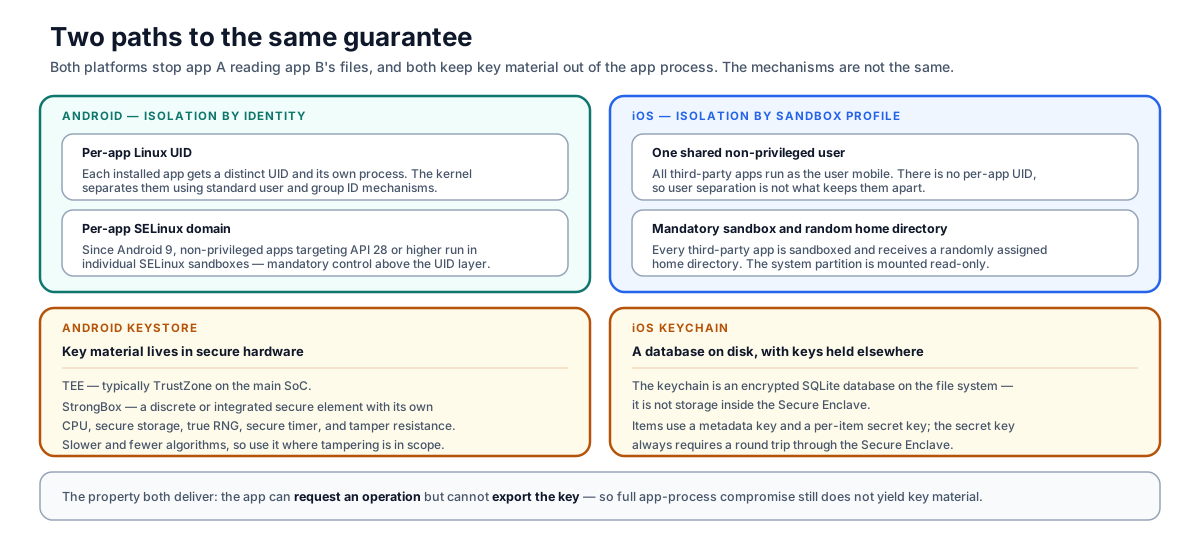
Same guarantee, two mechanisms — and where key material actually sits on each platform
Key storage
The property worth wanting is that key material never becomes readable by the app: the app asks the secure hardware to perform an operation and receives the result, and an attacker with full app-process compromise still cannot export the key.
- Android Keystore. Keys are generated and used inside a Trusted Execution Environment — typically TrustZone on an ARM SoC — or, on devices that support it, inside StrongBox, which the platform defines as an implementation in a discrete or integrated secure element with its own CPU, secure storage, a true random number generator, a secure timer, and tamper-resistance mechanisms. StrongBox is slower, more resource-constrained, and supports a limited algorithm set, so it is warranted where physical tampering is in the threat model rather than everywhere.
- iOS Keychain. The keychain is an encrypted SQLite database stored on the file system, not storage inside the Secure Enclave. Items are encrypted with a metadata key and a per-item secret key; Apple documents that the metadata key is protected by the Secure Enclave but cached in the Application Processor for query speed, while the secret key always requires a round trip through the Secure Enclave. Separately, keys can be generated directly in the Secure Enclave so the private key never exists outside it.
- Neither platform uses a TPM. The TPM is a Trusted Computing Group specification for PC-class platforms; the mobile equivalents are the Secure Enclave, the TEE, and StrongBox or a discrete secure element.
- Anything sensitive that is not in one of these —
SharedPreferences, an app-directory SQLite file,NSUserDefaults, a log line — is readable from a backup or a rooted device.
MASVS control groups
The OWASP Mobile Application Security Verification Standard defines eight control groups:
| Group | Coverage |
|---|---|
| MASVS-STORAGE | Secure storage of sensitive data on the device, including what must not be logged or backed up. |
| MASVS-CRYPTO | Correct use of platform cryptographic primitives and key management. |
| MASVS-AUTH | Authentication and authorization, including local biometric and device-credential flows. |
| MASVS-NETWORK | Secure network communication, including transport security and identity pinning. |
| MASVS-PLATFORM | Safe interaction with the platform and other apps — IPC, deep links, WebViews, custom URL schemes. |
| MASVS-CODE | Code quality and build settings, including dependency and update handling. |
| MASVS-RESILIENCE | Resistance to reverse engineering and tampering. |
| MASVS-PRIVACY | Privacy properties: data minimization, transparency, and user control. |
MASVS states the requirements; the MASTG (Mobile Application Security Testing Guide) provides the test cases that verify them.
Pinning and resilience, in proportion
- Certificate or public-key pinning constrains which certificate chain the app will accept, defeating a user-installed interception CA. The cost is operational: a pinned key that rotates without a shipped update bricks the app for every installed client. Pin to a public key rather than a leaf certificate, ship at least one backup pin, and have a remote kill switch. MASVS-NETWORK treats identity pinning as a defense-in-depth control rather than a baseline requirement, which is the right calibration — it is warranted for high-value flows, not universally.
- MASVS-RESILIENCE controls — root and jailbreak detection, anti-debugging, obfuscation via R8, ProGuard, or DexGuard — raise the cost of analysis. They do not create a boundary. An attacker with the device and enough time defeats all of them, and treating a root check as an authorization control puts the decision on the attacker’s hardware. Use them to slow mass automated abuse; never to protect a secret that the server could protect instead.
- Attestation moves the decision server-side, which is the structural fix: Google’s Play Integrity API and Apple’s App Attest and DeviceCheck produce a signed verdict that the server validates. Even then, treat it as one signal in a risk decision rather than a binary gate.
Client and mobile review checklist
The checklist below is a journal working model, not a published audit standard. When auditing a web or mobile client, evaluate these eight criteria:
| Diagnostic area | Evaluation question | Verification & audit evidence |
|---|---|---|
| CORS origin handling | Are allowed origins matched against an explicit list, rather than reflecting the Origin header or matching a loose pattern — especially where credentials are allowed? |
CORS middleware source, response header capture for a forged Origin, a test with a suffix-matching hostile origin. |
| CSP strength and rollout | Does the policy use per-response nonces with strict-dynamic rather than a host allowlist, set object-src and base-uri, and was it rolled out report-only first? |
Header capture across routes, CSP Evaluator output, nonce generation code, violation report volume. |
| Subresource integrity | Do externally hosted script and link elements carry an integrity digest — SHA-256, SHA-384, or SHA-512 — with crossorigin set? |
HTML source inspection, build-time SRI generation step, a tampered-asset load test. |
| Transport policy | Is HSTS set with an adequate max-age, and if the domain relies on preloading, is it actually on the preload list rather than merely sending the token? |
Header capture, preload list lookup for the domain, subdomain HTTPS coverage check. |
| Cookie and token placement | Are session cookies Secure, HttpOnly, SameSite-explicit and __Host- prefixed, with no session token in localStorage? |
Set-Cookie capture, client storage inspection, a grep for token writes to localStorage. |
| Mobile key storage | Is every long-lived secret held in the Android Keystore or the iOS Keychain, with key material non-exportable, rather than in preferences, plain files, or logs? | Key generation call sites, a filesystem and backup dump of the app container, log review on a debug build. |
| Platform interaction surface | Are exported components, deep links, custom URL schemes, and WebView settings reviewed — with JavaScript interfaces and file access disabled unless needed? | Manifest and Info.plist review, WebView configuration, an IPC fuzz or intent-replay test. |
| Server-side enforcement | Is every decision the client appears to make — entitlement, price, role, root status — re-decided server-side, with attestation verdicts validated on the server? | API authorization tests issued with a patched or proxied client, attestation verification code path. |
Nothing the client enforces is a boundary — re-decide everything server-side, and ship no secret to a client. The same-origin policy restricts reading, not sending, which is why CSRF is a separate problem and why reflecting the Origin header with credentials allowed is the dangerous CORS mistake. Prefer per-response nonces with strict-dynamic over host allowlists, and remember HSTS is trust-on-first-use — the preload token alone does not put a domain on the preload list. On mobile, Android isolates by per-app UID and SELinux while iOS runs every third-party app as mobile under a sandbox profile; the iOS Keychain is an encrypted database whose keys are protected by the Secure Enclave, not storage inside it, and neither platform uses a TPM.
Primary references
- W3C Content Security Policy Level 3 — a W3C Working Draft (13 August 2026), intended to become a Recommendation; verified the nonce, hash, and
'strict-dynamic'authoring guidance and the statement that CSP is defense in depth rather than a first line of defense. - W3C Subresource Integrity — a W3C Recommendation (23 June 2016); verified that conformant user agents must support SHA-256, SHA-384, and SHA-512.
- RFC 6797: HTTP Strict Transport Security — verified the policy semantics and the trust-on-first-use limitation.
- HSTS Preload List submission — verified that the
preloadtoken is a request for inclusion rather than inclusion itself, and the certificate, redirect, subdomain, andmax-agerequirements. - Apple Platform Security: Security of runtime process — verified that third-party iOS apps run as the non-privileged user
mobile, are sandboxed, and receive a randomly assigned home directory. - Apple Platform Security: Keychain data protection — verified that the keychain is a SQLite database on the file system and that the per-item secret key requires a round trip through the Secure Enclave.
- Android: Application sandbox — verified per-app UID assignment, kernel-level enforcement, and per-app SELinux domains from Android 9 for apps targeting API 28 or higher.
- Android Keystore system — verified the TEE and StrongBox backing options and the StrongBox hardware requirements.
- OWASP MASVS — verified the eight control groups and the division of responsibility between MASVS and the MASTG.