Governance, Risk & Compliance / Deep Dive
Cybersecurity Standards & Frameworks
Cybersecurity standards, frameworks, and audit reports serve distinct operational purposes. Selecting the appropriate model requires evaluating whether an organization needs a high-level organizing vocabulary (NIST CSF 2.0), a certifiable management system (ISO/IEC 27001), a prioritized safeguard list (CIS Controls), a detailed control catalog (NIST SP 800-53), or third-party audit evidence (SOC 2 Type II).
The Cybersecurity Standards & Framework Matrix
| Standard / Framework | Type | Primary Purpose | Target Audience | Certification Status |
|---|---|---|---|---|
| NIST CSF 2.0 | Voluntary Framework | Organizing vocabulary & outcome mapping across 6 Functions (Govern, Identify, Protect, Detect, Respond, Recover) | Enterprise leadership & security architects | Self-assessed (No formal certification) |
| NIST SP 800-53 Rev. 5 | Control Catalog | Catalog of roughly 1,190 security & privacy controls and control enhancements across 20 families | Federal agencies, FISMA contractors, high-assurance enterprises | The catalog itself is not self-executing; FIPS 200 makes baseline selection from it mandatory for federal information systems (excluding national security systems). Voluntarily adopted elsewhere as a control reference. |
| ISO/IEC 27001:2022 | Management Standard | Requirements for an Information Security Management System (ISMS) | Global enterprises requiring verifiable B2B security posture | Certified by accredited 3rd-party auditors |
| ISO/IEC 27002:2022 | Implementation Guide | Detailed implementation guidance for ISO 27001 Annex A controls | Security engineers implementing ISO 27001 | Companion guidance (Non-certifiable) |
| CIS Controls v8.1 | Prioritized Safeguard List | 153 concrete safeguards grouped into 18 Controls and 3 Implementation Groups (IG1, IG2, IG3) | Resource-constrained security teams needing prioritized actions | Self-assessed / Audit baseline |
| CISA CPGs | Critical Baseline Goals | Minimum high-impact practices for critical infrastructure operators | Critical infrastructure, SMBs establishing a security floor | Voluntary baseline guidance |
| FedRAMP | US Federal Cloud Authorization | Authorization framework for cloud service offerings sold to federal agencies, built on NIST SP 800-53 controls | Cloud service providers selling to US federal agencies | Mandatory for in-scope cloud services sold to federal agencies |
| CMMC | Defense Industrial Base Contractor Assessment | Assesses defense industrial base (DIB) contractors’ own cybersecurity practices (built on NIST SP 800-171) as a condition of DoD contract eligibility—a contractor assessment program, not a cloud-service authorization scheme like FedRAMP | Defense industrial base contractors bidding on or holding DoD contracts | Phased rollout tied to DoD contract requirements; verify current program status against the official DoD CMMC page |
| OWASP Top 10 | Awareness Document | Consensus list of critical web application security risks | Web developers, application security engineers | Educational awareness floor |
| OWASP ASVS 5.0.0 | Verification Standard | Testable application security requirements across 3 levels (L1, L2, L3) | AppSec engineers, penetration testers, QA auditors | Verifiable software standard |
| OWASP SAMM v2 | Maturity Model | Assesses and matures software security practices across 5 business functions | Software engineering leadership | Organizational assessment framework |
| SOC 2 (Type I / Type II) | Audit Attestation | Independent CPA audit report based on AICPA Trust Services Criteria | B2B SaaS vendors proving control operation to enterprise buyers | Independent CPA Audit Attestation Report |
NIST CSF 2.0: Strategic Organizing Framework
Restructured in 2024, NIST CSF 2.0 organizes cybersecurity outcomes across six core Functions:
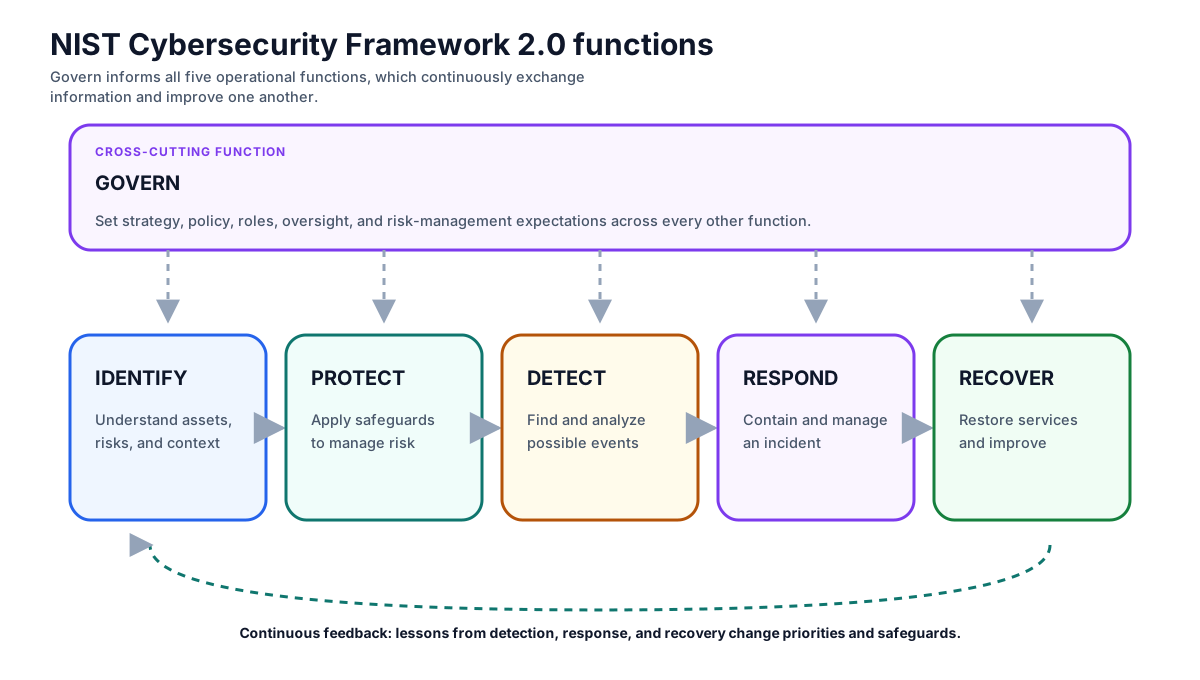
Govern is cross-cutting; the other functions continuously exchange feedback
- Govern: Establishes cybersecurity strategy, governance, risk tolerance, and policy oversight.
- Identify: Maps physical assets, systems, data, supply chain dependencies, and risk assessments.
- Protect: Implements identity controls, access management, awareness training, and platform security.
- Detect: Deploys continuous monitoring, SIEM detection rules, and anomaly detection.
- Respond: Executes incident containment, communication, and mitigation playbooks.
- Recover: Restores operational assets and services following security events.
NIST CSF 2.0 defines outcomes rather than prescriptive technical implementations, serving as an organizing umbrella mapped to candidate control catalogs like NIST SP 800-53 or CIS Controls.
ISO/IEC 27001:2022 vs ISO/IEC 27002:2022
ISO 27001 and ISO 27002 operate as a certifiable pair:
- ISO/IEC 27001:2022: Defines requirements for establishing, operating, and continually improving an Information Security Management System (ISMS). Organizations undergo a two-stage audit by an accredited Registrar to obtain a formal 3-year certificate. ISO 27001 requires publishing a Statement of Applicability (SoA) selecting or excluding Annex A controls.
- ISO/IEC 27002:2022: Provides implementation guidance for the 93 controls listed in Annex A across four themes: Organizational, People, Physical, and Technological.
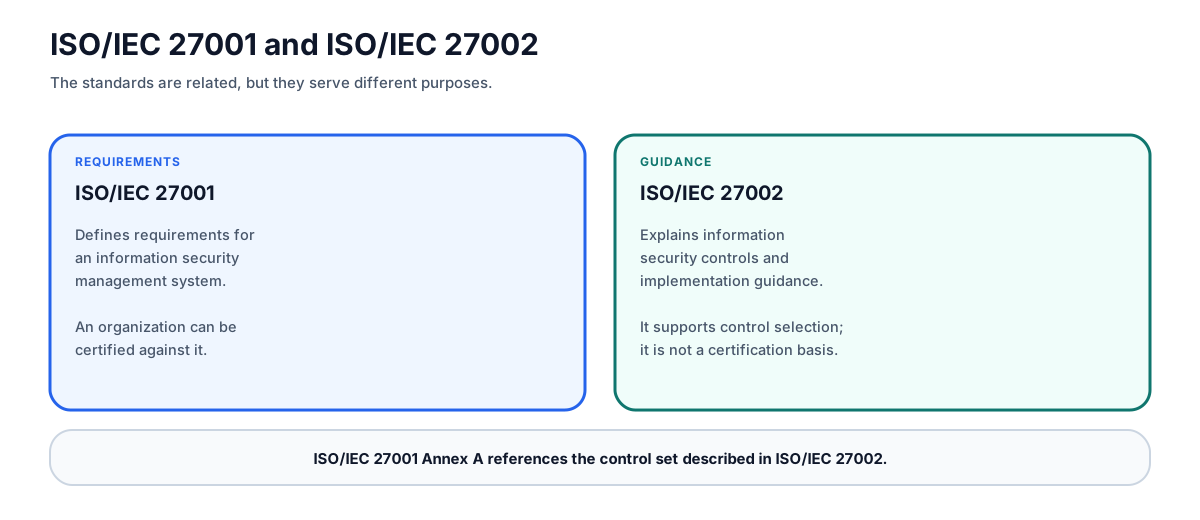
ISO 27001 defines certifiable requirements; ISO 27002 explains the controls
The OWASP AppSec Suite: Top 10, ASVS & SAMM
Application security engineering relies on three distinct OWASP frameworks:
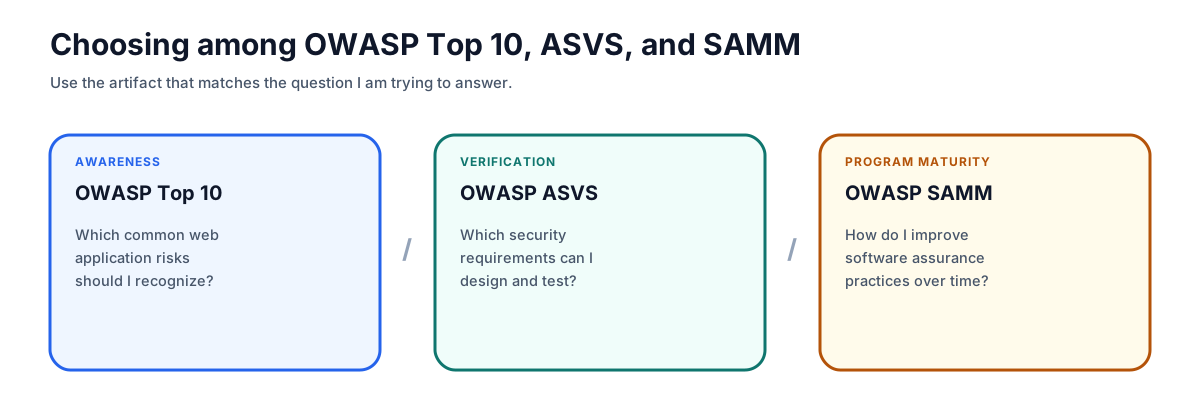
Choose the OWASP resource that matches the question
- OWASP Top 10: High-level risk categories (e.g., A01 Broken Access Control) designed for developer awareness.
- OWASP ASVS: Concrete, testable verification requirements at three levels. ASVS 5.0 replaced the data-sensitivity tiers used in ASVS 4.0 with a priority-based split, so the level names from the older edition (Opportunistic, Standard, High Assurance) no longer apply:
- Level 1: the minimum set — roughly 20% of ASVS requirements, deliberately small to keep the barrier to entry low. Mostly critical first-layer defenses against attacks that need no other precondition. ASVS notes that Level 1 is not necessarily verifiable by an external black-box tester without access to documentation or code.
- Level 2: the level most applications should target — about 50% of requirements, so roughly 70% of the standard cumulatively. Covers less common attacks and more complex protections against common ones.
- Level 3: the remaining ~30% — largely defense-in-depth mechanisms and controls that are useful but hard to implement.
- OWASP SAMM: Assesses and matures an organization’s software security program across 5 business functions comprising 15 security practices — governance and design as well as build and release.
CIS Controls v8.1: Prioritized Implementation
For organizations seeking a direct, prioritized roadmap, CIS Controls v8.1 organizes 153 Safeguards into three Implementation Groups (IGs):
- Implementation Group 1 (IG1): Essential cyber hygiene baseline (56 safeguards) achievable by resource-constrained organizations.
- Implementation Group 2 (IG2): Intermediate baseline (74 additional safeguards) for enterprises managing moderate operational complexity.
- Implementation Group 3 (IG3): High-assurance baseline (23 additional safeguards) protecting critical assets against targeted attacks.
SOC 2: Independent Third-Party Audit Attestation
SOC 2 is an independent CPA audit report governed by the AICPA Trust Services Criteria:
- Security (Mandatory baseline criterion for all SOC 2 reports)
- Availability (Optional)
- Confidentiality (Optional)
- Processing Integrity (Optional)
- Privacy (Optional)
Type I vs Type II Reports
- SOC 2 Type I: Evaluates whether control design is appropriately configured as of a single point in time.
- SOC 2 Type II: Evaluates whether controls operated effectively over a continuous observation period (typically 6 to 12 months).
Enterprise B2B SaaS buyers commonly ask for a SOC 2 Type II report as contractual evidence that controls actually operated. It is not the only accepted form: ISO 27001 certification is a frequent alternative, a Type I is sometimes accepted for a vendor’s first year, and which evidence satisfies a buyer is a procurement decision rather than a fixed rule.
Reading a SOC 2 report rather than collecting it
A report’s existence is weaker evidence than its contents. Four things determine what it actually proves:
- Scope: which systems, products, and Trust Services Criteria categories the engagement covered. A report scoped to one product line says nothing about another.
- Observation period: a Type II covers a stated window. A report whose period ended fourteen months ago is stale, and gaps between consecutive periods are not covered by either report.
- Opinion: qualified or unqualified. A qualified opinion names the criteria the auditor could not conclude on.
- Exceptions and CUECs: tested exceptions appear in the results section, and complementary user entity controls list what the report assumes you operate. Controls assigned to the customer are outside the vendor’s assurance.
Taxonomy of NIST Special Publications (SPs) & FIPS Standards
Engineering teams often navigate multiple NIST 800-series publications and Federal Information Processing Standards (FIPS). Below is how key NIST and FIPS publications map to specific engineering domains:
| Standard / Publication | Engineering Domain | Primary Scope & Function | Operational Placement |
|---|---|---|---|
| NIST FIPS 140-3 | Cryptography & Hardware Security | Security requirements for hardware and software cryptographic modules | Validating Hardware Security Modules (HSMs), TPMs, and cryptographic libraries. |
| NIST FIPS 199 / FIPS 200 | Security Categorization | Categorizing system impact (Low, Moderate, High) across CIA triad properties | Risk Assessment & System Categorization: Defining baseline security requirements based on potential harm severity. |
| NIST SP 800-30 / SP 800-37 / SP 800-39 | Risk Management Lifecycle | Risk Assessment (800-30), Risk Management Framework (800-37), Risk Governance (800-39) | Risk Engine: The continuous decision process connecting threat inputs, risk responses, and control monitoring. |
| NIST SP 800-53 Rev. 5 | Control Catalog & Safeguards | Catalog of 20 control families (Access Control, Audit and Accountability, System and Communications Protection, Incident Response). There is no separate Cryptography family — cryptographic controls sit inside System and Communications Protection (SC). | Enterprise Governance & Control Execution: The primary baseline catalog for FedRAMP, DoD, and enterprise risk controls. |
| NIST SP 800-63-4 | Digital Identity & Authentication | Guidelines for Identity (IAL), Authenticator (AAL), and Federation (FAL) assurance | Identity & Access Management (IAM): See Digital Identity Assurance Levels. |
| NIST SP 800-160 Vol. 1 / Vol. 2 | System Security Engineering | Systems security engineering for trustworthy secure systems, aligned to the ISO/IEC/IEEE 15288 lifecycle processes (Vol. 1); cyber-resiliency design principles for systems expected to keep operating while compromised (Vol. 2) | System Security Engineering: Building security into system design rather than adding it afterwards, and designing for continued operation under adversary presence. |
Application, CI/CD & Supply Chain Standards
| Standard / Framework | Focus Area | Primary Function | Best Used For |
|---|---|---|---|
| NIST SP 800-218 (SSDF) & SLSA v1.2 | Software Supply Chain | Secure development & build provenance | Hardening software supply chains, dependency integrity, and artifact provenance—see SLSA & Build Provenance Attestations for the deep dive. |
| OWASP ASVS 5.0.0 | Application Security | Testable application requirements | Designing, coding, and auditing secure web applications and API endpoints. |
| OWASP CI/CD Top 10 | Pipeline Security | CI/CD build hardening | Mitigating build pipeline manipulation, runner compromise, and un-gated deployments. |
| Threat Modeling (STRIDE / PASTA) | Architecture | Structured threat identification | Evaluating misuse cases and trust transitions tailored to project trade-offs—see Trust Boundaries & Threat Modeling. |
System Hardening Benchmarks & Vendor Security Baselines
While the high-level frameworks above define what safeguards are required, technical hardening benchmarks define the exact configuration settings needed to secure operating systems, containers, database engines, and cloud platforms:
| Hardening Standard / Baseline | Focus Area | Primary Function | Operational Placement |
|---|---|---|---|
| CIS Benchmarks | OS, Cloud & Container Hardening | Prescriptive technical configuration checklists (Linux, Windows, Kubernetes, AWS, GCP, Azure) | Technical Safeguards Execution: Concrete system-level hardening settings (e.g., SSH daemon configurations, IAM policies, container isolation). |
| Cloud Vendor Baselines (AWS Well-Architected / Azure Security / GCP Foundations) | Cloud Infrastructure Architecture | Cloud provider security architecture baselines | Cloud Infrastructure Architecture: Best-practice configuration for IAM identity perimeters, VPC Service Controls, and KMS key policies. |
| DISA STIGs | Defense & Federal System Hardening | DoD mandatory security technical implementation guides | High-Assurance Federal Infrastructure: Mandatory technical configuration baselines for military and defense IT environments. |
Which one to reach for
The lede’s question — which model an organization actually needs — resolves by asking what the output has to be, not which standard is best:
| If the need is… | Reach for | Because |
|---|---|---|
| A shared vocabulary for reporting posture to executives or a board | NIST CSF 2.0 | It defines outcomes, not implementations, so it survives changes of tooling and maps onto whatever catalog sits beneath it. |
| A prioritized list of things to actually do next, with limited staff | CIS Controls IG1 | 56 safeguards chosen for the attacks that occur most, deliverable without a dedicated security team. |
| An exhaustive control catalog to select a baseline from | NIST SP 800-53 | Required for federal systems via FIPS 200; useful elsewhere precisely because it is exhaustive rather than prioritized. |
| Testable requirements a developer or pentester can pass or fail | OWASP ASVS | Every requirement resolves to a pass/fail verdict against the application itself. |
| A certificate a counterparty will accept internationally | ISO/IEC 27001 | Accredited third-party certification of a management system, recognized across markets. |
| Evidence that controls operated over a period, for a US enterprise buyer | SOC 2 Type II | A CPA attestation over an observation window, which a point-in-time certificate does not provide. |
| A floor to hold critical-infrastructure operations to | CISA CPGs | A short, high-impact subset chosen for sectors that cannot absorb a long programme. |
| Exact configuration settings for a host, cluster, or cloud account | CIS Benchmarks or DISA STIGs | The frameworks above say what to achieve; only benchmarks say which setting to set. |
Two rules follow. Pick one framework as the organizing spine and map the others into it rather than running parallel programmes; and never substitute a document at one altitude for one at another — a SOC 2 report is not a hardening baseline, and a CIS Benchmark is not a management system.
ISO 27001 defines a management system, NIST SP 800-53 provides a technical control catalog, and hardening baselines like CIS Benchmarks give prescriptive per-system configuration — these operate at different altitudes and aren't interchangeable substitutes. Pick one framework as the organizing spine, map the rest into it, and choose by what output is required rather than by which standard is most cited.
Primary references
- NIST SP 800-53 Rev. 5: Security Controls for Information Systems — NIST CSRC SP 800-53
- ISO/IEC 27001:2022: Information security management systems requirements — ISO 27001 Standard
- NIST Cybersecurity Framework 2.0: CSWP 29 — NIST CSF 2.0 — verified the six Functions and the February 2024 publication.
- OWASP ASVS 5.0: Application Security Verification Standard — OWASP ASVS — verified the three priority-based levels and their proportions.
- AICPA: SOC for Service Organizations and the Trust Services Criteria — AICPA SOC — verified the five TSC categories and the Type I / Type II distinction.
- CIS Critical Security Controls v8.1 — CIS Controls list — verified 18 Controls, 153 Safeguards, and the Implementation Group structure.