Network Security / Architecture
Network Segmentation & Microsegmentation
Segmentation limits which communications may cross between security zones; microsegmentation applies the same idea at workload granularity. A VLAN, subnet, namespace, or label defines grouping, but isolation exists only when an enforcement point applies policy to every viable path.
Separate topology from enforcement
- Security zone: A group of assets with similar exposure, function, or protection requirements.
- Segmentation: Policy between zones, commonly enforced by routers, firewalls, cloud controls, or gateways.
- Microsegmentation: Finer policy between workloads, processes, interfaces, pods, or service identities.
- Containment: The resulting reduction in reachable targets after a compromise. It is an outcome to test, not an automatic property of having subnets.
A demilitarized zone (DMZ), application tier, and data tier are useful only if the allowed flows are explicit. If a public web workload may call an application service on one port, and only that service may call a database, compromise of the web workload does not directly create a permitted web-to-database path. The attacker can still abuse the allowed application path, steal a more privileged identity, exploit the enforcement plane, or find an alternate route.
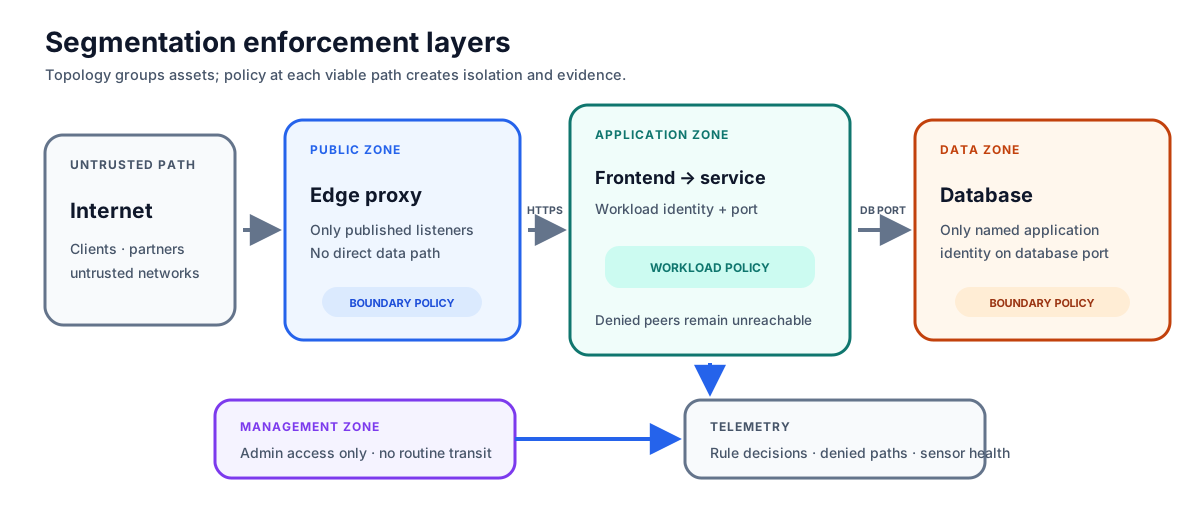
Conceptual model: topology groups assets; boundary and workload policy create isolation; telemetry validates the effective paths
Cloud controls are provider-specific
“Security group” and “network ACL” are AWS terms; do not project their semantics onto other clouds.
| Platform control | Scope and state | Rule/default behavior to remember |
|---|---|---|
| AWS security group | Stateful control associated with supported resource network interfaces | Allow rules only. A new security group starts with no inbound rules and an outbound allow-all rule; the VPC’s default security group additionally has an inbound rule from itself. Return traffic for an allowed flow is tracked. |
| AWS network ACL | Stateless control associated with one or more subnets | Ordered allow and deny rules. The VPC default network ACL has numbered allow-all rules; a new custom network ACL begins with only terminal deny rules. Return traffic must be allowed explicitly. |
| Google Cloud VPC firewall rule/policy | Distributed, stateful enforcement for VM interfaces, configured at network or policy scope | Supports allow and deny with priorities; implied actions and pre-populated rules depend on the network and policy layer. Return traffic for an allowed connection is tracked, and some platform traffic is always allowed. |
| Azure network security group (NSG) | Stateful rules on supported subnet and network-interface boundaries | Ordered inbound and outbound security rules include Azure default rules. NSGs are not an AWS security-group/NACL pair, and Azure Firewall is a separate centralized service. |
For AWS stateless network ACLs, the return rule must cover the ephemeral port selected by the connection initiator. The correct range depends on that client or intermediary: AWS documents examples including Linux 32768–61000, modern Windows 49152–65535, and services that use 1024–65535. Opening 1024–65535 can be an interoperability choice, not a universal operating-system range.
Apply microsegmentation at more than one layer
| Layer | Stable policy signal | Main failure mode |
|---|---|---|
| Host / cloud interface | Workload group, service account, instance identity, address, protocol, port | Stale membership, unintended inherited rules, alternate interfaces, or direct endpoints. |
Kubernetes NetworkPolicy |
Pod and namespace selectors, CIDRs, protocol, port | The network plugin must implement the policy; without a selecting policy, pods are non-isolated for that direction. Ingress and egress allowances are additive, both ends may need to permit a flow, traffic between a pod and its node is always allowed by the API model, and hostNetwork behavior is implementation-specific. |
| eBPF-based enforcement | Implementation-specific workload identity and kernel datapath context | “eBPF” identifies a mechanism, not one policy model or guarantee. Coverage depends on the product, attach points, kernel, host-network handling, and observability configuration. |
| Service mesh | Authenticated workload identity and application/TCP attributes | Mutual TLS (mTLS) authenticates and encrypts peers but does not itself decide which peer may call which resource. Authorization policy, traffic capture, enrollment, and strict-mode coverage are separate. |
In Istio, permissive peer authentication accepts both plaintext and mTLS during migration. Move covered workloads to strict mode and apply explicit authorization policy before claiming identity-based isolation. A compromised sidecar-mode workload may send traffic outside its own proxy; destination-side enforcement and lower-layer network policy remain important. Health checks, host networking, excluded ports, egress, and traffic that bypasses injection need explicit treatment.
For Kubernetes, begin with default-deny ingress and egress policies only after allowing required DNS, control-plane, identity, telemetry, and update paths. Creating a NetworkPolicy object with a network plugin that does not implement it has no effect.
Design, test, and operate the zone model
- Inventory applications, data, administrators, automation, third parties, and infrastructure dependencies.
- Draw all paths, including IPv6, peering/transit, load balancers, overlays, host networking, backup, monitoring, and emergency administration.
- Group assets by exposure and impact; write an allow matrix with source, destination, identity, protocol/port, direction, purpose, owner, and expiration.
- Apply coarse boundary controls and finer workload controls so one control-plane error does not expose every layer.
- Deploy in observe or staged mode where available, then test allowed and denied flows from the real zones.
- Alert on unexpected allows, repeated denies, direct-path attempts, policy/controller failure, rules with no owner, and topology drift.
- Revalidate after scaling, failover, CNI or mesh upgrades, address-family changes, service discovery changes, and incident containment actions.
Segmentation changes can strand production or management traffic. Keep versioned policy, an out-of-band recovery path, staged rollback, and dependency-aware change windows. During incident containment, prefer narrowly blocking the confirmed path while preserving evidence, identity, DNS, time, and response communications required for recovery.
Avoid false assurance
- A private subnet with no public address can still have reachable paths through load balancers, peering, VPNs, serverless connectors, proxies, or compromised internal workloads.
- “East-west inspection” does not prove authorization; an encrypted or unparsed flow may yield only metadata.
- A successful port scan samples one source, route, protocol, and time. Combine active tests with rule analysis, route analysis, logs, and alternate-path tests.
- Segmentation reduces reachable attack surface; it does not remove application authorization, identity, endpoint, or data-layer controls.
Zones and labels describe intended grouping; enforcement points create isolation. Use provider- and platform-specific semantics, combine boundary and workload policy, test every path and address family, and preserve a controlled rollback path when segmentation blocks a dependency.
Primary references
- NIST SP 800-207 and NIST SP 800-207A — verified network-tier and identity-tier policy boundaries, zero-trust decision points, and cloud-native enforcement models.
- AWS VPC security groups and network ACL comparison — verified scope, state, rule processing, return traffic, defaults, and ephemeral-port dependencies.
- Google Cloud VPC firewall rules and Azure network security groups — verified provider-specific state, priority, direction, and default-rule semantics.
- Kubernetes NetworkPolicy and Istio security best practices — verified policy prerequisites, additive isolation behavior, mTLS modes, and the boundary between peer authentication and authorization.