Cryptography / Infrastructure
Certificate Transparency (CT) & Merkle Audit Proofs
Certificate Transparency (CT) is an open cryptographic auditing framework for logging publicly trusted TLS server certificates into append-only, publicly verifiable Merkle hash trees. The CT protocol itself (RFC 6962/9162) does not compel a CA to log anything; enforcement comes from browser and root-program policy. Chrome and Apple platforms require qualifying Signed Certificate Timestamps (SCTs) for in-scope publicly trusted TLS certificates, while Firefox has enforced CT on desktop since version 135 for certificates chaining to CAs in Mozilla's Root CA Program. CT does not prevent CA misissuance; it makes in-scope certificates publicly discoverable so domain owners and monitors can detect them.
The Problem: Rogue CA Misissuance
Historically, any trusted Root CA in an operating system trust store could issue a valid certificate for any domain on the internet without domain owner knowledge (e.g., the 2011 DigiNotar compromise where rogue Google certificates were issued). Certificate Transparency does not stop a CA from issuing a rogue certificate, but it makes publicly trusted TLS server certificate issuance public and cryptographically auditable, so a rogue certificate becomes discoverable by the legitimate domain owner or third-party monitors instead of remaining secret.
Merkle Tree Architecture in CT (RFC 6962 / RFC 9162)
CT logs organize certificates into append-only Merkle hash trees. Specified in RFC 6962 and RFC 9162 — both published as Experimental RFCs, not IETF Standards Track — a Merkle Tree hashes leaf data pairwise up to a single cryptographic Root Hash:
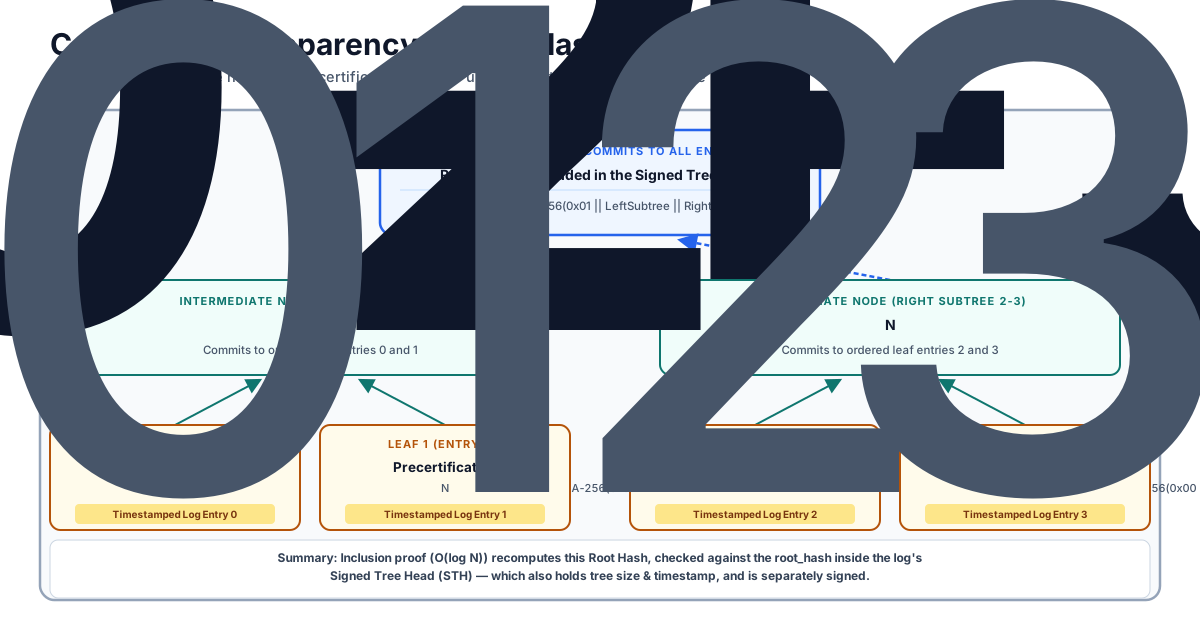
CT Merkle Tree: append-only binary tree allowing O(log N) inclusion and consistency verification
Cryptographic Proof Types
- Inclusion Proof (Audit Path): Proves in O(log N) time that a specific certificate exists inside a log tree containing N entries without revealing the full log.
- Consistency Proof: Proves in O(log N) time that an updated tree with N + M entries is a pure append-only extension of an earlier tree with N entries, ensuring past entries were never mutated or deleted.
Split-View (Equivocation) Risk
Inclusion and consistency proofs are only as trustworthy as the Signed Tree Head (STH) they’re checked against — and both proof types verify a claim relative to whatever tree the log presented to the requester at that moment, not relative to some single, globally-agreed tree state. A dishonest or compromised log operator can, in principle, equivocate: present one tree (and STH) to one set of clients and a different, conflicting tree (and STH) to another, with each proof independently checking out as valid against the STH it was paired with. Neither an inclusion proof nor a consistency proof, taken in isolation, detects this — they prove internal consistency of a presented view, not that all clients are seeing the same view.
Detecting a split-view requires an independent mechanism: gossip protocols and monitors/auditors that fetch and compare STHs from a log across many independent vantage points (different networks, different clients, different times), looking for two STHs from the same log that cannot both be consistent extensions of a common earlier tree. RFC 9162 §11.3 discusses this gossip/detection requirement explicitly as part of CT’s overall security model — it’s a structural gap the Merkle-tree cryptography alone doesn’t close, which is why production CT deployments depend on a broader ecosystem of monitors and auditors, not just on individual clients checking individual proofs.
Signed Certificate Timestamps (SCT) & Flow
When a domain owner or automated ACME agent requests a certificate, the CA submits the pre-certificate to multiple independent CT log servers. Each log returns a Signed Certificate Timestamp (SCT) promising inclusion within a Maximum Merge Delay (MMD, typically 24 hours):

SCT Delivery Workflow (embedded-SCT path — the most common of the three delivery mechanisms below): CA submits pre-certificate to CT logs, receives SCTs, and embeds them into the TLS certificate
Browser CT Enforcement Policies
CT enforcement is set independently by each browser vendor, rolled out on different dates, and scoped differently:
- Google Chrome: enforces CT for publicly-trusted TLS certificates issued after April 30, 2018 per Chrome Certificate Transparency Policy.
- Apple Safari / macOS / iOS: enforces CT platform-wide for publicly-trusted certificates issued after October 15, 2018 per Apple Certificate Transparency Policy.
- Mozilla Firefox: added CT enforcement on desktop platforms starting with Firefox 135 (February 2025), per that release’s own notes — requiring servers to prove public disclosure of their certificates before Firefox will trust them — scoped to certificates chaining to a CA in Mozilla’s Root CA Program.
- Microsoft Edge: as a Chromium-based browser, inherits Chrome’s enforcement by default; administrators can disable it for specific CAs or URLs via Edge policy.
1. Chrome Embedded-SCT Policy
For certificates evaluated under Chrome’s CT Policy using embedded SCTs:
| Certificate Lifetime | Required Embedded SCT Count | Log Operator Diversity Rule |
|---|---|---|
| 180 Days or Less | Minimum 2 SCTs | Must include SCTs from at least 2 distinct, independent CT log operators (e.g., Google + Cloudflare). |
| Over 180 Days | Minimum 3 SCTs | Must include SCTs from at least 2 distinct log operators to hedge against operator outage or compromise. |
2. Apple CT Policy Rules
Under Apple’s CT Policy, publicly trusted server certificates must satisfy Apple’s SCT requirements before Apple platforms will trust them. The best-documented path uses embedded SCTs, with counts set by certificate validity period and SCTs drawn from logs run by more than one distinct operator:
- Lifetime ≤ 180 days: At least 2 SCTs, from logs operated by at least 2 distinct log operators.
- Lifetime > 180 days up to 398 days: At least 3 SCTs, from logs operated by at least 2 distinct log operators.
These counts describe the embedded-SCT path specifically — not a single universal SCT requirement that applies regardless of delivery method. Apple’s policy also documents an alternate path built on SCTs delivered via the TLS signed_certificate_timestamp extension or OCSP stapling rather than embedded in the certificate, with its own count and currently-qualified-log requirements that aren’t necessarily identical to the embedded-path numbers above (and the two paths aren’t necessarily restricted to disjoint certificate populations the way “embedded vs. non-embedded” might suggest). Treat the counts above as the load-bearing numbers for the common embedded-SCT case, and consult the current policy document directly for the alternate path’s exact count and log-qualification rules, since CT policies are revised periodically.
3. TLS-Delivered SCTs vs. X.509 Embedded SCTs
SCTs can be delivered to the client browser via three distinct transport mechanisms:
- Embedded X.509 v3 Extension (OID
1.3.6.1.4.1.11129.2.4.2): Pre-certificates are submitted to logs by the CA before final issuance, and the received SCTs are statically baked directly into the certificate. This is the overwhelmingly common pattern. - TLS Extension (
signed_certificate_timestamp): The web server transmits SCTs during the TLS handshake—in TLS 1.3, carried within theCertificatemessage extensions for the target certificate entry; in TLS 1.2, delivered viaServerHelloextension. - OCSP Stapling: The web server includes SCTs wrapped inside a stapled OCSP response (
OCSPResponse). This delivery path has lost currency: per Chrome’s CT Policy, Chrome no longer accepts OCSP-delivered SCTs toward its compliance requirement starting with Chrome 148, leaving embedded X.509 extensions and the TLS extension as the paths CAs and servers can actually rely on.
For publicly trusted TLS certificates under browser CT policy, Certificate Transparency does not prevent CA misissuance; it makes submitted certificates or precertificates monitorable and log behavior auditable. Under current Chrome policy, embedded or TLS-delivered SCTs count toward CT compliance, while OCSP-stapled SCTs do not.
Primary references
- RFC 6962: Certificate Transparency — IETF RFC 6962
- RFC 9162: Certificate Transparency Version 2.0 — IETF RFC 9162
- Chrome CT Policy: Chrome Certificate Transparency Policy — Google Chrome CT Policy
- Apple CT Policy: Apple’s Certificate Transparency Policy — Apple Support HT209249 / 103214