Security Foundations / Concepts
Security Controls & Defense in Depth
A security control is a technical, physical, or administrative safeguard deployed to alter a specific risk exposure. Defense in depth combines diverse, less-correlated safeguards across identity, application, network, and data perimeters to reduce the likelihood that the failure of a single security barrier results in systemic compromise—layering lowers that likelihood, it does not eliminate it.
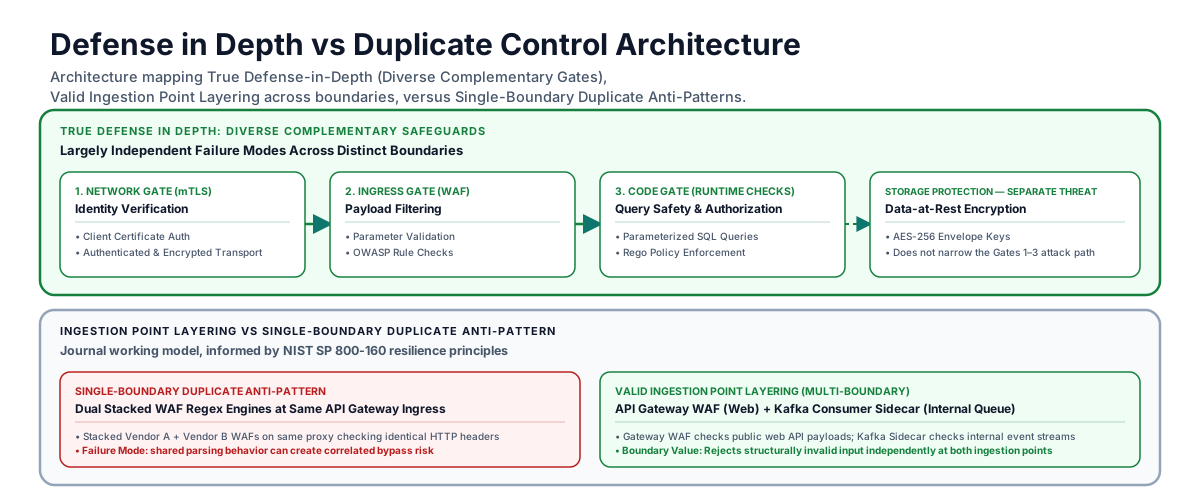
Defense in Depth vs Duplicate Control Architecture (journal working model): Panel 1 illustrates True Defense in Depth across 4 diverse boundaries (Network mTLS → Ingress WAF → Runtime Application Controls → Data-at-Rest Encryption)—the encryption-at-rest gate narrows exfiltration via a stolen disk/backup, not exfiltration by an already-authenticated application reading data it's entitled to decrypt. Panel 2 contrasts Valid Ingestion Point Layering across boundaries against Single-Boundary Duplicate Anti-Patterns.
The architecture diagram above illustrates two foundational concepts in security engineering:
- Panel 1 (True Defense in Depth): Demonstrates Diverse Complementary Safeguards across four distinct boundaries (Network mTLS, Ingress WAF, application parameterized queries and contextual validation, Data encryption at rest). The first three form a genuine sequential chain against the same in-band attack: if an adversary evades WAF payload filtering via zero-day encoding, downstream parameterized queries still block the injection—each gate operates with a largely independent failure mode. Encryption at rest is a complementary but separate layer, not a further narrowing of that same attack path: it protects against a different threat branch entirely—theft of the storage medium or a backup—and does not stop an already-authenticated application (including one being driven through its own database credentials by a successful SQL injection) from decrypting and exfiltrating the plaintext it is entitled to read.
- Panel 2 (Ingestion Point Layering vs Single-Boundary Anti-Patterns): Contrasts Valid Ingestion Point Layering (API Gateway WAF public web boundary + Kafka Consumer Sidecar internal queue boundary) against the Single-Boundary Duplicate Anti-Pattern (stacking two WAF regex engines with a shared parsing model on the exact same API Gateway ingress proxy).
Overlapping Security Control Classification Labels
Security controls can carry multiple labels drawn from distinct classification axes. Preventive, Detective, Corrective, and Recovery describe the control’s primary operational role or when it acts relative to an unwanted event. Compensating describes an approved control used in place of a different required or recommended control when it provides equivalent or comparable protection—not every safeguard that merely reduces risk. Deterrent describes an intended behavioral effect on a potential actor. Administrative, Physical, and Technical describe the control’s implementation domain. These labels are not mutually exclusive: a compensating control can be preventive or detective, a technical control can be corrective, and a warning mechanism can be both deterrent and detective. The table combines Corrective and Recovery for compact presentation; it is a journal working model, not the organization used by NIST SP 800-53 Rev. 5, which groups controls into 20 control families.
| Control Classification Label | Operational Goal & Mechanics | Primary Technical Realization | Typical Role in Defense in Depth | Residual Risk Profile |
|---|---|---|---|---|
| Compensating Controls | Approved alternative safeguards used in lieu of a required or recommended control that cannot be implemented, supported by a documented assessment showing equivalent or comparable protection for the requirement and threat scenario. | A virtual patch may qualify when a tested WAF rule provides protection comparable to the unavailable code fix for the relevant exploit path; a controlled jump host may qualify for a legacy administration path only when its authentication, authorization, monitoring, and network restrictions satisfy the unmet control objective. Neither example is compensating merely because it lowers risk. | Temporarily substitutes for the unavailable control; requires approval, test evidence, a named owner, and an expiry or reassessment trigger. | Equivalence can decay as the system or threat changes; residual gaps remain if the substitute protects only part of the original requirement. |
| Corrective / Recovery Controls | Mechanisms that automatically or operationally restore system integrity, revoke compromised access, or repair data corruption. | Automated SCIM 2.0 account deprovisioning, OAuth token revocation endpoints (RFC 7009), automated DB snapshot restores, pod auto-recreation. | Limits blast radius and attempts to restore an operational state after other layers fail—if what it restores from is itself uncompromised. | Only as clean as its source: restoring a compromised backup, or recreating a pod from a poisoned image/configuration/deployment pipeline, reintroduces the same compromise rather than resolving it. |
| Detective Controls | Safeguards that monitor, identify, and log active security incidents, unauthorized actions, or anomalous behaviors—continuously (SIEM correlation, IDS) or periodically/on-demand (scheduled scans, ad hoc log review). | SIEM log analytics (NIST SP 800-92), eBPF kernel runtime tracing, Intrusion Detection Systems (IDS), automated alert triggers. | Provides visibility and audit evidence when preventive controls are bypassed; value depends on prompt SOC response. | Vulnerable to alert fatigue, unparsed log formats, or zero-day obfuscation evading log signature rules. |
| Deterrent Controls | Safeguards designed to discourage potential adversaries from attempting an attack by raising perceived execution cost or legal consequences. | Visible legal warning banners on login portals ("All activity monitored and logged"), and publicly visible rate-limit response headers (X-RateLimit-*) signaling that requests are being throttled—the deterrent effect is the signal itself; the actual throttling enforcement is a Preventive Control. |
Can reduce opportunistic attack attempts; provides little to no effect against determined or automated adversaries. | Provides zero technical enforcement on payload execution if the adversary ignores the warning. |
| Preventive Controls | Countermeasures that automatically intercept, block, or neutralize unauthorized actions or malicious traffic prior to execution. | Default-deny authorization policies, network allowlisting/firewall rules, Web Application Firewall (WAF) rule-based filtering, mTLS certificate checks, WebAuthn FIDO2 origin binding, parameterized data access (SQL parameterization). | Usually the first line of defense against known, automated attack patterns—though parameterized data access and strong authorization protect broader classes of failure than signature-based filtering alone. | Vulnerable to unpatched zero-day vulnerabilities, parser bugs, or logic flaw evasions bypassing preventive rules. |
Honeypots are sometimes listed under deterrence, but their primary engineering value is deception and detection—luring an adversary onto an instrumented decoy generates detective telemetry (attacker TTPs, dwell time) rather than reliably discouraging the attempt in advance.
Security Control Domains
While a control’s operational role describes what it principally does—such as prevent, detect, correct, or recover—its Control Domain describes how or where it is implemented.
Operational-role labels, relationship labels such as Compensating, behavioral-effect labels such as Deterrent, and Control Domains such as Administrative, Physical, and Technical are distinct but overlapping classification axes. A single control can legitimately carry labels from more than one axis. There is no universal ranking of one domain’s effectiveness over another—effectiveness depends on the specific threat, objective, implementation quality, and environment. Each domain instead carries a distinct consistency and failure-mode profile:
Architectural Case Study: The Preventive Access Control Spectrum
Consider the single mitigation goal of Preventive Access Control (preventing unauthorized subjects from accessing sensitive server rooms or data enclaves). The enforcement domain dictates operational consistency and inherent failure modes, not a fixed effectiveness score:
| Control Domain Spectrum | Operational Enforcement Mechanics | Enforcement Profile If Left Unaudited (not a guaranteed outcome) | Inherent Risk Drivers & Failure Mechanics |
|---|---|---|---|
| Administrative Enforcement | Enforces written security policies stating “Employees must verify badges and must not allow un-badged visitors to enter.” | A purely manual, unaudited policy is prone to inconsistent execution—but the same policy backed by system enforcement (badge readers that hard-lock the door) and regular compliance audits can be highly consistent; treat administrative controls as needing verification of operating effectiveness, not as inherently unreliable. | Human cognitive fatigue, social engineering susceptibility, distraction, intentional policy bypass (courtesy door holding), and personnel turnover gaps. |
| Physical Enforcement | Upgrades to physical mantrap turnstiles, biometric data center door locks, and tamper-sealed server rack cages. | Enforces tangible spatial mechanics deterministically while functioning correctly—but mechanical wear, sensor miscalibration, and power loss can silently degrade that enforcement, and the door’s digital control components can fail or be compromised like any technical control. | Physical tailgating (miscalibrated sensors), stolen/cloned physical keycards, mechanical latch wear, physical lock-picking, or brute-force breach. Many physical control systems (badge readers, electronic locks) also have digital components and are not inherently immune to remote compromise. |
| Technical Enforcement | Upgrades to automated WebAuthn FIDO2 Hardware Passkeys, mTLS certificate validation, and kernel network microsegmentation. | Can enforce security invariants automatically at machine speed without requiring a human to act each time—but is not inherently deterministic: probabilistic detection models, misconfiguration, service unavailability, or batch/asynchronous processing can all produce inconsistent enforcement. | Reduces reliance on manual execution but does not eliminate error—risk shifts to Implementation & Configuration Risk (unsafe code logic, misconfigured origin validation rp.id, wildcard IAM rules, or unpatched software bugs). |
| Control Domain Category | Operational Definition | Primary Technical Safeguards & Mechanics | Target Engineering Scenarios | Consistency & Inherent Risk Profile |
|---|---|---|---|---|
| Administrative Controls | Governance policies, operational procedures, regulatory compliance frameworks, and personnel management workflows. | Manual Joiner-Mover-Leaver (JML) HR checklists, Separation of Duties (SoD) policies, security awareness training, incident response playbooks. | Regulatory compliance audits (SOC 2, ISO 27001), enterprise risk governance, personnel security onboarding. | Effectiveness depends on how the policy is enforced and verified: a policy backed by system enforcement and regular audit is materially more reliable than an unaudited manual checklist; risk drivers include personnel turnover gaps, social engineering, and manual policy bypass where verification is weak or absent. |
| Physical Controls | Tangible environmental and structural barriers protecting physical facilities, data centers, hardware, and physical media. | Biometric data center door locks, physical mantrap access gates, Faraday enclosures, CCTV surveillance, tamper-evident server rack seals. | On-premise data center protection, hardware key isolation, physical facility access control. | Enforces spatial boundaries while functioning correctly; vulnerable to keycard theft, sensor tailgating, mechanical failure or wear, and—since many physical controls have networked digital components (badge readers, electronic locks)—remote compromise like any technical control. |
| Technical Controls | Automated hardware and software mechanisms executing policy rules, access decisions, and cryptographic algorithms. | Default-deny authorization/firewall allowlisting, WAF rule-based filtering, mTLS certificate validation, WebAuthn FIDO2 origin binding, SCIM 2.0 API provisioning, AES-256 envelope encryption. | Zero Trust network ingress, microservice API authorization, automated database encryption, IAM token binding. | Continuous automated execution at machine speed, but not inherently deterministic—technical controls can be probabilistic (ML-based detection), misconfigured, temporarily unavailable, or batch/asynchronous rather than real-time; risk shifts to unsafe implementation or software misconfiguration. |
Control Selection, Tailoring & Shared Responsibility
Choosing a control set is not “deploy the entire catalog everywhere.” It involves four related but distinct decisions:
| Concept | What It Means | Concrete Example | Risk If Skipped |
|---|---|---|---|
| Selection | Choosing which controls from a catalog (e.g., NIST SP 800-53 Rev. 5) apply to a given system, driven by its risk/impact category (see the FIPS 199 categorization in Security Objectives & Properties). | A Low-impact internal tool selects a lighter baseline than a High-impact system processing regulated payment data. | Over-controlling low-value systems wastes engineering effort; under-controlling high-value systems leaves real gaps. |
| Tailoring | Adjusting a selected control’s parameters and scope to the system’s actual context—SP 800-53 explicitly supports this (parameter values, scoping guidance, compensating controls) rather than applying a control verbatim. | Setting a session-timeout control’s specific duration parameter based on the system’s own risk profile, not copying a generic default. | A control applied without tailoring may be technically present but poorly matched to the actual risk it’s meant to address. |
| Inheritance | A system relies on a control implemented and evidenced by a shared platform, rather than re-implementing it itself. | An application inherits physical data-center security and hypervisor isolation from its cloud provider instead of building its own. | Inheriting a control still means depending on someone else’s evidence—unverified inheritance (“the cloud provider handles that”) is a common source of unnoticed gaps. |
| Shared Responsibility | Cloud/SaaS providers and their customers divide control ownership by layer; the system’s actual control set is the union of what it implements directly and what it correctly inherits. | AWS Shared Responsibility Model: AWS secures “of the cloud” (physical infrastructure, hypervisor); the customer secures “in the cloud” (IAM policies, data encryption, application code). | Gaps concentrate at the boundary where each side assumes the other covers something—unencrypted S3 buckets are a control the provider makes available but does not enforce on the customer’s behalf. |
Complementary Interdependence of Control Roles
A common engineering question is: “If an enterprise deploys a robust Preventive Control (e.g., an API Gateway WAF configured with adequate rule sets to block known injection vectors), are Detective and Recovery Controls still necessary?”
NIST SP 800-53 Rev. 5’s control catalog and NIST CSF 2.0’s non-prescriptive Protect, Detect, Respond, Recover outcome functions both recognize that no preventive control provides absolute 100% protection—neither standard mandates this journal’s specific Preventive/Detective/Corrective taxonomy or a fixed deployment pattern; organizations choose their own controls to meet the outcomes. New attack vectors, zero-day parser evasions, and protocol edge cases continually emerge. Preventive controls can provide baseline protection against threats they were designed, configured, and shown through current operating evidence to address, but managing residual risk down to an acceptable tolerance level is, as a practical engineering matter, best served by deploying Preventive, Detective, and Corrective controls in complementary interdependence:
1. Detecting Emerging Vectors & Zero-Day Evasions
Not every preventive control depends on known signatures—parameterized data access and strong authorization enforce structural properties (parameterized queries separate bound data values from SQL syntax when used correctly—preventing input values from altering query structure, though dynamic query building or identifier interpolation can still reintroduce vulnerability; strong authorization ensures a request cannot proceed without a valid grant) rather than pattern-matching against known threats, so this signature-evasion risk applies specifically to pattern-matching preventive controls like WAF rulesets and signature-based filters, which are inherently bounded by known threat signatures and parameter schemas. Attackers regularly discover novel bypass techniques (e.g., HTTP request smuggling, nested URL encoding, or SQL parser desynchronization) that evade these filters. If a novel payload bypasses preventive WAF rules, Detective Controls (SIEM log analytics & eBPF runtime query tracing) provide the essential secondary capability to detect anomalous execution patterns inside the application boundary.
2. Reconnaissance Visibility & Active Threat Response
Preventive controls block unauthorized requests at the perimeter, but without Detective Security Telemetry, Security Operations Centers (SOC) operate without visibility into active adversary reconnaissance. Detective logging of blocked payload attempts exposes:
- Origin IP infrastructure, autonomous system numbers (ASNs), and adversary tooling signatures.
- Targeted API endpoints undergoing vulnerability discovery.
- Triggers for automated SOAR Playbooks to apply scoped firewall or WAF deny rules. Volumetric Distributed Denial-of-Service (DDoS) response may instead invoke provider-supported BGP Flow Specification (FlowSpec) or remotely triggered blackholing under separately tested route-validation, scope, approval, and rollback guardrails; those routing mechanisms are not interchangeable with an ordinary IP deny rule.
3. Compliance & Audit Evidence
Audit logging obligations differ by source, not just by scope: NIST SP 800-92 is non-regulatory technical guidance, not a requirement; SOC 2 logging expectations are assurance criteria (AICPA Trust Services Criteria) assessed by an independent auditor against a service organization’s own stated controls, not an externally imposed mandate; HIPAA and PCI DSS impose logging requirements when their respective scope conditions are met. HIPAA does so through the legally enforceable Security Rule. PCI DSS is a private payment-card standard usually enforced through card-brand, acquirer, processor, and contractual compliance relationships, but it can also be incorporated into law—for example, Nevada NRS 603A.215 requires qualifying data collectors that accept payment cards to comply with the current PCI DSS. Even where a requirement exists, the specific scope—which events, what retention period, whether tamper-evidence is mandated—varies by framework and system criticality; none of them universally mandates immutable logging of every permitted and denied request. Detective audit logs provide evidentiary support during security audits that preventive safeguards were actively enforcing organizational policy; ordinary logs are not automatically non-repudiable unless they are cryptographically chained or otherwise tamper-evident.
4. Blast Radius Containment & Recovery Preparedness
If a novel attack vector bypasses preventive and detective barriers to compromise system state, Corrective / Recovery Controls (automated database snapshot restores, SCIM token revocation, automated pod re-creation) help the organization restore data integrity and revoke compromised credentials, minimizing operational downtime. Automated pod re-creation only restores a clean state if the underlying container image, configuration, injected secrets, and deployment source are themselves uncompromised—recreating a pod from a poisoned image or a still-compromised CI/CD pipeline reintroduces the same compromise, so recovery controls need to verify the integrity of what they’re restoring from, not only automate the restore action.
Defense in Depth vs Duplicate Control Anti-Patterns
NIST SP 800-160 Vol. 2 (Engineering Trustworthy Secure Systems) discusses resilience and redundancy at a general level; it does not spell out this specific ingestion-point distinction. The distinction below between true Defense in Depth / Ingestion Point Layering and the Single-Boundary Duplicate Control Anti-Pattern is a journal working model informed by that resilience-engineering perspective:
Valid Ingestion Point Layering (Multi-Boundary Ingress Safeguards)
Deploying payload inspection at the API Gateway Ingress Proxy (Public Web Boundary) and at the Kafka Event Consumer Sidecar (Internal Message Queue Boundary) is VALID Defense in Depth.
- Architectural Rationale: Although both controls validate input schemas, they protect distinct ingestion points across different security boundaries. The API Gateway WAF inspects untrusted public HTTP traffic, while the Kafka Consumer Sidecar rejects malformed or structurally disallowed internal event messages that bypass the public gateway. This second check does not neutralize a compromised producer that sends malicious but schema-valid values, uses valid credentials, abuses allowed message semantics, or exploits downstream business logic; those cases require authorization, provenance, semantic validation, rate or sequence controls, and downstream invariant enforcement matched to the threat.
The Single-Boundary Duplicate Control Anti-Pattern
A Duplicate Control Anti-Pattern occurs when deploying inspection mechanisms with highly correlated failure modes at the exact same ingestion point and security boundary, adding cost and latency without meaningfully reducing risk:
- Real-World Anti-Pattern Example: Stacking two inline WAF regex engines (Vendor A WAF + Vendor B WAF) on the exact same API Gateway ingress proxy, both inspecting incoming HTTP headers with substantially the same SQL injection regex rules and the same underlying HTTP parsing behavior.
- Architectural Flaw: This adds processing latency, proxy memory overhead, and duplicate vendor cost with little incremental risk reduction. If an obfuscated SQL injection payload bypasses WAF 1 via HTTP request smuggling or double URL encoding, it is likely—though not guaranteed—to also bypass WAF 2, since a shared or similar HTTP parsing model tends to share the same blind spots. Products with genuinely different parsers, rule engines, or vendors can behave differently against the same payload, so redundancy is not inherently an anti-pattern; the problem is redundancy that does not diversify the failure mode.
| Architectural Evaluation Axis | True Defense in Depth & Ingestion Layering | Single-Boundary Duplicate Anti-Pattern |
|---|---|---|
| Control Mechanism Diversity | Combines distinct control types (e.g., mTLS identity + WAF parameter checks + parameterized data access and contextual validation + DB envelope encryption). | Deploys control types with a shared parsing/detection model at the exact same ingress point (e.g., near-identical WAF regex plugins stacked on the same API gateway). |
| Failure Mode Isolation | LARGELY INDEPENDENT FAILURE MODES: Compromise of layer 1 does not typically impair or bypass layer 2 safeguards. | CORRELATED FAILURE MODE: A parser flaw or HTTP smuggling trick that fools one engine is likely to fool the other if they share parsing logic. |
| Ingestion Point & Boundary Coverage | Protects distinct ingestion points across different boundaries (Public HTTP Gateway vs Internal Kafka Queue vs Data Enclave). | Repeatedly inspects the exact same ingestion point at a single boundary without adding perimeter depth. |
| Zero-Day Evasion Vulnerability | Higher resilience: zero-day evasion of one control is more likely to be caught by a complementary downstream mechanism with a different failure mode. | Lower resilience: a zero-day evasion technique effective against one inspection engine is more likely to also succeed against a near-identical duplicate. |
Foundational Security Design Principles
Saltzer and Schroeder’s 1975 paper The Protection of Information in Computer Systems defined eight classic design principles for building secure systems:
| Design Principle | Operational Definition | Security Risk Mitigated | Technical Realization |
|---|---|---|---|
| Complete Mediation | Check every access request to every object for authorization on every invocation. | Cached authorization bypass & state-desynchronization attacks. | Enforce Policy Enforcement Points (PEPs) at every layer an object can be reached from—gateway, service, and data layer alike, since a gateway alone typically cannot evaluate per-object ownership—without caching permission decisions indefinitely. |
| Economy of Mechanism | Keep security designs and control implementations as simple and small as possible. | Unverifiable code complexity, unintended side effects, and implementation bugs. | Use minimal microservice sidecar proxies and standardized, well-audited security libraries. |
| Fail-Safe Defaults | Base access decisions on permission rather than exclusion; default to deny. | Over-permissive default access and exposed un-gated endpoints. | Configure firewalls, API gateways, and authorization policies with implicit DENY ALL rules. |
| Least Common Mechanism | Minimize the amount of mechanism shared between multiple subjects or trust domains. | Cross-tenant information leakage through a shared cache, kernel, or library. | Isolate multi-tenant workloads with separate containers/VMs rather than one shared in-process cache. |
| Least Privilege | Grant subjects the absolute minimum permissions necessary to perform authorized tasks. | Lateral movement and privilege escalation during account compromise. | Implement scoped OAuth access tokens, short-lived IAM credentials, and Just-In-Time (JIT) access. |
| Open Design | The protection mechanism’s design should not need to stay secret to be effective—assume an attacker can study the architecture, and rely instead on specific, easily changed and protected secrets (such as keys or credentials). | Compromise caused by relying on secrecy of design; security collapse when architecture or source code becomes known. Open design does not prevent reviewers or attackers from discovering vulnerabilities. | Rely on peer-reviewed cryptographic algorithms (AES-256-GCM, Ed25519) rather than proprietary algorithms whose security depends on keeping their design secret. |
| Psychological Acceptability | Ensure security mechanisms are simple and unintrusive for human users. | User workaround behaviors, shadow IT adoption, and security bypasses. | Deploy seamless WebAuthn FIDO2 Passkeys instead of complex monthly password rotations. |
| Separation of Privilege | Require more than one condition, key, or party to grant access to a critical resource. | Single compromised credential or identity granting complete access. | Require dual-custody authorization for high-value financial transfers or production database drops. |
Defense in Depth (layering multiple independent controls across architectural boundaries) and Separation of Duties (dividing a multi-step task among different identities so no single one can complete it alone) are both legitimate, widely used security principles—the defense-in-depth theme runs through this whole page—but they are not part of Saltzer and Schroeder’s original eight; they are commonly cited alongside them.
Fail-Closed vs Fail-Open Architectural Trade-offs
System failures do not universally default to “Fail-Closed” / “Fail-Secure”. Security engineering requires choosing between Fail-Closed (Fail-Secure), Fail-Open, and Fail-Soft (Graceful Degradation) based on whether the primary constraint is Information Security or Human Life & Core Availability. A system might deliberately choose Fail-Open specifically because continued operation is the priority during a fault—this is sometimes described as “fail-operational,” a broader systems-engineering property (the system keeps performing its required function despite a fault) that is related to, but not synonymous with, the access-control behavior “fail-open.”
Saltzer and Schroeder’s “fail-safe defaults” principle (deny unless explicitly permitted) maps to Fail-Closed below, not Fail-Open—”fail-safe” and “fail-open” are not synonyms. In safety engineering, the state that is actually safe for people during a failure can be either open or closed depending on the hazard (a door should unlock in a fire; a vault should not), so “safe” has to be evaluated per scenario rather than treated as a fixed direction:
| Failure Mode Strategy | Failure Behavior Mechanics | Primary Architectural Priority | Target Engineering Scenarios | Residual Risk & Trade-off Profile |
|---|---|---|---|---|
| Fail-Closed (Fail-Secure) | Defaults to DENY ACCESS / BLOCK TRAFFIC / UNMOUNT KEYS when a control crashes, times out, or loses network connectivity. | Information Security, Confidentiality & Financial Integrity. | Zero Trust API Gateways, OPA PDP authorization engines, disk encryption drivers, WebAuthn MFA services. | Availability Trade-off: Component failure reduces availability while avoiding the additional exposure that failing open would cause; it does not eliminate confidentiality or integrity risk from other parts of the system. |
| Fail-Open | Defaults to ALLOW ACCESS / UNLOCK DOORS / BYPASS INSPECTION when a control crashes, loses power, or suffers hardware failure. | Human Life Safety, Physical Evacuation & Core Public Infrastructure Availability. | Data center fire exit maglocks (unlock on power loss); network inspection appliances configured to pass traffic uninspected rather than drop it entirely during an overload or crash. | Security Trade-off: Unauthorized physical entry or uninspected network traffic permitted during failure; the trade-off is accepted specifically to avoid loss of human life or public infrastructure collapse. |
| Fail-Soft (Graceful Degradation) | Falls back to a RESTRICTED DEGRADED MODE with reduced functionality while maintaining explicitly defined security invariants. A degraded mode is not automatically a compensating control; it receives that label only when it substitutes for a required or recommended control with documented equivalent or comparable protection. | Continuous Operational Resilience & Controlled Risk Bounding. | E-commerce recommendation engines falling back to static lists, microservices switching to cached read-only replicas during primary DB outage. | Operational Complexity Trade-off: Preserves core service availability; requires rigorous testing to ensure fallback modes do not expose security bypasses or stale, unauthorized data. |
Control Effectiveness Types & Lifecycle Governance
A control being “in place” answers fewer questions than it appears to. Three distinct effectiveness questions apply, and a control can pass one while failing another:
| Effectiveness Type | Question It Answers | Example of Passing This But Failing Another |
|---|---|---|
| Design Effectiveness | If this control operated exactly as designed, would it actually mitigate the risk it targets? | A WAF rule set is well-designed to block known SQL injection patterns—evaluated on paper, before anything is deployed. |
| Implementation Effectiveness | Was the control actually built and deployed to match its design? | The WAF rule set is deployed exactly as specified—verified once, at deployment time. |
| Operating Effectiveness | Does the control continue to function correctly over time, under real production conditions? | The same WAF rule set is silently disabled six months later during an unrelated config change, and nobody notices—design and implementation were both fine; operation failed. |
A control audit that only checks design (“is there a policy?”) or implementation (“was it deployed once?”) without checking operating effectiveness (“is it still running correctly today?”) systematically overstates how protected a system actually is.
That’s the case for treating control status as something with a shelf life, not a one-time checkbox:
| Lifecycle Concern | What It Requires | Failure Mode Without It |
|---|---|---|
| Control Exceptions | A documented, time-boxed deviation from a required control, with a named owner and—when a substitute can provide equivalent or comparable protection—an approved compensating control while the exception is active. If no comparable substitute exists, record that residual gap explicitly instead of relabeling a weaker safeguard. | An undocumented exception (“we turned off the WAF rule for load testing”) is indistinguishable from an unnoticed outage. |
| Expiry | Every exception and compensating control has a defined end date or review date. | An exception with no expiry date tends to become a permanent, undocumented gap—”temporary” in name only. |
| Evidence Freshness | Verification evidence (a passing test, an audit finding, a pentest result) is dated and tied to a specific system version or audit period. | A year-old SAST scan does not prove today’s code—after months of subsequent changes—is still compliant. |
| Reassessment Triggers | Defined events that force a control to be re-evaluated: architecture change, new threat intelligence, an incident, evidence going stale, or an exception nearing expiry. | Without explicit triggers, controls are only re-checked on whatever cadence someone happens to remember, which tends toward never. |
Secure System and Control Retirement
Retirement is a controlled lifecycle stage, not merely deleting a deployment. NIST SP 800-160 Vol. 1 Rev. 1 treats disposal as part of the system lifecycle, while NIST SP 800-88 Rev. 2 provides current media-sanitization guidance. A retirement plan should identify the system and control dependencies being removed, migrate or archive records according to retention requirements, revoke identities, credentials, certificates, tokens, and cryptographic keys, remove routes and third-party integrations, sanitize or destroy data-bearing media at the required assurance level, and preserve evidence that each closure action succeeded. Decommissioning one component also triggers reassessment of inherited controls and downstream systems that relied on it; a retired gateway, identity provider, or logging sink can silently remove protection or evidence from systems that remain active.
Control Validation & Testing Pipeline
Validating security control effectiveness benefits from an integrated, multi-stage testing pipeline. The 4-stage pipeline and validation cadence below are a journal working example, not a universal requirement or a specific standard’s mandated schedule—actual frequency should be set by the organization’s own risk assessment, change velocity, and applicable compliance obligations:
| Pipeline Stage | Validation Focus | Testing Methodology & Tools | Target Execution Frequency |
|---|---|---|---|
| 1. Static Design Review | Architectural threat modeling & policy specification verification. | STRIDE threat modeling, NIST SP 800-53 control gap analysis. | Pre-implementation & major release planning. |
| 2. Automated CI/CD Testing | Static code analysis, dependency scanning & policy linting. | SAST (Semgrep), SCA (Trivy), OPA policy unit tests (rego test). |
Every git push & pull-request build pipeline. |
| 3. Dynamic Penetration Testing | Dynamic application scanning and simulation of known attack techniques against live controls. | DAST (OWASP ZAP), breach & attack simulation (BAS)—BAS runs predefined, repeatable attack techniques against deployed controls and is not equivalent to a human-led, adaptive red team engagement—and manual pentesting. | Continuous automated DAST; annual manual pentests (illustrative cadence—see intro above). |
| 4. Continuous Audit Telemetry | Runtime telemetry verification & automated compliance reporting. | SIEM log verification, eBPF runtime tracing, AWS IAM Access Analyzer. | Continuous 24/7 real-time monitoring. |
Essential Security Control Diagnostic Checklist
When auditing enterprise security controls and defense-in-depth architecture, evaluate these 7 diagnostic questions:
| Diagnostic Focus Area | Key Architectural Evaluation Question | Target Verification & Audit Evidence |
|---|---|---|
| Compensating Controls Audit | For every control labeled compensating, is the unavailable required or recommended control identified, and does current test evidence support equivalent or comparable protection within the documented scope and threat model? | Requirement-to-substitute mapping, approval and expiry records, comparative test results & periodic effectiveness reviews. |
| Control Independence Audit | Are security controls across layers truly independent, or do they share common failure modes? | Architecture dependency graphs, threat modeling documents & failure mode effect analyses (FMEA). |
| Control Type Selection | Is each control domain (administrative, physical, technical) chosen based on the specific risk, requirement, dependency, and coverage gap it addresses—rather than pursued as an evenly “balanced” distribution for its own sake? | NIST SP 800-53 control coverage matrix & enterprise security posture reports. |
| Correlated Inspection Audit | Are duplicate WAF or inspection engines creating false confidence because they share substantially the same parser, rules, or failure modes? | WAF/parser architecture review, bypass-test results & detection-engine diversity evidence. |
| Failure Mode Isolation | If an external WAF or ingress gateway fails, does the downstream application enforce baseline security? | Application-level input validation code & API gateway bypass penetration test logs. |
| Recovery Validation | Are automated recovery mechanisms (token revocation, snapshot restores) routinely tested? | Automated DR failover execution logs & OAuth token revocation endpoint unit tests. |
| Secure Retirement | Does decommissioning revoke identities and keys, remove dependencies and routes, apply retention rules, sanitize data-bearing media, and preserve evidence of closure? | Approved retirement plan, revocation logs, dependency-removal tests, sanitization records & closure sign-off. |
Security controls carry overlapping labels for operational role, substitution, deterrence, and implementation domain; a control is compensating only when it replaces another control with documented equivalent or comparable protection. Defense in depth depends on sufficiently independent failure modes and verification from selection through secure retirement.
Primary references
- NIST SP 800-53 Rev. 5: Security Control Families and Catalog — NIST CSRC SP 800-53
- NIST Compensating Controls Glossary — verified that a compensating control is used in lieu of a recommended control and provides equivalent or comparable protection — NIST CSRC Glossary
- CIS Controls v8.1: Center for Internet Security Critical Security Controls — CIS Controls
- NIST SP 800-160 Vol. 2: Developing Cyber-Resilient Systems — NIST CSRC SP 800-160 Vol. 2
- NIST Cybersecurity Framework 2.0 — NIST CSF 2.0
- NIST SP 800-92: Guide to Computer Security Log Management — NIST CSRC SP 800-92
- Saltzer, J.H. & Schroeder, M.D. (1975): The Protection of Information in Computer Systems — IEEE Proceedings
- NIST SP 800-160 Vol. 1 Rev. 1: Engineering Trustworthy Secure Systems — NIST CSRC SP 800-160 Vol. 1
- NIST SP 800-88 Rev. 2: Guidelines for Media Sanitization — NIST CSRC SP 800-88
- RFC 8955 / RFC 5635: BGP Flow Specification and Remotely Triggered Black Hole Filtering — verified that routing-layer DDoS controls are distinct mechanisms requiring explicit routing policy and scope — RFC 8955 / RFC 5635