Security Foundations / Concepts
Operational Resilience, Business Continuity & Disaster Recovery
Operational resilience is the ability to continue delivering critical outcomes through disruption and to recover within explicitly accepted limits. Business continuity keeps essential business services operating through people, process, facility, supplier, and technology workarounds; disaster recovery restores the supporting technology and data. Neither high availability nor backups alone establishes resilience—the design must connect business-impact priorities, recovery objectives, tested recovery strategies, decision authority, communications, and verified failback.
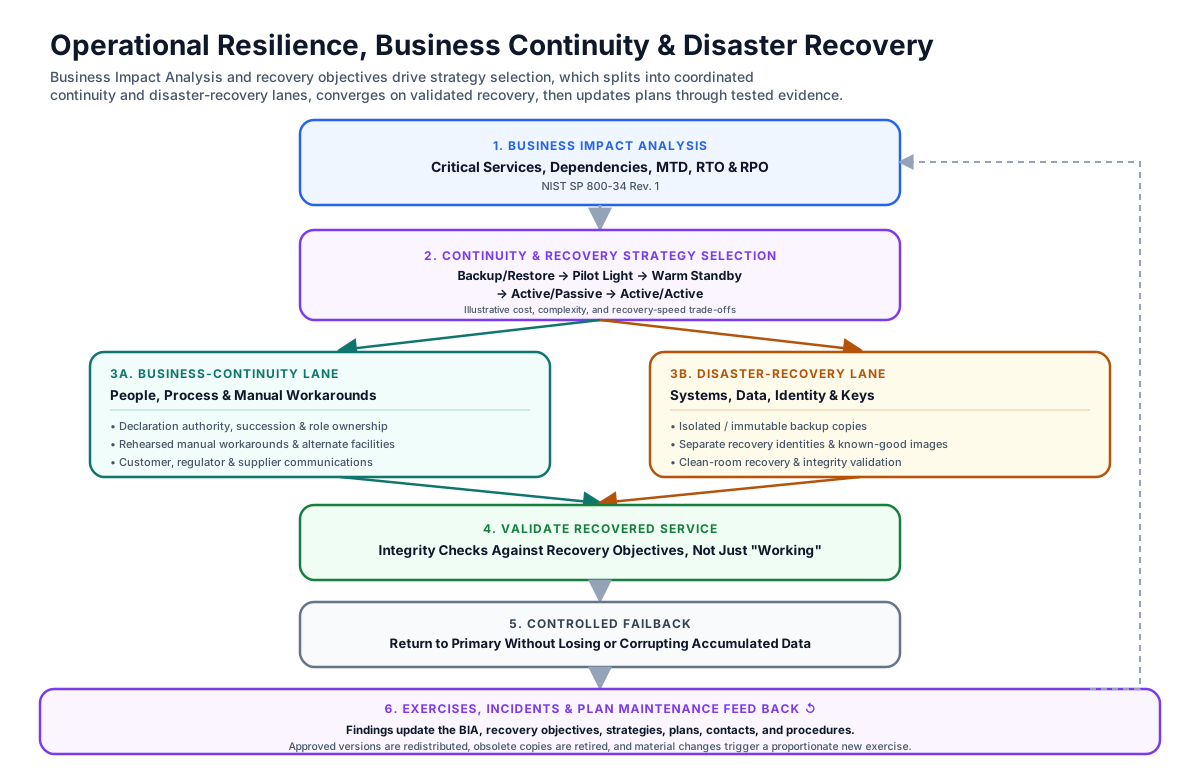
Journal working model: Business Impact Analysis & recovery objectives → continuity/recovery strategy selection → parallel business-continuity and disaster-recovery lanes → validated recovery → controlled failback → exercise and incident findings update the BIA, strategies, plans, contacts, and procedures.
Operational Resilience, Business Continuity, Disaster Recovery, and Incident Response
These four terms describe related but distinct responsibilities, and conflating them leaves gaps that nobody notices until an actual disruption:
- Operational resilience is the outcome: the organization’s ability to continue delivering its critical services through disruption, adapting and recovering within limits it has explicitly accepted in advance. It is a property of the whole system—people, process, technology, facilities, and suppliers—not a single plan or control.
- Business continuity is the discipline of keeping essential business services running during a disruption, primarily through people, process, manual workarounds, alternate facilities, and supplier substitution. A business continuity plan (BCP) can keep a claims-processing team operating from a different office with paper forms while the primary system is down.
- Disaster recovery (DR) is the discipline of restoring the technology and data that business continuity depends on—systems, infrastructure, applications, and information—to a defined recovery point and within a defined recovery time.
- Incident response, covered in Monitoring, Incident Response & Operational Learning, manages the security incident itself: detecting it, containing it, eradicating its cause, and learning from it. Continuity and DR run in parallel with incident response when the incident causes an operational disruption. Incident response provides containment, eradication, and compromise-state evidence; the designated incident and recovery authority authorizes restore and reconnection; DR performs the restoration; and continuity keeps the business running while that happens.
A ransomware event illustrates the boundary: incident response isolates infected hosts and provides evidence about the blast radius and compromise state; the designated authority decides when restoration and reconnection may proceed; disaster recovery restores systems and data from a point known to predate the compromise; and business continuity keeps critical business functions running—manually if necessary—for however long that recovery takes. Treating these as one undifferentiated “recovery” effort tends to lose track of who owns which decision.
The standards have a related boundary. ISO 22301:2019 with Amendment 1:2024 specifies requirements for a business continuity management system (BCMS) across organizational capabilities. ISO/IEC 27031:2025 focuses more narrowly on information and communication technology readiness for business continuity. ISO/IEC 27031 can inform the technology-recovery capability inside a broader ISO 22301-aligned continuity program; it does not replace the business-wide BCMS.
Business Impact Analysis
A Business Impact Analysis (BIA) is the exercise that turns “this system matters” into specific, defensible recovery objectives. NIST SP 800-34 Rev. 1 describes the BIA as the step that identifies and prioritizes system components by correlating them to the mission or business processes they support, then characterizes the impact of their unavailability on those processes.
A BIA needs to establish:
- Critical services and minimum acceptable service levels: which business processes must continue, and at what reduced capacity or quality is still acceptable, rather than treating every process as equally critical.
- Dependencies across categories that are easy to omit: people with specific skills or authority, physical facilities, identity and access systems, cloud provider services, network connectivity, the data itself, third-party suppliers, and the communication channels needed to coordinate a response. A recovery plan that restores an application but not the identity provider it depends on, or the single person who knows how to run a manual workaround, has not actually restored the service.
- Maximum Tolerable Downtime (MTD): the total time the process owner can accept an outage before the impact becomes unacceptable—NIST SP 800-34 frames this as the outer constraint that Recovery Time Objective must fit inside, with margin for the recovery itself to run into complications.
- Recovery Time Objective (RTO): the maximum acceptable time a resource can remain unavailable before it produces unacceptable impact on the processes and the MTD it supports.
- Recovery Point Objective (RPO): the point in time to which data must be recoverable after a disruption, given the most recent usable backup—directly setting how much data loss is acceptable and how frequently backups or replication must run.
- Recovery sequencing: the order in which dependent systems must come back online, since restoring an application before the database or identity provider it depends on wastes the recovery window.
RTO and RPO are targets set during planning, not evidence that a system can actually meet them. Only a tested restore—covered under Exercises below—demonstrates whether the real recovery time and actual data loss fall inside those targets.
Recovery Strategies
The following are illustrative cloud-region deployment patterns, informed by AWS’s backup/restore, pilot-light, warm-standby, and multi-site active/active model plus a full-capacity active/passive variant. The ordering expresses the intended cost and recovery-time trade-off in that model, not guaranteed RTOs: actual recovery time and data loss depend on implementation, data volume, dependencies, automation, available capacity, failure mode, and exercise results.
| Strategy | Mechanism | Relative Recovery Potential (Illustrative) | Trade-off |
|---|---|---|---|
| Backup / Restore | Data and configuration are backed up on a schedule; recovery means provisioning infrastructure and restoring from backup. | Usually the highest RTO because infrastructure and data must be recreated or restored. | Lowest steady-state cost; largest gap between last backup and the outage (RPO is only as good as backup frequency). |
| Pilot Light | A minimal version of core infrastructure runs continuously (e.g., a replicated database with compute scaled to zero); recovery scales up the surrounding stack around that core. | Potentially lower RTO because core data services are already present, but missing capacity and components still require deployment. | Lower cost than a full standby environment; still requires scaling and validating the rest of the stack during the outage. |
| Warm Standby | A scaled-down but fully functional replica runs continuously in a separate environment; recovery scales it up to full capacity. | Potentially lower RTO than pilot light because a functional environment is already running, although it still needs scaling and validation. | Higher steady-state cost than pilot light; still a capacity-scaling step before full load. |
| Active/Passive | A full-capacity standby environment runs idle (or accepting no traffic) and is promoted to primary on failover. | Potentially low RTO when the full-capacity standby, routing, and promotion procedures work as tested. | Highest steady-state cost of the single-standby patterns; the passive side is paid for but normally idle. |
| Active/Active | Two or more environments serve production traffic simultaneously; failure of one is absorbed by the others. | Potentially the lowest interruption for failures covered by the design, but shared dependencies, data consistency, and regional evacuation can still delay recovery. | Highest cost and operational complexity; requires solving data consistency and conflict resolution across simultaneously active sites. |
A common-mode failure defeats all of these if the standby shares the same failure trigger as the primary—the same compromised credentials, the same poisoned deployment pipeline, or the same replicated corruption. This is why replication, on its own, is not a recovery strategy for every failure mode: synchronous or near-real-time replication can rapidly propagate deletions, corruption, or ransomware-encrypted writes when the primary accepts those changes. Replication semantics, lag, snapshots or versioning, anomaly controls, and access separation determine what propagates and whether rollback remains possible. Replication therefore protects against some infrastructure failures but, by itself, does not provide a historical recovery point for logical or malicious changes—that gap is what recoverable, point-in-time backups kept separate from the replication path are for.
Cyber-Recovery Safeguards
Recovering from an infrastructure failure and recovering from a targeted compromise (ransomware, an insider with administrative access, a supply-chain compromise of the deployment pipeline) are different problems. Cyber-recovery safeguards specifically assume the adversary had time to look for—and try to destroy—the organization’s recovery capability itself, which is a realistic pattern in modern ransomware operations that explicitly target backup infrastructure before triggering encryption:
- Isolated or immutable backup copies: at least one backup copy that a compromised production credential cannot reach or delete—an air-gapped copy, a separate administrative domain, or object storage with write-once-read-many (WORM) immutability enforced for a defined retention period.
- Separate administrative identities and recovery credentials: recovery infrastructure should not be reachable using the same credentials, identity provider, or privileged-access path as production, so that a compromise of production administrative access does not automatically compromise the recovery path too.
- Known-good infrastructure, configuration, images, and keys: recovery needs a verified-clean source for compute images, infrastructure-as-code, and cryptographic key material—restoring application data onto a still-compromised image, configuration, or deployment pipeline reintroduces the same compromise, a caveat already noted for automated recovery controls generally in Security Controls & Defense in Depth.
- Clean-room recovery and integrity validation before reconnecting production: restoring into an isolated environment first, scanning and validating the restored state, and only then reconnecting to production networks and identity systems—reconnecting an unvalidated restore directly to production risks reintroducing the same compromise or re-encrypting the same data a second time.
Plan Activation and Communications
A plan that only specifies technical steps and omits who is authorized to invoke it tends to stall exactly when speed matters most:
- Declaration authority: who is authorized to formally declare a business continuity or disaster recovery event and activate the plan—this is a named role, not “whoever notices first.”
- Incident, continuity, and DR ownership: which role owns which decision, matching the incident-response role separation already covered in Monitoring, Incident Response & Operational Learning—continuity and DR ownership should be named separately from the incident commander role, even when one person holds multiple roles in a small team.
- Succession: a named backup for each critical decision-making role, since a single point of failure in the response organization itself defeats the plan.
- Manual workarounds: documented, rehearsed procedures for keeping the business process running without the affected system, not just an assumption that staff will improvise correctly under pressure.
- Customer, regulator, and supplier communications: pre-approved templates and named owners for external communication, coordinated with the notification and escalation criteria already covered in Monitoring, Incident Response & Operational Learning when the disruption is also a security incident.
- Decision records: a timestamped record of what was declared, by whom, and what recovery or continuity actions were authorized—needed for the same reasons an incident response scribe function is needed.
Exercises and Evidence
A continuity or disaster recovery plan that has never been exercised is a hypothesis, not a capability. Exercises should increase in scope and disruption over time, and each should produce measured evidence against the stated objectives, not just a completion checkbox:
| Exercise Type | What It Validates | Typical Cadence |
|---|---|---|
| Tabletop | Walks the response team through a scenario verbally—decision authority, escalation paths, and plan completeness—without touching production systems. | Frequent; low cost, low disruption. |
| Component Restore | Actually restores a single backup or component to verify the backup is usable and the restore procedure works as documented. | Regular; validates RPO only when the recovered data timestamp and measured data loss are compared with the target. |
| Regional Failover | Fails over a service to its standby region or environment under controlled conditions. | Periodic; validates RTO assumptions and the failover procedure itself. |
| Full Failover | Fails over an entire critical service end-to-end, including dependencies, under conditions closer to a real event. | Less frequent given cost and risk; highest-fidelity validation. |
| Failback | Returns operation to the original primary environment after a failover, validating that failback doesn’t lose or corrupt data accumulated on the standby. | Often the most neglected exercise—failover is rehearsed far more often than the return trip. |
| Supplier-Loss Exercise | Tests the plan’s manual workarounds for the loss of a specific critical third-party dependency. | Periodic, scoped to the organization’s most critical suppliers. |
Every exercise should record what was actually measured against the stated objective—the achieved recovery time against the RTO, the actual data loss against the RPO, and what failed—and every gap it surfaces needs a tracked corrective action with an owner and a closure date, the same discipline already established for postmortem action items in Monitoring, Incident Response & Operational Learning. An exercise that reveals a gap and is never followed up leaves the same untested assumption in place for the next real event.
Plan Maintenance & Change Control
A successful exercise does not keep a plan current indefinitely. NIST SP 800-34 Rev. 1 treats plan maintenance as an ongoing lifecycle activity, and NIST SP 800-53 Rev. 5 CP-2 requires contingency plans to be reviewed and updated at organization-defined frequencies and when relevant changes or testing problems occur. The organization should define both a calendar cadence and event-driven triggers rather than relying on either one alone.
Required maintenance triggers include material changes to business processes, architecture, data, identity or key dependencies, facilities, recovery regions, suppliers, staffing or succession, notification obligations, and the threat or failure assumptions used by the plan. Incidents, exercises, failed restores, missed RTO/RPO targets, and corrective-action findings also trigger review. Each update should:
- name the plan owner, version, approver, effective date, and next scheduled review;
- trace the change to the BIA, dependency inventory, recovery objectives, strategy, procedures, contacts, or exercise schedule it affects;
- distribute the approved version to every role and location that needs it, including offline or independently accessible recovery copies;
- retire or clearly mark obsolete copies so responders do not execute conflicting procedures; and
- determine whether the change is material enough to require a new tabletop, component restore, failover, failback, or supplier-loss exercise.
A closed corrective-action ticket is not sufficient evidence when the approved plan, runbook, contact list, or recovery automation still contains the old assumption. Closure requires confirming that the affected artifacts changed and, where the risk warrants it, that the revised procedure was exercised.
Essential Resilience & BCDR Diagnostic Checklist
When auditing an organization’s operational resilience posture or a specific system’s recovery plan, evaluate these 8 diagnostic questions:
| Diagnostic Focus Area | Key Evaluation Question | Target Verification & Audit Evidence |
|---|---|---|
| Dependency Completeness | Does the BIA capture people, facilities, identity, cloud, network, data, supplier, and communication dependencies—not just the application itself? | BIA documentation naming each dependency category and its owner. |
| Recovery-Objective Ownership | Are RTO and RPO explicitly set and owned by the business process owner, not defaulted to whatever the current architecture happens to deliver? | Signed-off BIA with RTO/RPO per critical process. |
| Backup Isolation & Restore Validation | Is at least one backup copy isolated from production administrative access, and has a restore from it actually been tested recently? | Immutable/air-gapped backup configuration; dated component-restore exercise results. |
| Identity & Key Recovery | Can the organization recover identity systems and cryptographic key material using credentials and infrastructure independent of production, or does recovery depend on the same access path that might be compromised? | Documented separate recovery-admin identity path; key recovery procedure and test record. |
| Failover & Failback Testing | Has failover been tested under realistic conditions, and—separately—has failback been tested to confirm it doesn’t lose or corrupt data? | Dated regional/full failover exercise results; a distinct dated failback exercise result. |
| Communications & Third-Party Continuity | Are customer/regulator/supplier communication owners and templates pre-defined, and has the plan been tested against the loss of a critical supplier? | Communication plan with named owners; supplier-loss exercise record. |
| Corrective-Action Closure | Do gaps found during exercises get tracked to a named owner and closure date, the same as incident postmortem actions? | Corrective-action tracker cross-referenced to exercise reports. |
| Plan Currency & Distribution | Is the plan reviewed on a defined cadence and after material business, system, dependency, staffing, supplier, incident, or exercise changes; are approved versions distributed and obsolete copies retired? | Version history, change-trigger log, approval record, distribution acknowledgement, obsolete-copy register & post-change exercise evidence. |
Operational resilience begins with the critical outcome and its maximum tolerable disruption, not with a preferred backup product or failover pattern. A continuity or disaster-recovery plan remains credible only when it is exercised, updated after relevant change, distributed to responders, and protected from obsolete conflicting copies.
Primary references
- NIST SP 800-34 Rev. 1 — verified the BIA process and the MTD, RTO, RPO, recovery-strategy, testing, and plan-maintenance concepts.
- NIST SP 800-53 Rev. 5 — verified the Contingency Planning control family and associated recovery-control scope.
- NIST Cybersecurity Framework 2.0 — verified Recover outcomes covering recovery execution, communications, integrity checks, and improvement.
- ISO 22301:2019 with Amendment 1:2024 — verified the current published BCMS standard and its applicable amendment.
- ISO/IEC 27031:2025 — verified the ICT-readiness scope and its boundary relative to the broader BCMS.
- AWS Well-Architected disaster-recovery strategies — verified the cloud-specific backup/restore, pilot-light, warm-standby, and multi-site active/active comparison.