AI & LLM Security / Risk & Governance
AI & LLM Threat Frameworks & Risk Management
Artificial Intelligence (AI) and Large Language Model (LLM) systems shift where the security boundary sits. A conventional application separates instructions from data structurally, at a parser. An LLM does not: system instructions, user input, retrieved documents, and tool output arrive as one token stream, and the model infers its next action probabilistically from all of it. Three frameworks are commonly stacked over that problem — NIST AI RMF 1.0 for governance structure, the OWASP Top 10 for LLM Applications for ranked application risk, and MITRE ATLAS for observed adversary behavior. They answer different questions, and none substitutes for another.
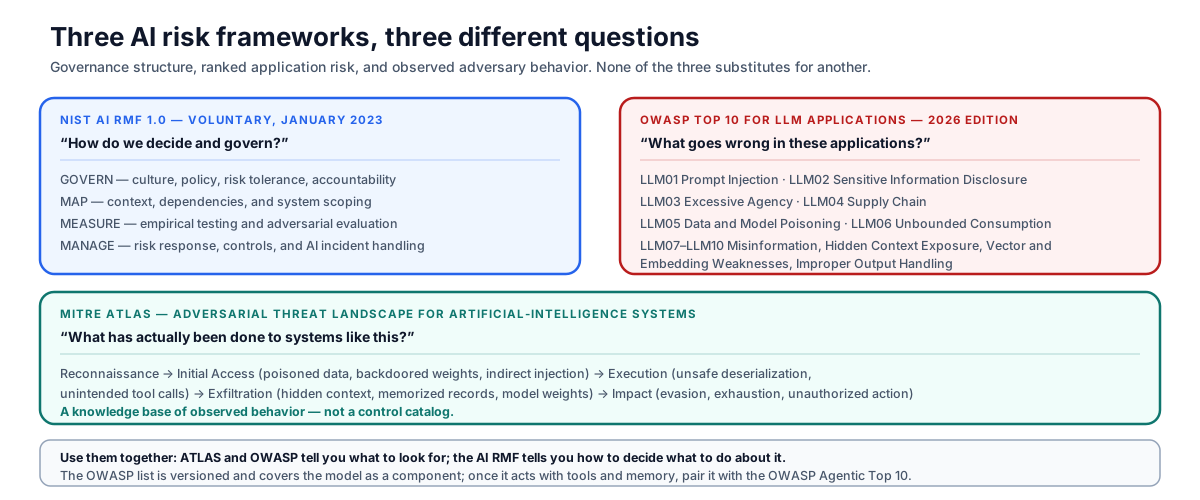
Three frameworks, three questions: how to govern (NIST AI RMF 1.0), what goes wrong (OWASP Top 10 for LLM Applications), and what has been done (MITRE ATLAS)
Where the AI risk surface differs from conventional software
| Security dimension | Conventional software | AI & LLM systems |
|---|---|---|
| Execution model | Deterministic compiled logic (f(x) -> y). |
Token-by-token inference (P(next token | preceding tokens)), sampled from a distribution. |
| Instruction/data boundary | Enforced structurally by a parser (for example, a prepared SQL statement). | No structural boundary: system prompt, retrieved data, and user text share one context window. |
| Vulnerability class | Code injection, memory corruption, broken access control. | Prompt injection, model and data poisoning, excessive agency, over-reliance on fabricated output. |
| Attacker goal | Remote code execution, database exfiltration. | Guardrail bypass, hidden-context disclosure, agent hijacking, exfiltration through the retrieval path. |
The row that matters most is the second. Nondeterministic sampling is a configuration choice — set temperature to zero and output becomes largely reproducible — but the missing instruction/data boundary does not go away at any temperature. Treat it as the root cause and the rest of this section follows from it.
NIST AI Risk Management Framework (AI RMF 1.0)
The AI RMF 1.0 was published by NIST in January 2023 as voluntary guidance. It does not certify systems or mandate controls; it structures how an organization reaches and records risk decisions across the AI lifecycle, through four core functions.
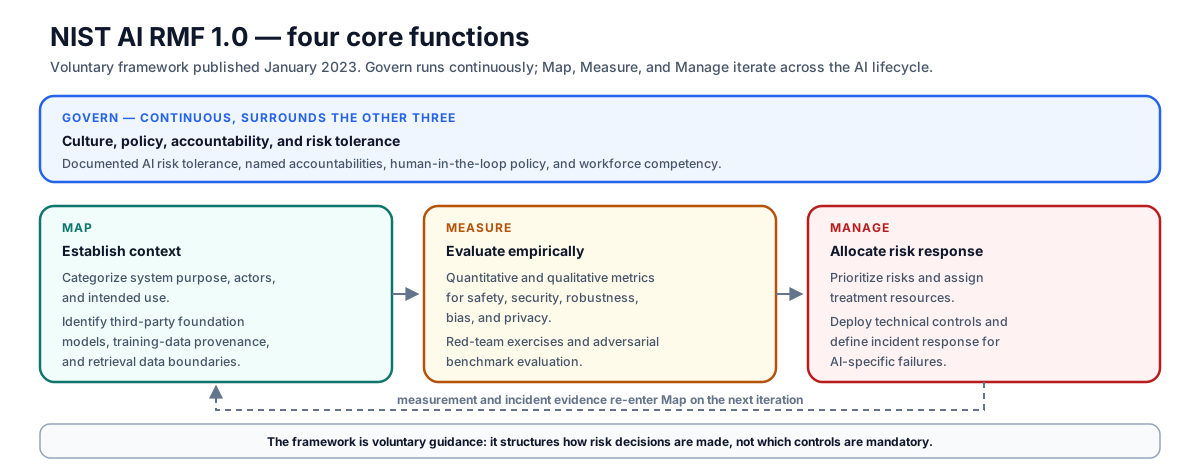
NIST AI RMF 1.0: Govern runs continuously around Map, Measure, and Manage, which iterate across the lifecycle
- Govern — establishes risk culture, policy, documented risk tolerance, named accountabilities, and human-in-the-loop expectations. It is continuous rather than a stage.
- Map — categorizes system context, capability, dependencies, and impact. This is where third-party foundation models, training-data provenance, and retrieval data boundaries get identified.
- Measure — evaluates safety, security, robustness, bias, and privacy with quantitative and qualitative metrics, including red-team exercises and adversarial benchmark evaluation.
- Manage — prioritizes risks and allocates response, deploys technical controls, and defines incident response for AI-specific failures.
Because the framework is voluntary, “aligned to the AI RMF” describes a process, not a compliance state. Nothing in it makes a control mandatory.
A working rule for model retirement
This subsection is a journal working model, not a NIST requirement. The AI RMF asks that decommissioning be governed; it does not supply these triggers.
Models accumulate in production far more readily than they are removed. A practical retirement trigger list:
- A training or fine-tuning dataset turns out to contain unacceptably biased, poisoned, or unlicensed data — for example, a data license is withdrawn or a source is subject to a takedown.
- Evaluation shows the deployed model has drifted outside its accepted safety and quality baselines.
- A replacement model passes the same safety benchmarks, making continued exposure of the older model unnecessary. Note that a smaller replacement is usually a cost and latency decision that trades some robustness away — it is a reason to retire the old model only once the replacement has actually cleared the same bar.
Retirement means revoking the model from inference endpoints and routing tables, not merely deprecating it in documentation. An endpoint that still answers is still in scope.
OWASP Top 10 for LLM Applications
The OWASP Top 10 for LLM Applications ranks the risks the community and the incident record together judge most critical for LLM-backed applications — which, as the next section shows, is not the same as most frequent. The entries below are the 2026 edition.
| ID | Name | Operational description |
|---|---|---|
| LLM01:2026 | Prompt Injection | Any input — user text, retrieved content, tool output, image, audio, video, intermediate reasoning, or persistent memory — alters model behavior in ways the developer did not intend. |
| LLM02:2026 | Sensitive Information Disclosure | Confidential, regulated, or proprietary data escapes through an unauthorized channel. Not only the final answer: tool-call arguments, reasoning traces, retrieved chunks, logs, embeddings, and timing all count. |
| LLM03:2026 | Excessive Agency | Tool access, permissions, or autonomy beyond what the task requires, so a malfunctioning model can take damaging action regardless of what caused the malfunction. |
| LLM04:2026 | Supply Chain | Compromised training data, models, adapters, conversion pipelines, or deployment platforms — including a promoted model artifact that is not what it claims to be. |
| LLM05:2026 | Data and Model Poisoning | Manipulation of data or model artifacts at any ingestion point — pre-training, fine-tuning, embedding creation, retrieval, or distribution — to embed harmful behavior or backdoors. |
| LLM06:2026 | Unbounded Consumption | Uncontrolled inference enabling denial of service, unsustainable cost, or model cloning. The defining property is cost asymmetry: cheap for the attacker, expensive for the operator. |
| LLM07:2026 | Misinformation | Incorrect or unsupported output credible enough to be acted on by a person, a workflow, or an agent. |
| LLM08:2026 | Hidden Context Exposure | Extraction or reconstruction of non-user-facing context — system prompts, policy text, tool schemas, workflow rules — that materially increases attacker capability. |
| LLM09:2026 | Vector and Embedding Weaknesses | Attacks on the geometry of the embedding space and similarity search itself, which succeed even when retrieved content carries no malicious instructions. |
| LLM10:2026 | Improper Output Handling | Model output passed downstream without validation, reaching browsers, databases, shells, or terminal sinks — including insecure generated code. |
How the 2026 ranking was built, and where its scope ends
Two things about this edition change how it should be read.
The ranking is no longer vote-only. Community voting carries three-quarters of the weight; the remaining quarter comes from an incident corpus of 7,714 real reports, of which 6,639 carried enough detail to classify. The two disagreed in useful places. Prompt injection falls out of the top ten on raw incident count alone yet holds first place, which the project attributes to a defense effect — teams already spend heavily holding it off, so fewer clean exploits reach public databases. Misinformation runs the other way: voters placed it near the bottom and the incident record near the top, and it lands in the middle.
This list stops where the model stops being a component. The project draws the boundary explicitly: these ten own the risk when a model is a component inside an application. Once it becomes an actor — calling tools, carrying memory between sessions, setting downstream consequences in motion — the risk moves to the OWASP Agentic Top 10 and its ASI identifiers. Neither list covers that ground alone, so an agentic system needs both. MCP & Agentic Security is where that boundary matters in practice.
Two habits worth keeping:
- Write the edition into the identifier.
LLM03:2026is precise; a bareLLM03silently changes meaning between editions. Only Prompt Injection and Sensitive Information Disclosure held their rank — the other eight all moved. - Re-check the mapping before quoting a rank. Excessive Agency was
LLM06:2025and isLLM03:2026; System Prompt Leakage wasLLM07:2025and is now, renamed and broadened,LLM08:2026 Hidden Context Exposure. The furthest single move was Improper Output Handling, down five places fromLLM05:2025toLLM10:2026.
MITRE ATLAS
MITRE ATLAS (Adversarial Threat Landscape for Artificial-Intelligence Systems) is a knowledge base of adversary tactics and techniques observed against AI and machine-learning systems, modeled after ATT&CK. It records what has been done, which is a different question from what should be controlled.
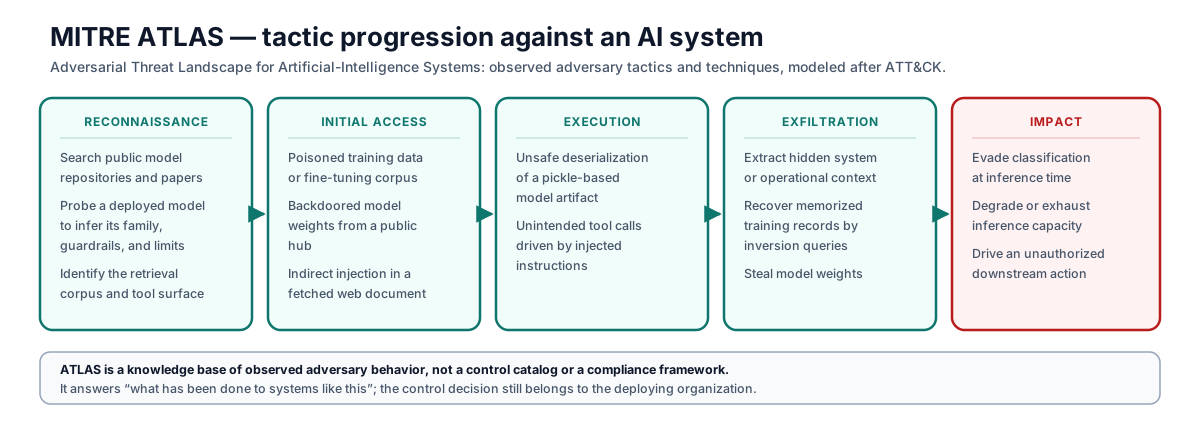
MITRE ATLAS tactics as an attack progression, with representative techniques at each stage
- Reconnaissance — searching public model repositories and papers, probing a deployed model to infer its family and guardrails, identifying the retrieval corpus and tool surface.
- Initial access — poisoned training data, backdoored weights pulled from a public hub, or indirect prompt injection planted in a document the system will fetch.
- Execution — unsafe deserialization of a model artifact, or unintended tool calls driven by injected instructions.
- Exfiltration — recovering hidden operational context, extracting memorized training records through inversion queries, or stealing model weights.
- Impact — evading classification, degrading inference availability, or driving an unauthorized downstream action.
ATLAS is not a control framework and carries no compliance weight. Use it to populate a threat model; use the AI RMF to decide what to do about what it surfaces.
What these frameworks do not cover
Stacking all three still leaves gaps that have to be closed elsewhere:
- No framework here supplies a mitigation that eliminates prompt injection. They classify and rank it; OWASP’s own 2026 entry states that no reliable prevention mechanism exists today. See Prompt Injection & Context Safety.
- None of them is a legal or regulatory obligation by itself. Jurisdictional AI regulation is separate, and adopting a voluntary framework does not discharge it.
- The OWASP list is a ranking, not a coverage guarantee. A risk that did not make the top ten is not thereby acceptable in a given system, and the list explicitly hands agentic risk to a separate Agentic Top 10.
- ATLAS lags novel technique classes, because it records what has been observed and reported.
- An incident-weighted ranking inherits reporting bias. A well-defended risk produces fewer public reports, which is precisely why prompt injection ranks first on the vote while falling out of the top ten on raw incident count.
Diagnostic checklist
When auditing an enterprise AI deployment, evaluate these six criteria:
| Diagnostic area | Evaluation question | Audit evidence |
|---|---|---|
| Governance | Is AI risk tolerance documented, with named accountabilities and a stated human-in-the-loop policy? | AI governance charter & system mapping records. |
| Prompt injection containment | Are untrusted inputs isolated architecturally, rather than only filtered, and is the residual risk written down? | Architecture records & red-team injection test logs. |
| Agent tool scoping | Are destructive operations gated on explicit human approval of the resolved arguments? | Tool permission manifests & approval audit logs. |
| Retrieval authorization | Do retrieval queries enforce the caller’s document access rights inside the query itself? | Vector store authorization config & multi-tenant isolation tests. |
| Model artifact safety | Are weights stored as safetensors or scanned before load, with torch.load restricted where legacy files remain? |
CI scan reports & loader configuration. |
| Adversarial evaluation | Are applications exercised against ATLAS techniques on a recurring schedule, not once at launch? | Red-team benchmark reports with dates. |
The root AI risk is the missing instruction/data boundary, not nondeterminism. NIST AI RMF 1.0 is voluntary governance structure, the OWASP Top 10 for LLM Applications is a versioned ranking — always cite the edition, because only two of ten held their rank in 2026 — and MITRE ATLAS records observed adversary behavior rather than prescribing controls. The OWASP list covers the model as a component; once it becomes an actor with tools and memory, pair it with the Agentic Top 10.
Primary references
- NIST AI Risk Management Framework (AI RMF 1.0) — verified the four core functions, the January 2023 publication, and the framework’s voluntary status.
- OWASP Top 10 for LLM Applications 2026 — version 2026, CC BY-SA 4.0. Verified all ten identifiers, names, and descriptions from the document itself, along with the 75/25 vote-to-incident weighting, the 7,714-report corpus with 6,639 classified, and the boundary handing agentic risk to the Agentic Top 10.
- OWASP Agentic Security Initiative — the project home for the
ASIagentic identifiers referenced by the LLM Top 10. - MITRE ATLAS — verified the tactic names and the knowledge-base framing.