Security / Overview
What Is Security?
Security is the continuous engineering discipline of protecting people, information, services, and valuable assets from unacceptable harm. It is neither a single product nor a static state of zero risk; rather, it is the systematic process of identifying threat scenarios, assessing risk, executing strategic responses via security controls, and governing residual risk.
Defining Security Domains: Security vs InfoSec vs Cybersecurity
While the term “Security” is used casually as a general heading, technical engineering standards provide useful distinctions between these domains, each defined within its own standard’s specific scope rather than as one universally enforced boundary:
| Security Domain | Representative Standard / Law | Primary Scope & Focus |
|---|---|---|
| Security (Generic) | No single standard defines generic “Security” universally; CNSSI 4009 and NIST SP 800-37 (an RMF-specific publication) each use working definitions within their own scope, used here as a practical starting point. | The general condition resulting from protective measures ensuring freedom from hostile harm across physical, operational, human, and digital assets. |
| Information Security (InfoSec) | FISMA (44 U.S.C. § 3552) / ISO/IEC 27001 | Protecting information and information systems from unauthorized access, use, disclosure, disruption, modification, or destruction to preserve Confidentiality, Integrity, and Availability (CIA). |
| Cybersecurity | NIST CSF 2.0 / ISO/IEC TS 27100:2020 | Protecting digital infrastructure, software applications, cloud services, and network data streams connected to cyberspace against cyber threats. ISO/IEC 27032:2023 is narrower guidance for Internet security rather than the broad definition used here. |
| System Security Engineering | NIST SP 800-160 Vol. 1 Rev. 1 | The engineering discipline of building trustworthy secure systems across the full system lifecycle—requirements, architecture, hardware, software, and cryptographic design—so they function predictably under hostile conditions. |
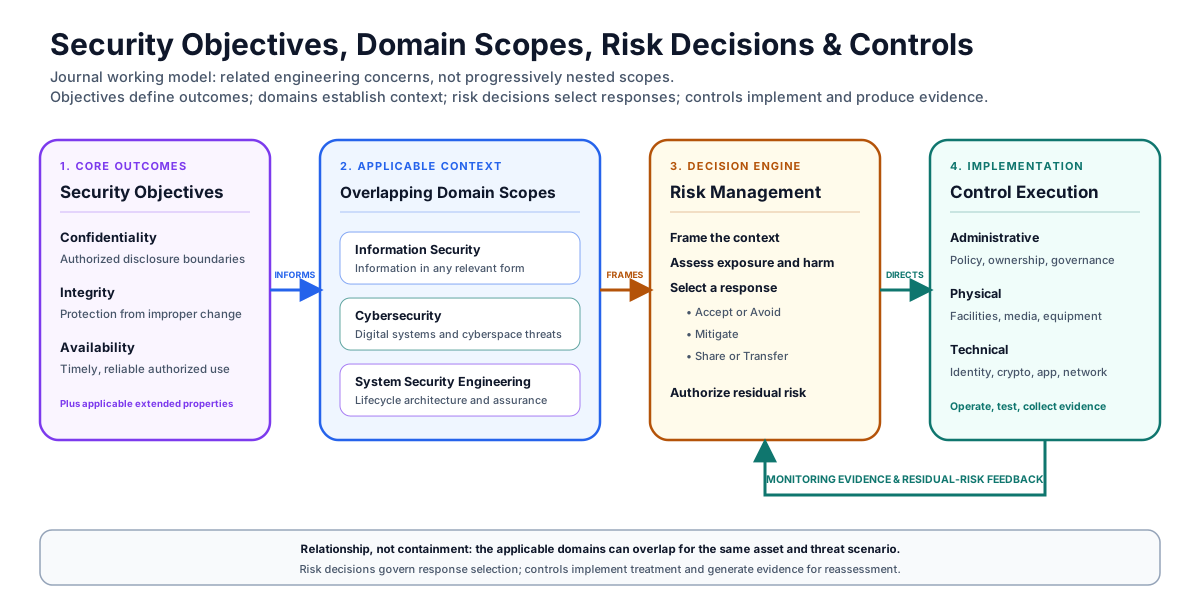
Conceptual relationship model (journal working model, not a normative standard diagram): Core Security Objectives → Overlapping Domain Scopes → Risk Decisions → Administrative, Physical, and Technical Control Execution → Monitoring Evidence and Residual-Risk Feedback. The arrows show an engineering relationship, not containment.
Core Security Objectives: The CIA Triad & System Properties
Evaluating harm to an asset requires testing it against fundamental security properties defined in NIST FIPS 199:
1. The CIA Triad
- Confidentiality: Preserves authorized restrictions on information access and disclosure, preventing unauthorized observation (e.g., encrypting PII at rest via AES-256-GCM).
- Integrity: Guards against improper information modification or destruction, ensuring non-repudiation and authenticity (e.g., cryptographic signatures on API payloads and database records).
- Availability: Ensures timely and reliable access to and use of information and services (e.g., redundant load balancers, rate limiting, and auto-scaling failover clusters).
2. Beyond the CIA Triad
Comprehensive security engineering expands beyond the CIA triad to address additional critical properties across systems:
- Authenticity: Verifying that a user, process, system, or payload is genuine (NIST SP 800-63-4).
- Accountability: Producing evidence—via audit logging (NIST SP 800-92)—that supports tracing system actions to an authenticated identity; the strength of that attribution still depends on identity binding, log integrity, access controls to the logs, time synchronization, and investigative context, not the logging mechanism alone.
- Privacy: Ensuring data processing respects individual rights and regulatory boundaries (NIST Privacy Framework).
- Safety: Ensuring system operational failures do not cause physical injury, environmental damage, or loss of life (ISO 26262 / NIST SP 800-160).
- Resilience: The capacity of a system to withstand, adapt to, and recover from adverse conditions or attacks (NIST SP 800-160 Vol. 2 Rev. 1).
A Common Decision Engine: Continuous Risk Management
Whether protecting a physical paper archive (Information Security) or a cloud-native microservice (Cybersecurity), security protection is never arbitrary. Both domains aim to preserve the core CIA Triad, and both commonly rely on Risk Management (NIST SP 800-39 / ISO/IEC 27005) to connect objectives, threats, and controls—though the specific process each domain follows can differ in detail.
The five-stage breakdown below is a practical synthesis for this journal, informed by NIST SP 800-39 and SP 800-37 rather than a direct restatement of either publication’s formal process steps. It connects abstract security objectives to concrete technical controls across five continuous operational stages:
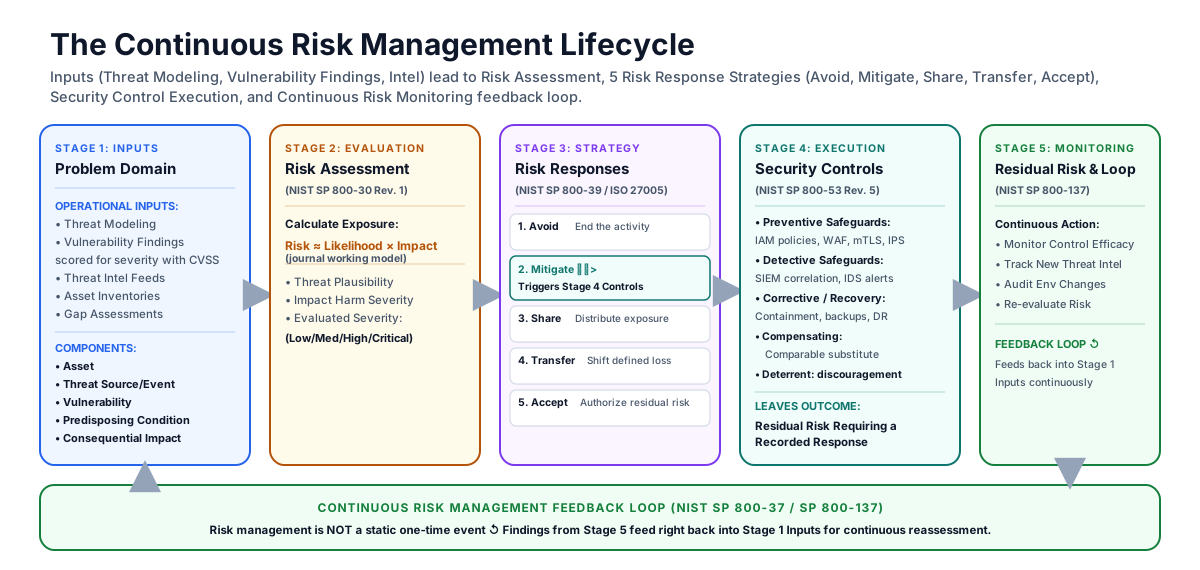
A practical risk-management workflow informed by NIST SP 800-39 / SP 800-37, not a literal reproduction of either lifecycle: Inputs → Assessment → Strategic Response Selection (Avoid, Mitigate, Share, Transfer, or Accept) → Controls Execution → Continuous Monitoring Feedback Loop
Operational Lifecycle Breakdown
| Lifecycle Stage | Primary Operational Actions & Mechanics | System Scenario Example |
|---|---|---|
| Stage 1: Inputs (Problem Domain) |
Gathers inputs from Threat Modeling, vulnerability scan findings scored with CVSS, Threat Intel, Asset Inventories, and Gap Audits to construct scenario components (Asset, Threat, Vulnerability, Impact)—CVSS itself scores a vulnerability’s severity, it does not perform the scan that discovers it. | Unauthenticated public API route exposing customer database queries without rate limiting. |
| Stage 2: Evaluation (Risk Assessment) |
Calculates exposure severity per NIST SP 800-30 Rev. 1 by rating threat plausibility and harm consequence—commonly approximated as a simplified working model, Risk ≈ Likelihood × Impact, though SP 800-30 itself does not mandate multiplication. |
Rating data exfiltration likelihood as High and financial harm as Critical. |
| Stage 3: Strategy (Response Selection) |
Selects a response type; NIST SP 800-39 names five: Accept, Avoid (redesign feature), Mitigate (deploy controls), Share, and Transfer (insurance/SLAs)—share and transfer are distinct but often grouped together informally. | Selecting Mitigate to deploy technical security controls. |
| Stage 4: Execution (Control Mechanics) |
Implements safeguards drawn from the NIST SP 800-53 Rev. 5 control catalog, which is organized into 20 control families. For defense-in-depth analysis, this journal additionally applies overlapping labels: Preventive, Detective, Corrective / Recovery, Compensating, and Deterrent. The first group describes operational role or timing, Compensating describes an approved substitute that provides equivalent or comparable protection when a required or recommended control cannot be used, and Deterrent describes intended behavioral effect; these are not five mutually exclusive stages or one official NIST taxonomy. Full breakdown in Security Controls & Defense in Depth. | Deploying OIDC/OAuth token verification, Web Application Firewall (WAF), and mTLS. |
| Stage 5: Loop (Continuous Audit) |
Continuously monitors control efficacy (NIST SP 800-137), tracks new threats, and feeds metrics back into Stage 1 Inputs for re-assessment. | Automated SIEM alerting on brute-force spikes and feeding log metrics into annual audits. |
A vulnerability alone does not constitute a risk. Risk assessment requires determining whether a plausible threat can reach the vulnerability, the magnitude of the resulting impact, and how existing controls alter overall probability. Risk management is never a static, one-time activity—it operates as a continuous feedback loop (NIST SP 800-37).
Essential System Security Diagnostic Checklist
When evaluating the security posture of any new feature or system architecture, audit these 6 diagnostic questions:
| Diagnostic Focus Area | Key Architectural Evaluation Question | Target Verification & Audit Evidence |
|---|---|---|
| Asset Categorization | What sensitive data, critical services, or business operations require protection? | Data classification inventories, CMDB registers & asset catalogues. |
| Control Verification | Which preventive, detective, and corrective/recovery controls execute the reduction strategy; where a required or recommended control is replaced, does the approved compensating control provide equivalent or comparable protection; and where deterrence is claimed, what behavior is expected to change? | Security controls baseline mapping (NIST SP 800-53 Rev. 5), compensating-control assessment records & continuous monitoring logs. |
| Domain Boundary Identification | Which information-security, cybersecurity, physical-security, and system-engineering scopes overlap for this asset and threat scenario? | Scope boundary documents & system security plan (SSP) architecture bounds. |
| Exposure Assessment | What is the risk severity based on threat likelihood and consequential impact? | Risk assessment reports (NIST SP 800-30 Rev. 1). |
| Objective Testing | Which CIA triad properties, safety, or privacy limits would be breached if compromised? | FIPS 199 impact categorization & privacy impact assessments (PIA). |
| Strategic Response Selection | Which response strategy—Accept, Avoid, Mitigate, Share, or Transfer—is authorized by the risk owner? | Risk treatment decision record signed off by the policy-defined acceptance authority (NIST SP 800-39). |
Security architecture begins by identifying assets, required security properties, plausible threat scenarios, and unacceptable harm before selecting controls. Controls should be risk-driven, independently verified, and layered so that one failure does not automatically become systemic compromise.
Primary references
- NIST SP 800-53 Rev. 5: Security and Privacy Controls for Information Systems and Organizations — NIST CSRC SP 800-53
- ISO/IEC 27001:2022: Information security, cybersecurity and privacy protection — Information security management systems — ISO 27001 Overview
- NIST SP 800-39: Managing Information Security Risk — NIST CSRC SP 800-39
- NIST SP 800-30 Rev. 1: Guide for Conducting Risk Assessments — NIST CSRC SP 800-30
- NIST FIPS 199: Standards for Security Categorization of Federal Information and Information Systems — NIST CSRC FIPS 199
- NIST Cybersecurity Framework 2.0 — NIST CSF 2.0
- NIST SP 800-37 Rev. 2: Risk Management Framework for Information Systems and Organizations — NIST CSRC SP 800-37
- ISO 26262:2018: Road vehicles — Functional safety — ISO 26262
- ISO/IEC TS 27100:2020: Information technology — Cybersecurity — Overview and concepts — ISO/IEC TS 27100
- NIST SP 800-160 Vol. 2 Rev. 1: Developing Cyber-Resilient Systems — NIST CSRC SP 800-160 Vol. 2