Cryptography / Concepts
Digital Signatures & Non-Repudiation
Digital signatures provide cryptographic evidence that a signature validates for specific payload bytes under a particular public key. This supports payload integrity and origin authentication only when the public key is authentically bound to the expected signer and the signing key remains uncompromised; verification alone does not prove real-world identity, exclusive key custody, human intent, or legal non-repudiation. A verifier holding the public key can check the signature independently.
The Digital Signature Pipeline
RSA-PSS and ECDSA operate over a fixed-size digest rather than the raw payload: their signing operation is a bounded modular/algebraic transform, and feeding in variable-length or attacker-chosen data directly (without a hash-and-pad step) invites malleability and existential-forgery attacks, not just a performance hit. That hashing step is part of the algorithm’s own definition, not necessarily something the caller must do externally first — RFC 8017’s RSASSA-PSS-Sign interface, for example, takes the full message M and performs the EMSA-PSS encoding, including hashing, internally. Some lower-level or hardware APIs (HSM/PKCS#11 “sign this digest” primitives) do expose a precomputed-digest interface instead; whichever convention a given library uses, hashing the message yourself and then feeding the result into an API that also hashes internally causes accidental double hashing, a real and recurring implementation bug, not just a performance concern. Ed25519 and Ed448 (pure EdDSA per RFC 8032) take the raw message and hash it internally as part of the algorithm itself (Ed25519 using SHA-512; Ed448 using SHAKE256) — with separate prehash variants (Ed25519ph / Ed448ph) for cases that need to hash large messages before signing. The pipeline below is a conceptual simplification of the RSA-PSS/ECDSA case; signatures generally execute across a three-stage pipeline:
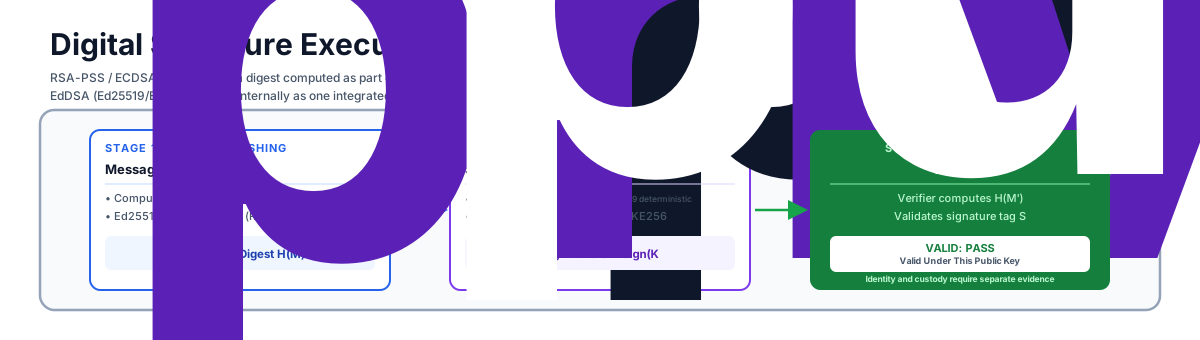
Digital signature pipeline: payload hashing, private key signature computation, and public key verification
- Hashing Phase: Compute a cryptographic hash digest H(M) over message M using SHA-256 or SHA3-256.
- Signing Phase: Compute signature tag S over digest H(M) using private key Kpriv.
- Verification Phase: The verifier computes H(M’) over received message M’ and verifies S against public key Kpub. A successful result establishes that the signature validates for M’ under that public key; signer identity and key custody require separate evidence.
Signature Scheme Comparison Matrix
| Algorithm | Mathematical Foundation | Per-Signature Nonce Safety | Target Engineering Guidance |
|---|---|---|---|
| ECDSA (FIPS 186-5) | Elliptic Curve Discrete Logarithms | HIGH RISK: Random k reuse leaks private key d. | Use RFC 6979 deterministic nonces or migrate to Ed25519 / ML-DSA. |
| Ed25519 (RFC 8032 §5.1) | Edwards-curve Digital Signatures | NO PER-SIGNATURE RNG DEPENDENCY: Nonce derived deterministically via SHA-512(private key half || message), eliminating the ECDSA-style catastrophic key leak from a reused or weak random k — this addresses that specific failure mode, not every signature-security concern (e.g., fault-injection attacks against deterministic schemes remain a separate consideration). | Widely used in modern APIs, SSH keys, and software signing; one of several algorithms WebAuthn Level 3 supports, not its universal default (ECDSA P-256 is also common in authenticators). |
| Ed448 (RFC 8032 §5.2) | Edwards-curve Digital Signatures | NO PER-SIGNATURE RNG DEPENDENCY: Nonce derived deterministically via SHAKE256(private key half || message), eliminating the ECDSA-style catastrophic key leak from a reused or weak random k. | Higher security-level alternative to Ed25519; less common support in SSH/WebAuthn tooling, useful for long-term high-assurance roots. |
| FIPS 204 ML-DSA (Dilithium) | Module Lattice Cryptography | POST-QUANTUM APPROVED: Primary NIST post-quantum digital signature standard. | Candidate replacement for RSA/ECDSA signatures in PKI and TLS, pending the specific protocol/profile’s support — TLS 1.3 PQC signature negotiation, CA tooling, and client compatibility are all still rolling out; check actual implementation support before depending on it in a given deployment. |
| FIPS 205 SLH-DSA (SPHINCS+) | Stateless Hash Trees | STATELESS HASH-BASED DESIGN: Hedged hash tree signatures independent of lattice assumptions, with no internal state to manage between signatures (unlike stateful hash-based schemes such as XMSS/LMS). | High-assurance post-quantum fallback for firmware signing and long-term roots. |
| RSA-PSS (RFC 8017) | Prime Factorization + Probabilistic Salt | Standard randomized salt | Recommended RSA signature padding scheme for new designs; PKCS#1 v1.5 is not banned outright by the relevant standards (it remains defined in RFC 8017 and widely deployed for compatibility), but new systems should default to RSA-PSS rather than PKCS#1 v1.5. |
The ECDSA Nonce Leakage Catastrophe & RFC 6979
Legacy ECDSA requires generating a cryptographically random 256-bit integer k for every signature. If k is reused across two signatures under the same private key, an adversary can recover private key d via simple modular arithmetic:
d = (s1 r2 - s2 r1)-1 (s2 h1 - s1 h2) mod n
Mitigation: Deterministic Nonces (RFC 6979 & Ed25519)
These are two distinct constructions, not one shared formula, though both eliminate per-signature RNG failure risk.
RFC 6979 §3.2 (ECDSA/DSA) derives k via an HMAC-based DRBG seeded from Kpriv and H(M) — not a single hash call. It iterates K = HMACK(V || 0x00 || int2octets(Kpriv) || bits2octets(H(M))) and V = HMACK(V) to initialize state, then repeatedly re-hashes V to generate output bits until a candidate k in range [1, n-1] is produced (retrying on out-of-range values).
RFC 8032 §5.1.6 (Ed25519) derives its nonce differently: r = SHA-512(prefix || M) mod L, where prefix is the second (upper) 32 bytes of SHA-512(private key seed) — the first 32 bytes become the clamped signing scalar — and M is the message (or, in the Ed25519ph prehash variant, SHA-512(M)). This is a single direct SHA-512 hash, not an HMAC-DRBG, so despite both mechanisms being called “deterministic nonce generation,” they are architecturally unrelated.
Signature Verification: A Verifier’s Checklist
“The signature is valid” is a narrower statement than it sounds — it means that a signature validates for a specific byte string under a specific public key and accepted algorithm. Everything else a verifier actually needs to trust the result is a separate check, and skipping any of them is a recurring source of real vulnerabilities:
- Key-to-identity binding: A signature that validates under a public key says nothing about whose key it is unless that key is bound to an identity through a trusted mechanism — a CA-issued certificate chain (see Certificates), a pinned key, or an out-of-band fingerprint check. Verifying the signature without verifying this binding is exactly the gap that lets an attacker substitute their own key.
- Accepted algorithms and parameters: Confirm the signature algorithm and its parameters (curve, hash function, key size) are ones your system actually intends to accept — a verifier that accepts any algorithm the signer claims to have used is vulnerable to algorithm-confusion attacks (e.g., an attacker relabeling an HMAC tag as an “RSA signature” against a verifier that naively trusts a client-supplied algorithm field).
- Canonical encoding / malleability: Some signature schemes (notably ECDSA) have a documented malleability property — a valid signature
(r, s)can be transformed into another valid signature(r, n-s)for the same message and key. Systems that use a signature’s bytes as a unique identifier (transaction IDs keyed by signature hash, replay-detection caches) need to normalize or reject the malleable form, or they’ll treat the same logical signature as two different ones. - Context / domain separation: Confirm the signature was produced for the context you’re verifying it in, not just that it’s valid somewhere — a signature scheme without domain separation lets a signature created for one purpose (or one protocol version) be replayed as valid for another (see Safe Protocol Composition on the Cryptography Overview page).
- Replay / freshness: A valid signature over an old message is still a valid signature — nothing about signature verification itself detects replay. Protocols that need freshness bind a nonce, timestamp, or sequence number into what’s signed, and the verifier must actually check it.
- Certificate validity (if applicable): If the public key arrives via a certificate, confirm the certificate is currently valid — not expired, not before its start date, and chaining to a trusted root — separately from confirming the signature itself is mathematically valid.
- Revocation status (if applicable): A certificate can be within its validity window and still have been revoked (key compromise, mis-issuance). See the certificate revocation discussion on the Certificates page for why this check is best-effort in practice, not a guarantee — but it’s still a check a careful verifier should attempt.
- Key compromise / rotation awareness: A signature valid under a key that has since been reported compromised or rotated out shouldn’t necessarily be trusted going forward, depending on your system’s policy — this is a systems/process concern (key lifecycle tracking) as much as a cryptographic one, but it’s part of what “is this signature trustworthy” actually means in production.
Trusted Timestamping and Long-Term Signature Validation
A timestamp included inside a signed message (item 5 above) is not independent evidence of signing time, because the signer chose that value — it provides freshness only when the surrounding protocol actually checks it against an acceptable time window, nonce, or sequence rule. That’s a different guarantee from proving when a signature came into existence, which matters once a verifier is checking a signature well after the fact — potentially after the signer’s certificate has expired, been revoked, or become unavailable (see the certificate-validity and revocation checks above).
For independent time evidence, a verifier can rely on a trusted Time-Stamping Authority (TSA) using the Time-Stamp Protocol defined by RFC 3161. The TSA signs a cryptographic imprint (hash) of the signature or signed object and returns a TimeStampToken. A valid token is evidence that the submitted data existed no later than the TSA’s recorded time — it does not prove when the data was originally created, only that it already existed by that point.
Long-term signature validation may require preserving, alongside the signature itself:
- the original signed object and signature;
- the signer’s certificate chain;
- applicable certificate-revocation evidence, such as CRLs or OCSP responses (see the revocation discussion on the Certificates page);
- the TSA’s timestamp token and its own certificate chain;
- the validation policy and algorithms considered acceptable at the asserted time.
A trusted timestamp lets a validation policy establish that a signature existed while the signer’s certificate was still valid, even if verification itself happens after that certificate has expired. Revocation still needs careful interpretation in this scenario: the verifier may need to determine whether the signing key was reported compromised before or after the timestamped signature existed, since a timestamp predating a revocation is treated differently than one postdating it. For retention periods long enough to outlast a TSA’s own certificate or the cryptographic algorithms currently in use, the timestamp and validation evidence may themselves need to be renewed (re-timestamped under newer algorithms) before that expiry or algorithmic weakening occurs — RFC 9921 is one current mechanism for carrying RFC 3161 timestamp tokens (in both timestamp-then-sign and sign-then-timestamp modes) within COSE-based protocols built around this same long-term-validation problem.
Trusted timestamping strengthens evidence of existence and timing. On its own, it does not prove the signer’s real-world identity, exclusive key custody, human intent, authorization, or legal non-repudiation — those remain the separate concerns covered elsewhere in this checklist and on the Certificates page.
Hardware Key Custody: HSMs & Secure Enclaves
Cryptographic key custody relies on reducing private key extraction and cloning risks. Production architectures can store signing keys inside Hardware Security Modules (HSMs), AWS KMS, or TPM 2.0 / Secure Enclaves and configure them as non-exportable, so applications request cryptographic sign operations over secure APIs without private key bytes ever entering application memory. Non-exportability is a configuration choice these platforms support, though — a key created or imported with export permitted remains exportable despite living in an HSM, so verify the actual key policy rather than assuming HSM-backed implies non-exportable.
A verifiable signature establishes that the tag validates for specific bytes under a public key — it does not, by itself, establish legal non-repudiation. Whether a signature supports attribution to a specific person depends on jurisdiction, evidentiary rules, an authenticated key-to-person binding, and evidence of key custody and signing intent, not on the cryptography alone.
A valid signature establishes that a tag validates for specific bytes under a public key; signer identity, exclusive key custody, intent, and legal attribution require separate evidence. Reusing an ECDSA nonce across signatures leaks the private key; use RFC 6979 deterministic nonces or Ed25519 instead.
Primary references
- NIST FIPS 186-5: Digital Signature Standard (DSS) — NIST CSRC FIPS 186-5
- RFC 8032: Edwards-Curve Digital Signature Algorithm (EdDSA / Ed25519) — RFC 8032 (IRTF/CFRG Informational, not IETF Standards Track)
- RFC 6979: Deterministic Usage of the Digital Signature Algorithm (DSA) and ECDSA — IETF RFC 6979
- RFC 3161: Internet X.509 Public Key Infrastructure Time-Stamp Protocol (TSP) — RFC Editor: RFC 3161
- RFC 9921: Time-Stamp Protocol (TSP) Timestamp Tokens for COSE — IETF RFC 9921
- RFC 7515: JSON Web Signature (JWS) — RFC 7515 security considerations, covering key protection and origin-authentication dependencies
- RFC 3552: Guidelines for Writing RFC Text on Security Considerations — RFC 3552 §4.3, covering non-repudiation limits